
Biological mesh reinforcement,
does it really help with Reduction of clinically detected stoma-site incisional hernia within two years?
research showsThe grade is B with 72 points. ROCSS randomized 790 patients; among 650 with the two-year primary assessment, clinical incisional hernia occurred in 39/323 (12%) with mesh versus 64/327 (20%) with sutures alone, adjusted RR 0.62 (95% CI 0.43-0.90). The trial reduced an actual hernia event, but it is the sole confirmatory trial and primary-outcome data were missing for 17.7%.
ads claimBiological mesh being collagen and its tested effect on clinical hernia are separate facts. The result should not be transferred to another mesh, another placement plane, or treatment of an established hernia.
Useful facts when choosing a product
- The tested strategy placed non-crosslinked porcine collagen matrix deep to the abdominal wall with at least 3 cm overlap.
- ROCSS is one trial dual-registered as NCT02238964 and ISRCTN46330337.
- The main trial had public funding, while the pilot received Allergan funding and donated mesh.
Chamgap Semantic Classification Code
Candidate index · review held
P.non-crosslinked-porcine-collagen-biological-mesh-placed-deep-to-the-abdominal-wall-during-stoma-closure.UNK.clinically-detected-stoma-site-incisional-hernia-within.reduce.UNKProcedures, devices and tests > Non-crosslinked porcine collagen biological mesh placed deep to the abdominal wall during stoma closure > Unknown > clinically detected stoma-site incisional hernia within > Reduction claim > Unknown
An automated migration candidate, not an issued permanent code; exact claim scope remains under review. This machine-generated migration candidate helps retrieval but is not a permanent assignment. The original verdict ID and URL remain authoritative.
What the research actually shows
ROCSS used a computer-based minimization algorithm for 790 patients in 37 hospitals across three countries. Patients and trained outcome assessors were masked. The article states that primary analyses followed the intention-to-treat principle, and the registered two-year clinical hernia endpoint matched the paper. Only 650 patients had the primary assessment, exceeding 15% missingness. NIHR funded the main trial, while Allergan supplied an unrestricted pilot grant and free mesh.
Why this is classified as B (72)
A large trial reduced an actual hernia event, but absent independent replication and 17.7% primary-outcome missingness give B with 72 points.
Counterpoint. Symptomatic hernia, reoperation, and long-term durability remain uncertain.
Rejudgment record. Cross-check applied — Cross-checked the ROCSS article and both registrations for the primary endpoint, analysis denominator, masking, funding, and missingness
| Endpoint | H | Hard endpoint - actual events such as death |
| Replication | R1 | Single confirmatory trial |
| Independence | I1 | Mixed funding sources |
| Effect size | E+ | Meets the clinically important threshold |
Stored derived and displayed grades match; this is not a current recalculation or validity check (B).
Sub-claim grades by effect
This ingredient is marketed for several effects. A single overall grade blends strong and weak claims together, so each effect is graded separately here. The overall grade reflects the strongest disconfirming or core claim.
| Effect (sub-claim) | Grade | Basis |
|---|---|---|
| Biological-mesh reinforcement reduces two-year clinical incisional hernia | B | Rates were 39/323 versus 64/327, adjusted RR 0.62. |
| Biological-mesh reinforcement reduces two-year reoperation | D | Rates were 42/344 versus 54/346, RR 0.78 (0.54-1.13), crossing no effect. |
Cross-check — AI research and Codex final gate
Evidence Table
| Study | Design | Sample | Funding | Endpoint | Result | Weight |
|---|---|---|---|---|---|---|
| Reinforcement of Closure of Stoma Site (ROCSS) Collaborative and West Midlands Research Collaborative. 2020 ROCSS | Patient- and assessor-masked randomized controlled trial in 37 hospitals across three countries | 790 randomized (394/396), 650 in the primary endpoint analysis (323/327) | Public NIHR funding for the main trial; unrestricted pilot grant and donated mesh from Allergan | Clinically detected stoma-site incisional hernia two years after randomization | 39/323 (12%) versus 64/327 (20%), adjusted RR 0.62 (95% CI 0.43-0.90), P=0.012 | Single large confirmatory trial; both registrations identify the same trial |
Receipt — 1 References
All 1 cited sources were verified for existence at the original page (as of 2026-08-15).
Final verification and publication gate: Codex · Evidence date: 2026-08-15 · Corrections: none
Cite this verdict
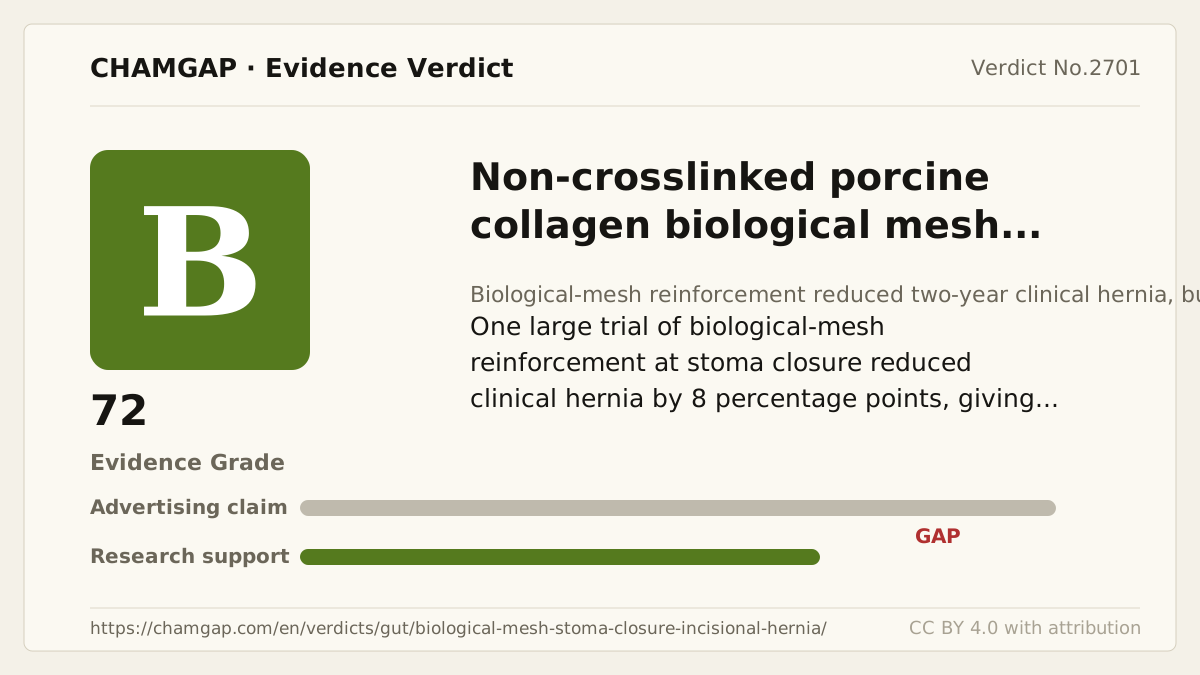
[Chamgap] Biological mesh reinforcement x prevention of incisional hernia after stoma closure — Evidence Grade B·72. 1 cited sources checked. Source: https://chamgap.com/en/verdicts/gut/biological-mesh-stoma-closure-incisional-hernia/ · CC BY 4.0CC BY 4.0 — free to use with attribution; do not distort grades, numbers, or verdict meaning.
What this document does and does not do
Chamgap is an information source. It reports what research has and has not confirmed; it does not tell readers what to take or buy. That decision belongs to readers and, when needed, medical or legal professionals. This verdict reflects literature available up to the search date and may change as new research appears. Nothing here is medical advice.