
Berberine hydrochloride tablets,
does it really help with Reduction of colorectal adenoma recurrence after complete polypectomy?
research showsGrade C with 54 points. In the modified ITT analysis of a 1,108-person double-blind trial, recurrence was 155/429 (36%) versus 216/462 (47%), RR 0.77 (95% CI 0.66-0.91; P=.001). Only 891 participants with efficacy data were analyzed, and no prespecified minimum clinically important difference for adenoma recurrence was verified.
ads claimDo not claim colorectal-cancer prevention, treatment of existing adenomas, or replacement of colonoscopy.
Useful facts when choosing a product
- This verdict applies only to the displayed formulation, route, dose, duration, population, endpoint, and comparator.
- Berberine hydrochloride, botanical extracts, combination formulas, dihydroberberine, other derivatives, and topical products are not interchangeable.
- Warning. Constipation occurred in 6/446 versus 1/478, and long-term clinical safety and interactions are not fully established. Surveillance colonoscopy is not replaced.
Chamgap Semantic Classification Code
Permanent code issued
S.berberine-hydrochloride.oral.colorectal-adenoma-recurrence.reduce.placeboSupplements and nutraceuticals > Berberine hydrochloride > Oral > Colorectal adenoma recurrence after complete polypectomy > Reduction claim > Placebo
Bound to recurrence of at least one adenoma after 0.6 g/day for one to two years; adenoma count, advanced adenoma, colorectal cancer, and same-cohort follow-up are separate. The code identifies the intervention and claim; it never contains the evidence grade, score, or safety result.
Exact Claim Classification
These independent facets prevent evidence from different forms, routes, populations, effects, and comparators from being mixed.
| Intervention class | S · Supplement or nutraceutical |
|---|---|
| Canonical ingredient or intervention | Berberine hydrochloride |
| Source or part used | Purified berberine hydrochloride; source plant unverified |
| Formulation or processing | 0.3-g berberine hydrochloride tablets |
| Route | Oral |
| Dose | 0.3 g twice daily (0.6 g/day) |
| Duration | One to two years; a second-year colonoscopy if year 1 was negative |
| Population | Adults aged 18-75 with one to six histologically confirmed adenomas completely removed within six months |
| Effect or condition | Lower adenoma recurrence |
| Primary endpoint | At least one recurrent adenoma at any follow-up colonoscopy |
| Comparator | Matching placebo |
| Duplicate-detection key | Berberine hydrochloride|0.3-g berberine hydrochloride tablets|Oral|Adults aged 18-75 with one to six histologically confirmed adenomas completely removed within six months|Lower adenoma recurrence|One to two years; a second-year colonoscopy if year 1 was negative |
What the research actually shows
The final NCT02226185 report was separated from later analyses of the same cohort, with retraction and correction status checked.
Why this is classified as C (54)
Axes are S/R1/I2/E+/B2/CX. I2 and E+ are two strengths, but surrogate status, roughly 20% missing efficacy data, no independent replication, and no verified clinical-importance threshold yield C/54.
Counterpoint. The 11-percentage-point absolute difference and precise RR are strengths, but missing efficacy data and lack of independent confirmation remain.
Rejudgment record. Independent Codex cross-check — One formulation, route, population, claim, principal endpoint, and comparator
| Endpoint | S | Surrogate marker - laboratory or imaging measures |
| Replication | R1 | Single confirmatory trial |
| Independence | I2 | Decisive evidence is publicly or non-profit funded |
| Effect size | E+ | Meets the clinically important threshold |
| Precision | CX | No pooled confidence interval could be confirmed |
Stored derived and displayed grades match; this is not a current recalculation or validity check (C).
Cross-check — AI research and Codex final gate
Evidence Table
| Study | Design | Sample | Funding | Endpoint | Result | Weight |
|---|---|---|---|---|---|---|
| Berberine versus placebo for the prevention of recurrence of colorectal adenoma: a multicentre, double-blinded, randomised controlled study | Multicenter, randomized, double-blind, placebo-controlled trial at 7 hospitals. | Randomized, analyzed, and completed denominators are kept distinct where reported. | Funding, product support, employee authorship, and conflicts were assessed separately. | The principal endpoint contract is preserved; other outcomes remain separate. | Verified estimates are preserved; missing confidence intervals were not invented. | Evidence weight reflects directness, formulation match, hierarchy, and reporting limitations. |
Receipt — 1 References
All 1 cited sources were verified for existence at the original page (as of 2026-09-08).
Final verification and publication gate: Codex · Evidence date: 2026-09-08 · Corrections: 1
Correction log — 1
Corrections applied to this verdict, in chronological order. Changes are logged, not erased.
- 2026-09-14 · English evidence-table placeholder correction — Replaced 1 generic English evidence-table placeholder field with specific source-bound translations of the retained Korean record. No new research or medical reassessment was performed; grade, score, citations, and evidence date are unchanged. (grade C unchanged)
Cite this verdict
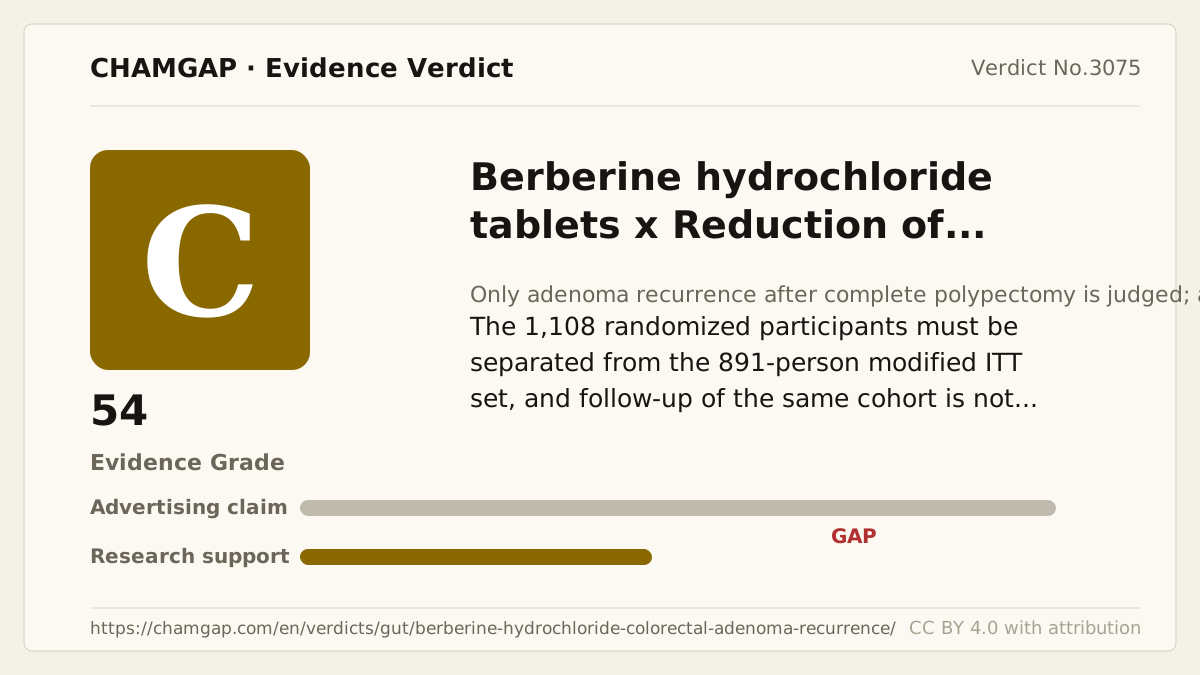
[Chamgap] Berberine Hydrochloride for Colorectal Adenoma Recurrence—36% Versus 47% by Two Years, With Efficacy Data Missing for About One Fifth — Evidence Grade C·54. 1 cited sources checked. Source: https://chamgap.com/en/verdicts/gut/berberine-hydrochloride-colorectal-adenoma-recurrence/ · CC BY 4.0CC BY 4.0 — free to use with attribution; do not distort grades, numbers, or verdict meaning.
What this document does and does not do
Chamgap is an information source. It reports what research has and has not confirmed; it does not tell readers what to take or buy. That decision belongs to readers and, when needed, medical or legal professionals. This verdict reflects literature available up to the search date and may change as new research appears. Nothing here is medical advice.