
Transmeatal low-level laser,
does it really help with Relief of chronic tinnitus severity and distress in adults?
research showsTransmeatal low-level laser is rated D because sham-controlled trials and a synthesis of 11 randomized trials did not significantly improve tinnitus. However, the pooled THI difference was -2.85 points with a 95% CI from -8.99 to 3.28, which still includes the preliminary clinically important threshold of about seven points, so meaningful benefit is not excluded and F is unwarranted.
ads claimMarketing connects a listed wavelength and power to inner-ear repair and tinnitus treatment. The output specification is factual, but clinical superiority over sham is not established.
Useful facts when choosing a product
- The active device in the Gungor trial emitted 650-nm light at 5 mW through the ear canal for 15 minutes daily for one week (J Laryngol Otol. 2008;122(5):447-451). This is a physical device specification.
- The Nakashima trial used a 60-mW active laser for six minutes once weekly over four weeks (Otol Neurotol. 2002;23(3):296-300). Emission of light does not establish tinnitus benefit.
Chamgap Semantic Classification Code
Candidate index · review held
UNK.transmeatal-low-level-laser-therapy.UNK.chronic-tinnitus-severity-and-distress.relieve.shamUnknown > Transmeatal low-level laser therapy > Unknown > chronic tinnitus severity and distress > Symptom-relief claim > Sham procedure or device
An automated migration candidate, not an issued permanent code; exact claim scope remains under review. This machine-generated migration candidate helps retrieval but is not a permanent assignment. The original verdict ID and URL remain authoritative.
What the research actually shows
Teggi 2009 randomized and analyzed 60 participants in a double-blind sham-controlled trial and found a total THI comparison of P=0.97. Nakashima 2002 studied 45 people and 68 ears and found no between-group difference. Chen 2020 pooled 11 sham-controlled trials and 670 participants, yielding THI MD -2.85 points (95% CI -8.99 to 3.28), a null result. Seven THI points is not an established threshold but a preliminary estimate originating with Zeman 2011, so it is used only as a conservative boundary. Because the interval reaches -8.99, it cannot exclude meaningful benefit and gives C0. Verdict 498, Ginkgo at D with 25 points, applies the same null-with-residual-uncertainty logic, while also sharing the limitation that the seven-point boundary is preliminary. Verdict 918, oral zinc at D with 35 points, is likewise null with residual uncertainty.
Why this is classified as D (30)
P, R0, I2, E0, B2, and C0 derive D with 30 points. Trials were small, short, and directionally mixed; the pooled estimate was null but its interval retained meaningful benefit.
Counterpoint. Evaluation for hearing loss, medicines, temporomandibular factors, cervical factors, and other contributors comes first. Evidence cannot be transferred directly when a marketed device uses a different wavelength or power.
Rejudgment record. Cross-check applied — Applied null sham-controlled trials and the 11-trial synthesis while assigning C0 because the pooled THI interval still includes benefit at the preliminary clinically important threshold
| Endpoint | P | Symptom or function itself is the target - including patient reports and performance tests |
| Replication | R0 | Trials conflict in direction |
| Independence | I2 | Decisive evidence is publicly or non-profit funded |
| Effect size | E0 | Null |
| Precision | C0 | The confidence interval leaves room for benefit |
Stored derived and displayed grades match; this is not a current recalculation or validity check (D).
Sub-claim grades by effect
This ingredient is marketed for several effects. A single overall grade blends strong and weak claims together, so each effect is graded separately here. The overall grade reflects the strongest disconfirming or core claim.
| Effect (sub-claim) | Grade | Basis |
|---|---|---|
| Reduction in THI tinnitus handicap score | D | The 11-trial pooled MD of -2.85 points was null with a wide interval. |
| Reduction in tinnitus loudness and annoyance | D | Multiple sham-controlled trials found no consistent between-group improvement. |
| Subjective tinnitus improvement response | D | Pooled RR 1.35 (0.81 to 2.27) was null while leaving room for benefit. |
Cross-check — AI research and Codex final gate
Evidence Table
| Study | Design | Sample | Funding | Endpoint | Result | Weight |
|---|---|---|---|---|---|---|
| Teggi R et al. 2009 | Prospective randomized double-blind sham-controlled trial | 60 outpatients randomized and analyzed | No manufacturer funding reported in the abstract or bibliographic record | Change in total THI and its subscales | Total THI P=0.97 and subscales P=0.89; primary clinical assessment failed | Key direct null sham-controlled trial |
| Nakashima T et al. 2002 | Prospective randomized double-blind sham-controlled trial | 45 participants and 68 ears randomized; 68 ears analyzed | Indexed as non-United States government support; no manufacturer funding reported | Tinnitus loudness, duration, quality, and annoyance | No significant clinical-outcome difference between active 60-mW laser and sham; primary assessment failed | Repeated direct null trial |
| Chen CH et al. 2020 | Systematic review and meta-analysis of sham-controlled randomized trials | 11 randomized trials and 670 participants | Institutional funding from Taipei Veterans General Hospital, grants V108C-145 and V109C-135 | THI and subjective improvement rate | THI MD -2.85 (-8.99 to 3.28), P=0.362; improvement RR 1.35 (0.81 to 2.27), P=0.250 | Decisive synthesis for effect and C0 precision |
Receipt — 4 References
All 4 cited sources were verified for existence at the original page (as of 2026-07-24).
Final verification and publication gate: Codex · Evidence date: 2026-07-24 · Corrections: none
Cite this verdict
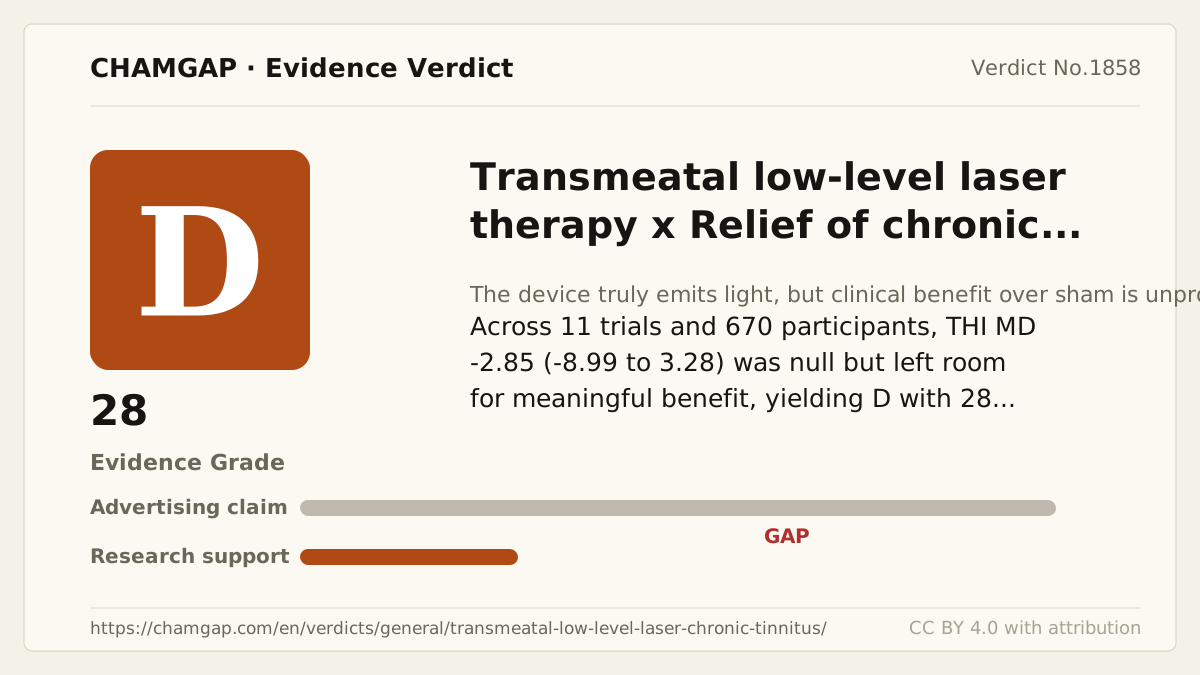
[Chamgap] Transmeatal low-level laser x chronic tinnitus relief — Evidence Grade D·30. 4 cited sources checked. Source: https://chamgap.com/en/verdicts/general/transmeatal-low-level-laser-chronic-tinnitus/ · CC BY 4.0CC BY 4.0 — free to use with attribution; do not distort grades, numbers, or verdict meaning.
What this document does and does not do
Chamgap is an information source. It reports what research has and has not confirmed; it does not tell readers what to take or buy. That decision belongs to readers and, when needed, medical or legal professionals. This verdict reflects literature available up to the search date and may change as new research appears. Nothing here is medical advice.