
Oral rehydration salts, a glucose-electrolyte solution,
does it really help with Correction of mild to moderate dehydration caused by diarrhea, vomiting, or heat?
research showsFor mild to moderate dehydration in a person who can drink, correctly prepared oral rehydration solution is standard treatment for replacing water and electrolytes lost through diarrhea. In childhood gastroenteritis, important clinical outcomes are similar to intravenous rehydration and most oral treatment succeeds. Shock, severe dehydration, altered consciousness, or persistent inability to drink requires urgent assessment and intravenous treatment.
ads claimEvidence for treating dehydration does not establish broad improvement in everyday fatigue, hangovers, skin, or athletic performance. During mild heat exposure, water plus salty food can also work, and the evidence does not mean oral rehydration solution is superior to every sports beverage or that more fluid is always better.
Useful facts when choosing a product
- Ready-to-drink liquids and powders for reconstitution are sold in South Korea, and preparation volumes may differ, including 200 mL and 1 L products.
- For one liter, the WHO reduced-osmolarity formula contains 13.5 g anhydrous glucose, 2.6 g sodium chloride, 1.5 g potassium chloride, and 2.9 g trisodium citrate dihydrate.
- Powder must be mixed only with the exact water volume stated on its label and must not be made arbitrarily concentrated or dilute.
Chamgap Semantic Classification Code
Candidate index · review held
UNK.rehydration-salts.oral.correction-of-mild-to-moderate-dehydration-caused-by-diarrhea-vomiting-or-heat.assess.UNKUnknown > rehydration salts > Oral > Correction of mild to moderate dehydration caused by diarrhea, vomiting, or heat > Association or change assessment > Unknown
An automated migration candidate, not an issued permanent code; exact claim scope remains under review. This machine-generated migration candidate helps retrieval but is not a permanent assignment. The original verdict ID and URL remain authoritative.
What the research actually shows
A Cochrane review of oral versus intravenous rehydration in childhood gastroenteritis included 17 trials and 1,811 participants and found no important clinical difference. A reduced-osmolarity review of 11 trials found about 41% less unplanned intravenous-fluid use than with the older WHO formula. WHO and UNICEF specify 75 mmol/L sodium, 75 mmol/L glucose, and total osmolarity of 245 mOsm/L.
Why this is classified as A (95)
Independent multinational randomized trials, systematic reviews, and international standards converge on the same clinical conclusion. Outcomes include intravenous-fluid use, treatment failure, vomiting, and stool output rather than surrogate markers, supporting A.
Counterpoint. Oral rehydration solution is a valid option for mild heat dehydration, but it is not treatment for heat stroke. Very high temperature, confusion, or collapse requires immediate cooling and emergency care.
Rejudgment record. New verdict — The assessment evaluated direct clinical outcomes for standard formulations, oral-versus-intravenous comparisons, reduced-osmolarity comparisons, eligible populations, and treatment failure while separating generic hydration marketing.
Sub-claim grades by effect
This ingredient is marketed for several effects. A single overall grade blends strong and weak claims together, so each effect is graded separately here. The overall grade reflects the strongest disconfirming or core claim.
| Effect (sub-claim) | Grade | Basis |
|---|---|---|
| Correction of mild to moderate dehydration caused by diarrhea or vomiting | A | Standard oral rehydration solution is established by many randomized trials and systematic reviews as treatment that reduces intravenous-fluid use and has a low failure rate. |
| Oral correction of mild dehydration caused by heat | A | For mild heat illness in an alert person who can drink, oral rehydration with water or a glucose-salt solution is recommended; heat stroke is outside this indication. |
| Improved general fatigue, vitality, or athletic performance in people without dehydration | ? | Established evidence concerns correction of dehydration; no direct human evidence program was identified for broad wellness benefits in normally hydrated people. |
Cross-check — AI research and Codex final gate
Evidence Table
| Study | Design | Sample | Funding | Endpoint | Result | Weight |
|---|---|---|---|---|---|---|
| Study 1 | Systematic review of randomized and quasi-randomized trials | 1811 | Cochrane systematic review; funding varied across original trials | Treatment failure, death, hospital stay, weight gain, and adverse events | No important clinical difference was found between oral and intravenous rehydration for childhood gastroenteritis, while about one in 25 orally treated patients required additional intravenous therapy. | High |
| Study 2 | Systematic review of randomized trials comparing reduced-osmolarity with older WHO oral rehydration solution | 8 | Cochrane systematic review; funding varied across original trials | Unplanned intravenous fluids, stool output, vomiting, and hyponatremia | Reduced-osmolarity solution lowered unplanned intravenous-fluid use and improved stool-output and vomiting outcomes. | High |
| Study 3 | International guideline based on global clinical trials and program evidence | Public global-health guidance from WHO and UNICEF | Need for intravenous fluids, stool output, vomiting, and mortality prevention | The statement summarized reductions of about 33% in intravenous-fluid use, 20% in stool output, and 30% in vomiting with reduced-osmolarity solution versus the older formula. | High | |
| Study 4 | Travel and environmental medicine clinical guidance | US Centers for Disease Control and Prevention | Oral rehydration for heat cramps and heat exhaustion and emergency care for heat stroke | Most mild heat illness can be managed with rest, cooling, and oral water or glucose-salt solution, while heat stroke requires immediate emergency treatment. | Moderate to high |
Receipt — 5 References
All 5 cited sources were verified for existence at the original page (as of 2026-07-17).
Final verification and publication gate: Codex · Evidence date: 2026-07-17 · Corrections: none
Cite this verdict
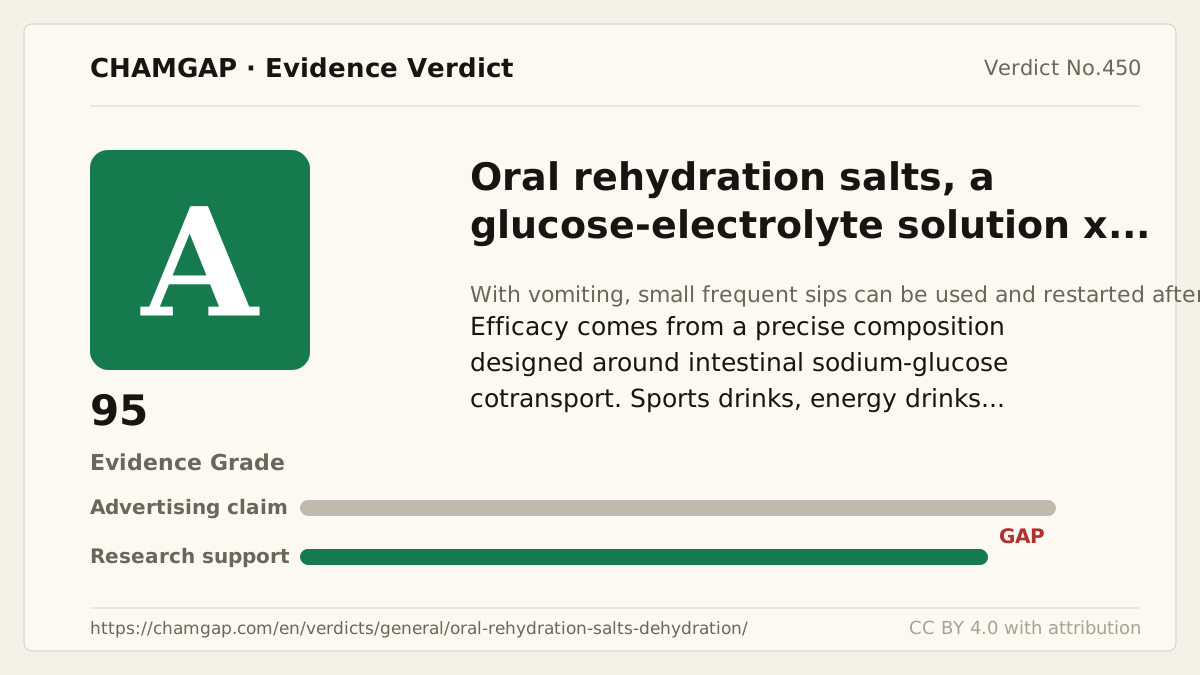
[Chamgap] Oral rehydration salts for dehydration: strongly established oral therapy when the glucose-electrolyte composition is correct — Evidence Grade A·95. 5 cited sources checked. Source: https://chamgap.com/en/verdicts/general/oral-rehydration-salts-dehydration/ · CC BY 4.0CC BY 4.0 — free to use with attribution; do not distort grades, numbers, or verdict meaning.
What this document does and does not do
Chamgap is an information source. It reports what research has and has not confirmed; it does not tell readers what to take or buy. That decision belongs to readers and, when needed, medical or legal professionals. This verdict reflects literature available up to the search date and may change as new research appears. Nothing here is medical advice.