
Guaiac fecal occult blood testing,
does it really help with Reduced colorectal cancer mortality through repeated fecal occult blood screening in asymptomatic middle-aged and older adults?
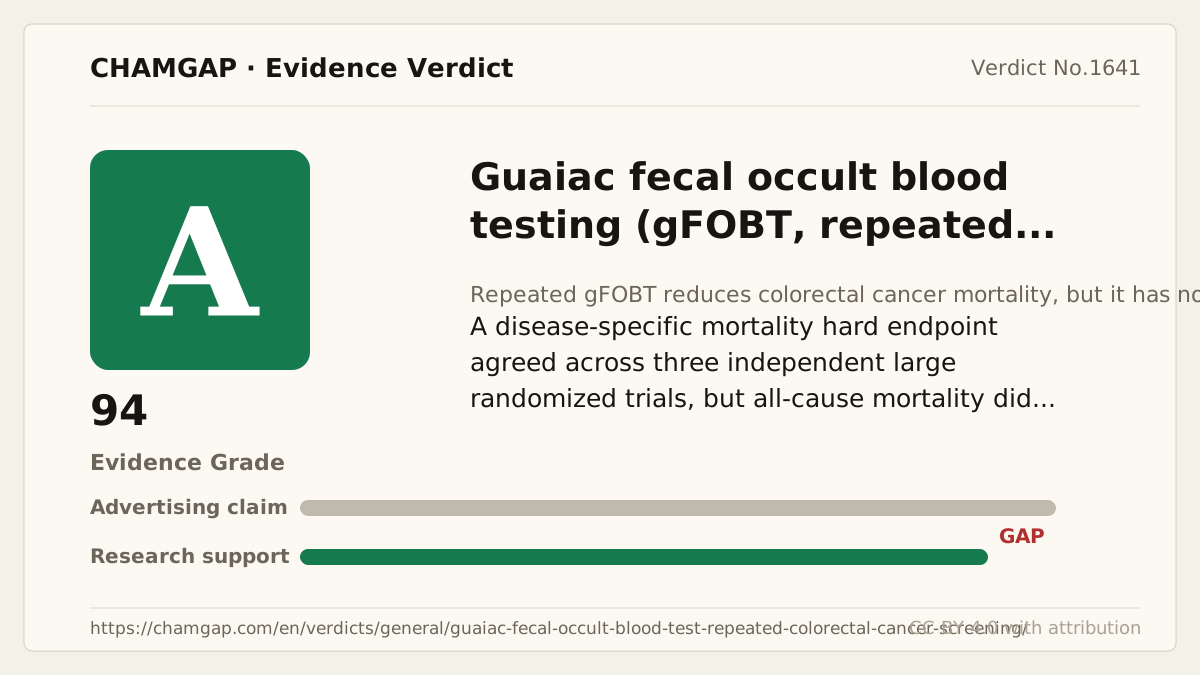
research showsRepeated gFOBT screening is rated A because multiple independent large randomized trials show reduced colorectal cancer mortality in asymptomatic middle-aged and older adults. The peer-reviewed Minnesota original report analyzed 46,551 participants for the primary analysis, and its primary endpoint succeeded: annual testing reduced colorectal cancer mortality by 33%. Longer follow-up also found a 21% reduction with biennial testing, while the independent Nottingham and Funen population trials pointed in the same direction. All-cause mortality, however, was not reduced. A positive test is not a diagnosis, and confirmatory colonoscopy can produce false-positive workups, unnecessary procedures, bleeding, perforation, and overdiagnosis.
ads claimPromotion can make a simple stool test sound as though one use prevents colorectal cancer and death from any cause. The demonstrated claim is narrower: colorectal cancer mortality falls when asymptomatic middle-aged and older adults repeat testing on schedule and complete colonoscopy after a positive result; lower all-cause mortality has not been shown.
Useful facts when choosing a product
- gFOBT detects occult blood through guaiac oxidation driven by the heme activity of hemoglobin, and a positive result is not itself a colorectal cancer diagnosis.
- The tested programs used annual or biennial repetition with diagnostic colonoscopy after a positive result, not one-time testing.
- Some traditional gFOBT kits require dietary and medicine restrictions because vitamin C may cause false negatives while red meat and some plant peroxidases may cause false positives; the specific kit instructions govern.
- A positive result can lead to unnecessary colonoscopy, and colonoscopy rarely causes bleeding or perforation; screening also carries some risk of overdiagnosis.
Chamgap Semantic Classification Code
Candidate index · review held
P.guaiac-fecal-occult-blood-testing.diagnostic.colorectal-cancer-mortality-through-repeated-fecal-occult-blood-screening-in-asymptomatic-middle-aged-and-older-adults.reduce.UNKProcedures, devices and tests > Guaiac fecal occult blood testing > Diagnostic or screening > colorectal cancer mortality through repeated fecal occult blood screening in asymptomatic middle-aged and older adults > Reduction claim > Unknown
An automated migration candidate, not an issued permanent code; exact claim scope remains under review. This machine-generated migration candidate helps retrieval but is not a permanent assignment. The original verdict ID and URL remain authoritative.
What the research actually shows
The Minnesota, Nottingham, and Funen reports were peer-reviewed randomized controlled trial originals. Minnesota's actual primary analysis included 46,551 participants and its primary colorectal cancer mortality endpoint succeeded; annual screening yielded RR 0.67 (95% CI 0.50 to 0.87), and long-term biennial screening yielded RR 0.79 (95% CI 0.62 to 0.97). Nottingham randomized 152,850 people and analyzed mortality in 150,251 (75,253 screening and 74,998 control), reporting colorectal cancer mortality OR 0.85 (95% CI 0.74 to 0.98), while Funen compared 30,967 with 30,966 and reported RR 0.82. Meta-analysis found about an 18% reduction in colorectal cancer mortality with gFOBT but no significant all-cause mortality benefit. In Minnesota, 4 perforations and 11 serious bleeding events occurred among 12,246 colonoscopies performed at the university hospital.
Why this is classified as A (94)
Independent large Minnesota, Nottingham, and Funen randomized trials consistently reduced the hard endpoint of disease-specific mortality, giving A with 94 points. The endpoint was not a surrogate, the key primary endpoints succeeded, and Minnesota's actual primary analysis included 46,551 participants. The null all-cause mortality result remains an explicit limitation.
Counterpoint. Current screening choices also include fecal immunochemical testing and colonoscopy. Age, family history, prior polyps, bleeding symptoms, and access should guide the method and interval.
Rejudgment record. Cross-check applied — A was based on the successful primary colorectal cancer mortality endpoint in the peer-reviewed Minnesota original with 46,551 participants and consistent replication in the independent large Nottingham and Funen trials; null all-cause mortality remains a separate limitation
Sub-claim grades by effect
This ingredient is marketed for several effects. A single overall grade blends strong and weak claims together, so each effect is graded separately here. The overall grade reflects the strongest disconfirming or core claim.
| Effect (sub-claim) | Grade | Basis |
|---|---|---|
| Reduced colorectal cancer mortality with repeated gFOBT | A | Cancer-mortality hard endpoints agreed across the independent large Minnesota, Nottingham, and Funen trials. |
| Reduced colorectal cancer incidence with repeated gFOBT | B | Long-term Minnesota follow-up found lower incidence with annual testing and polypectomy, but consistency across trials and intervals is weaker than for mortality. |
| Reduced all-cause mortality with repeated gFOBT | D | Large randomized evidence examined this outcome and did not find a significant reduction in all-cause mortality. |
Cross-check — AI research and Codex final gate
Evidence Table
| Study | Design | Sample | Funding | Endpoint | Result | Weight |
|---|---|---|---|---|---|---|
| Mandel JS et al. 1993 Minnesota Colon Cancer Control Study | Peer-reviewed original randomized controlled screening trial | 46,551 participants in the actual primary analysis | United States National Cancer Institute and academic research support | Primary endpoint of colorectal cancer mortality | The primary endpoint succeeded; annual screening RR was 0.67 (95% CI 0.50 to 0.87), while the initially smaller biennial effect reached RR 0.79 (0.62 to 0.97) at 18 years. | Key large hard-endpoint randomized trial |
| Hardcastle JD et al. 1996 Nottingham trial | Peer-reviewed original population-based randomized screening trial | 152,850 randomized; 150,251 in the mortality analysis (75,253 screening and 74,998 control) | Public and academic screening research | Primary endpoint of colorectal cancer mortality | The primary endpoint succeeded; invitation to repeated gFOBT significantly reduced colorectal cancer mortality (OR 0.85, 95% CI 0.74 to 0.98). | Independent large replication trial |
| Kronborg O et al. 1996 Funen trial | Peer-reviewed original population-based randomized screening trial | 61,933 actually compared; 30,967 screening and 30,966 control | Danish public and academic research support | Primary endpoint of colorectal cancer mortality | The primary endpoint succeeded; repeated testing significantly reduced colorectal cancer mortality, with 13-year RR 0.82 (0.69 to 0.97). | Independent large replication trial |
Receipt — 5 References
All 5 cited sources were verified for existence at the original page (as of 2026-07-24).
Final verification and publication gate: Codex · Evidence date: 2026-07-24 · Corrections: none
Cite this verdict
[Chamgap] Guaiac fecal occult blood testing x reduced colorectal cancer mortality with repeated screening — Evidence Grade A·94. 5 cited sources checked. Source: https://chamgap.com/en/verdicts/general/guaiac-fecal-occult-blood-test-repeated-colorectal-cancer-screening/ · CC BY 4.0CC BY 4.0 — free to use with attribution; do not distort grades, numbers, or verdict meaning.
What this document does and does not do
Chamgap is an information source. It reports what research has and has not confirmed; it does not tell readers what to take or buy. That decision belongs to readers and, when needed, medical or legal professionals. This verdict reflects literature available up to the search date and may change as new research appears. Nothing here is medical advice.