
Intravenous tranexamic acid,
does it really help with Reduced four-week all-cause and bleeding mortality when given early to adults with severe traumatic bleeding?
research showsIntravenous tranexamic acid is rated A because a very large hard-endpoint randomized trial showed lower four-week all-cause and bleeding mortality when it was given early to adults with severe traumatic hemorrhage. CRASH-2 randomized 20,211 patients in 274 hospitals across 40 countries; all-cause mortality was 14.5% versus 16.0%, RR 0.91 (95% CI 0.85 to 0.97), and bleeding death was 4.9% versus 5.7%, RR 0.85 (95% CI 0.76 to 0.96). An exploratory timing analysis found the greatest bleeding-mortality benefit within one hour, RR 0.68, while administration after three hours was potentially harmful, RR 1.44, so treatment should be given as soon as possible and generally within three hours. This international mortality trial supports A with 96 points in parity with the A95 postpartum-hemorrhage tranexamic-acid verdict; delayed treatment, thrombosis, seizures, and kidney function remain separate safety considerations.
ads claimPromotion can erase the timing window and adjunctive role by suggesting tranexamic acid for any bleeding at any time or as a stand-alone hemostatic injection. The evidence concerns early intravenous treatment of adults with severe traumatic bleeding or its risk, not replacement of operative or interventional source control and balanced transfusion.
Useful facts when choosing a product
- The CRASH-2 regimen was tranexamic acid 1 g intravenously over 10 minutes followed by 1 g infused over eight hours. Hospital protocols and kidney function can modify actual administration.
- Treatment should be given as soon as possible after injury, with the greatest benefit observed within one hour. Administration after three hours should generally be avoided because of the signal for increased bleeding death.
- Tranexamic acid supplements rather than replaces emergency surgery, blood components, damage-control resuscitation, and definitive control of the bleeding source. Its administration must not delay transfer to the operating room, intervention, or transfusion.
- Large trauma-trial data did not show increased vascular occlusive events, but thromboembolism still requires clinical surveillance, and rapid intravenous injection can cause hypotension. Kidney impairment can require dose reduction because of accumulation, and high doses can increase seizure risk.
Chamgap Semantic Classification Code
Candidate index · review held
M.tranexamic-acid.intravenous.all-cause-and-bleeding-mortality-when-given-early-to-adults-with-severe-traumatic-bleeding.reduce.placeboMedicinal interventions > Tranexamic acid > Intravenous > all-cause and bleeding mortality when given early to adults with severe traumatic bleeding > Reduction claim > Placebo
An automated migration candidate, not an issued permanent code; exact claim scope remains under review. This machine-generated migration candidate helps retrieval but is not a permanent assignment. The original verdict ID and URL remain authoritative.
What the research actually shows
The CRASH-2 trial collaborators randomized 20,211 adults with or at risk of significant traumatic bleeding within eight hours of injury to tranexamic acid, 1 g over 10 minutes followed by 1 g over eight hours, or matching placebo under double masking. Among analyzed patients, four-week all-cause mortality was 1,463 of 10,060 (14.5%) versus 1,613 of 10,067 (16.0%), RR 0.91, and bleeding death was 489 (4.9%) versus 574 (5.7%), RR 0.85. A 2011 analysis exploring the prespecified time interaction found bleeding-death RR 0.68 within one hour, 0.79 at one to three hours, and 1.44 after three hours. The evidence therefore supports administration as soon as possible and within three hours without delaying surgery, interventional hemorrhage control, blood products, or damage-control resuscitation.
Why this is classified as A (96)
Among 20,211 CRASH-2 participants, four-week all-cause mortality fell from 16.0% to 14.5%, RR 0.91, and bleeding mortality from 5.7% to 4.9%, RR 0.85. Direct mortality endpoints in a very large international double-blind randomized trial and biologically coherent timing. Two later trials by independent, publicly funded investigators followed: PATCH-Trauma was null on its six-month survival-with-function primary outcome but found 28-day mortality RR 0.79 (0.63 to 0.99), and STAAMP was not significant on its primary 30-day mortality outcome (8.1% versus 9.9%; absolute difference −1.8 percentage points, 95% CI −5.6 to 1.9). All three point the same way on mortality, though the latter two are not individually confirmatory, supporting A with 96 points. The harm signal after three hours, uncommon thrombosis or seizures, and kidney-based dose concerns remain safety matters independent of efficacy.
Counterpoint. The greatest benefit is expected in patients with actual or high-risk severe bleeding who are still within three hours of injury. Routine use in low-risk bleeding or long after injury is not equivalent to the CRASH-2 result.
Rejudgment record. New verdict — Prioritized direct hard endpoints from a double-blind randomized trial of 20,211 patients across 40 countries that significantly reduced four-week all-cause and bleeding mortality, while restricting efficacy to treatment within three hours based on the timing interaction
Sub-claim grades by effect
This ingredient is marketed for several effects. A single overall grade blends strong and weak claims together, so each effect is graded separately here. The overall grade reflects the strongest disconfirming or core claim.
| Effect (sub-claim) | Grade | Basis |
|---|---|---|
| Reduced four-week all-cause mortality with early intravenous treatment in severe traumatic bleeding | A | CRASH-2 reduced the direct mortality endpoint from 16.0% to 14.5%, RR 0.91, in a very large trial. |
| Reduced bleeding mortality with early intravenous treatment in severe traumatic bleeding | A | Cause-specific bleeding mortality also fell from 5.7% to 4.9%, RR 0.85. |
| Greater reduction in bleeding mortality when treatment begins within one hour of injury | B | The exploratory timing analysis found RR 0.68 within one hour and a harm signal after three hours, RR 1.44, making early treatment essential. |
Cross-check — AI research and Codex final gate
Evidence Table
| Study | Design | Sample | Funding | Endpoint | Result | Weight |
|---|---|---|---|---|---|---|
| CRASH-2 trial collaborators. 2010 | International randomized double-blind placebo-controlled trial | 20,211 adult trauma patients in 274 hospitals across 40 countries | UK NIHR HTA, Pfizer, BUPA Foundation, and J P Moulton Charitable Foundation | In-hospital all-cause and cause-specific death within four weeks of injury | All-cause mortality 14.5% versus 16.0%, RR 0.91 (95% CI 0.85 to 0.97); bleeding mortality 4.9% versus 5.7%, RR 0.85 (95% CI 0.76 to 0.96). | Pivotal very large mortality-endpoint randomized trial |
| CRASH-2 collaborators; Roberts I et al. 2011 | Exploratory analysis of the prespecified time interaction in CRASH-2 | 20,211 adult trauma patients in CRASH-2 | Mixed public, charitable, and industry support for CRASH-2 | Bleeding death according to time from injury to treatment | Bleeding death fell within one hour, RR 0.68, and at one to three hours, RR 0.79, but increased after three hours, RR 1.44. | Key analysis defining the early-treatment window |
| PATCH-Trauma Investigators / Gruen RL et al. 2023 | International multicenter randomized double-blind placebo-controlled trial (NCT02187120): prehospital tranexamic acid 1 g bolus then 1 g over eight hours in hospital versus matched placebo | 1,310 patients with severe trauma | The paper states that no commercial support was provided; funding came from public and non-profit sources including the Australian NHMRC and the Health Research Council of New Zealand. No author overlap with CRASH-2 was identified. | The primary outcome was survival with a favorable functional outcome at six months (GOS-E 5 or higher); mortality was a secondary outcome. | The primary outcome was null: 307/572 (53.7%) versus 299/559 (53.5%), RR 1.00 (95% CI 0.90 to 1.12), P=0.95. Death by 28 days was 113/653 (17.3%) versus 139/637 (21.8%), RR 0.79 (0.63 to 0.99), and death by six months was 123/648 (19.0%) versus 144/629 (22.9%), RR 0.83 (0.67 to 1.03). | Independently recruited replication by different investigators with public funding; mortality points the same way but the primary outcome was null |
| Guyette FX et al. 2020 STAAMP | US multicenter randomized double-blind placebo-controlled prehospital trial (NCT02086500) of tranexamic acid versus placebo in patients with hypotension or tachycardia within two hours of injury | 903 in the intention-to-treat analysis (447 tranexamic acid, 456 placebo) | The paper states it was funded by grant W81XWH-13-2-0080 from the US Army Medical Research and Materiel Command, a public source. No manufacturer funding was identified and there is no author overlap with CRASH-2. | The primary outcome was 30-day all-cause mortality, the same endpoint as this verdict. | Thirty-day mortality was 8.1% versus 9.9%, an absolute difference of −1.8 percentage points (95% CI −5.6 to 1.9), P=0.17, so a reduction was not confirmed. | The only independent replication whose primary outcome is mortality; same direction but not statistically significant |
Receipt — 4 References
All 4 cited sources were verified for existence at the original page (as of 2026-07-22).
Final verification and publication gate: Codex · Evidence date: 2026-07-22 · Corrections: none
Cite this verdict
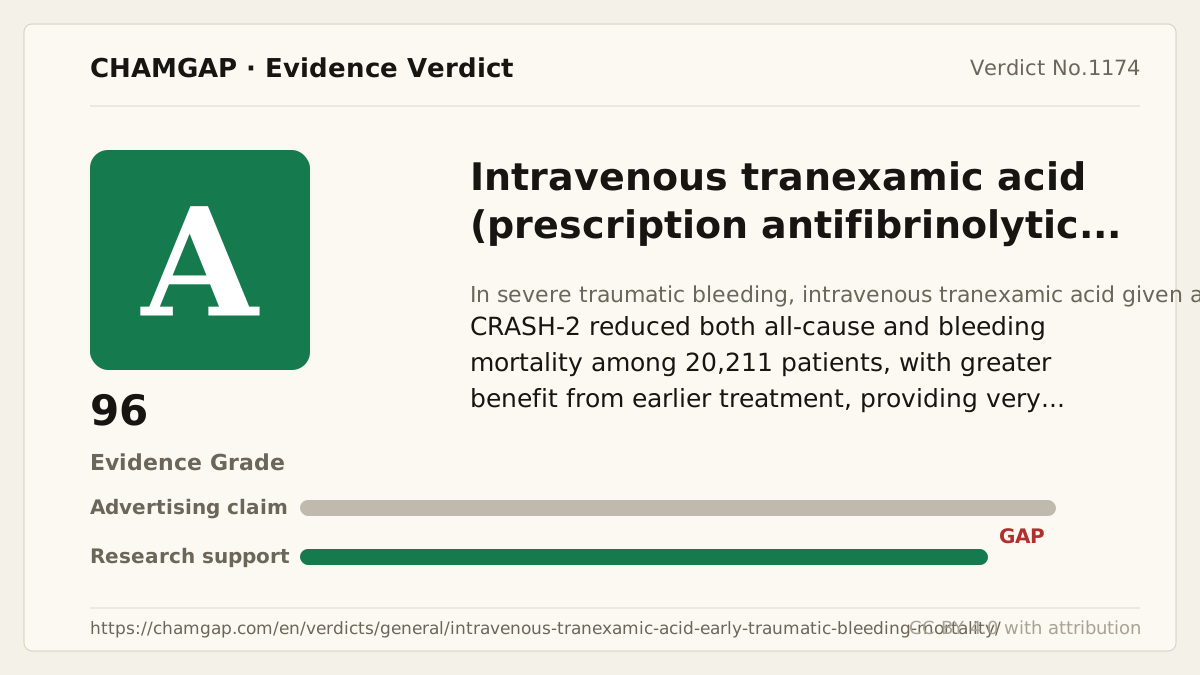
[Chamgap] Intravenous tranexamic acid x reduced all-cause and bleeding mortality in severe traumatic hemorrhage — Evidence Grade A·96. 4 cited sources checked. Source: https://chamgap.com/en/verdicts/general/intravenous-tranexamic-acid-early-traumatic-bleeding-mortality/ · CC BY 4.0CC BY 4.0 — free to use with attribution; do not distort grades, numbers, or verdict meaning.
What this document does and does not do
Chamgap is an information source. It reports what research has and has not confirmed; it does not tell readers what to take or buy. That decision belongs to readers and, when needed, medical or legal professionals. This verdict reflects literature available up to the search date and may change as new research appears. Nothing here is medical advice.