
Tamsulosin,
does it really help with Facilitation of spontaneous passage of ureteral stones 5 mm or smaller?
research showsTamsulosin is rated D for stones 5 mm or smaller. SUSPEND randomized 1,167 participants and included 1,136 in the actual primary analysis; the primary endpoint failed (OR 1.04, 95% CI 0.77 to 1.43). The prespecified Cochrane subgroup was also null for stones 5 mm or smaller, with RR 1.06 (0.98 to 1.15; P=.16).
ads claimBenefit in larger stones or the overall alpha-blocker literature is applied to small stones that already have a high spontaneous-passage rate.
Useful facts when choosing a product
- Tamsulosin is an alpha-1 blocker for benign prostatic hyperplasia and stone-expulsion use may be off label.
- Dizziness, orthostatic hypotension, syncope, and ejaculatory dysfunction can occur.
Chamgap Semantic Classification Code
Candidate index · review held
M.tamsulosin.UNK.facilitation-of-spontaneous-passage-of-ureteral-stones-5-mm-or-smaller.assess.placeboMedicinal interventions > Tamsulosin > Unknown > Facilitation of spontaneous passage of ureteral stones 5 mm or smaller > Association or change assessment > Placebo
An automated migration candidate, not an issued permanent code; exact claim scope remains under review. This machine-generated migration candidate helps retrieval but is not a permanent assignment. The original verdict ID and URL remain authoritative.
What the research actually shows
SUSPEND randomized 1,167 participants and analyzed 1,136 after post-randomization exclusions and missing outcomes. Its primary endpoint failed, and the Cochrane estimate for stones 5 mm or smaller was also null. Verdict 796, which is C with 45 points, concerns urinary symptoms from benign prostatic hyperplasia with the same drug; that indication is entirely different and its evidence was not transferred to stones.
Why this is classified as D (34)
The primary endpoint failed among 1,167 randomized participants and 1,136 in the primary analysis, and the estimate for stones 5 mm or smaller was RR 1.06 (0.98 to 1.15). The upper limit leaves 15% relative benefit, so the grade is D with 34 points, not F.
Counterpoint. Larger or distal stones may warrant a different assessment, while infection, impaired kidney function, or uncontrolled pain requires prompt care.
Rejudgment record. Cross-check applied — Prioritized the failed large-trial primary endpoint and null pooled estimate for stones 5 mm or smaller, while assigning D rather than F because the upper confidence limit leaves 15% relative benefit
| Endpoint | H | Hard endpoint - actual events such as death |
| Replication | R2 | Independently replicated across trials |
| Independence | I2 | Decisive evidence is publicly or non-profit funded |
| Effect size | E0 | Null |
| Precision | C0 | The confidence interval leaves room for benefit |
Stored derived and displayed grades match; this is not a current recalculation or validity check (D).
Sub-claim grades by effect
This ingredient is marketed for several effects. A single overall grade blends strong and weak claims together, so each effect is graded separately here. The overall grade reflects the strongest disconfirming or core claim.
| Effect (sub-claim) | Grade | Basis |
|---|---|---|
| Increased passage of ureteral stones 5 mm or smaller | D | The large trial and size-specific pooled estimate were null. |
| Shorter passage time for ureteral stones 5 mm or smaller | D | Reliable direct benefit specific to small stones has not been established. |
| Reduced additional procedures for ureteral stones 5 mm or smaller | D | The patient-centered primary endpoint in SUSPEND failed. |
Cross-check — AI research and Codex final gate
Evidence Table
| Study | Design | Sample | Funding | Endpoint | Result | Weight |
|---|---|---|---|---|---|---|
| Pickard R et al. 2015 SUSPEND | Multicenter double-blind randomized placebo-controlled trial | 1,167 randomized; 1,136 in the actual primary analysis | Public funding from the United Kingdom NIHR Health Technology Assessment programme | Stone passage within four weeks without further intervention | Primary endpoint failed: OR 1.04 (95% CI 0.77 to 1.43). | Large key trial |
| Campschroer T et al. 2018 | Cochrane systematic review and meta-analysis | 67 randomized trials and 10,509 participants; 15 placebo-controlled trials and 5,787 participants | Authors reported no manufacturer conflicts; academic Cochrane synthesis | Stone clearance and major adverse events | Null for 5 mm or smaller, RR 1.06 (0.98 to 1.15; P=.16); positive for larger stones, RR 1.45 (1.22 to 1.72). | Key size-stratified synthesis |
Receipt — 2 References
All 2 cited sources were verified for existence at the original page (as of 2026-07-24).
Final verification and publication gate: Codex · Evidence date: 2026-07-24 · Corrections: none
Cite this verdict
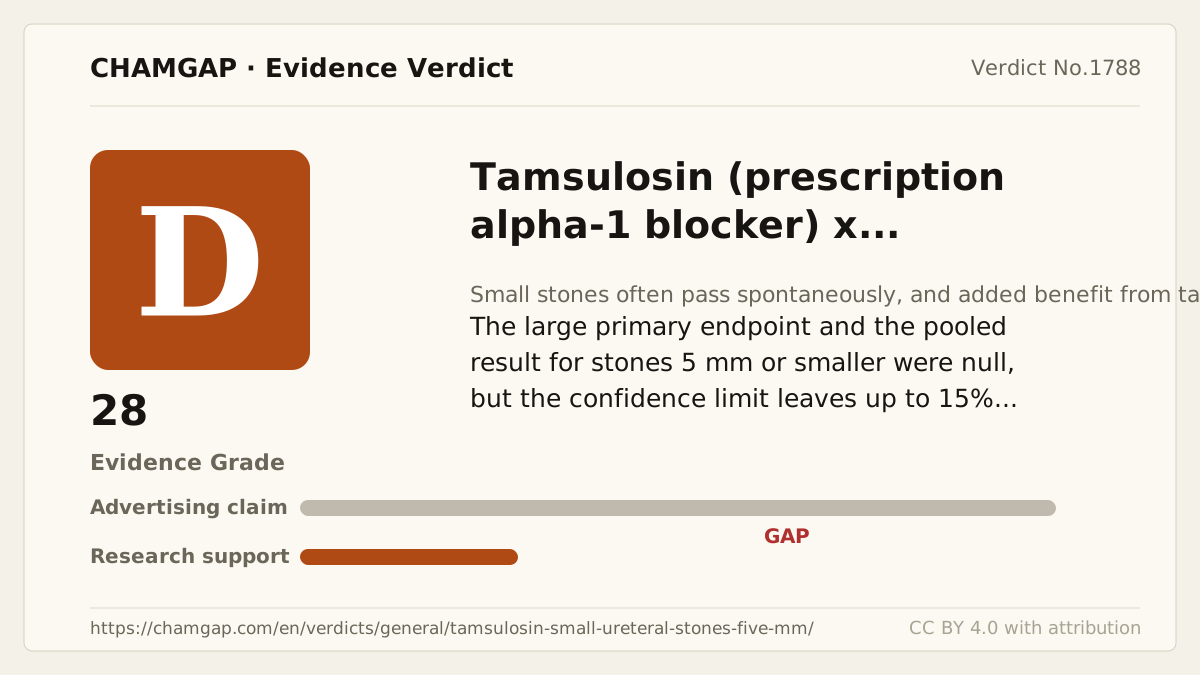
[Chamgap] Tamsulosin x passage of ureteral stones 5 mm or smaller — Evidence Grade D·34. 2 cited sources checked. Source: https://chamgap.com/en/verdicts/general/tamsulosin-small-ureteral-stones-five-mm/ · CC BY 4.0CC BY 4.0 — free to use with attribution; do not distort grades, numbers, or verdict meaning.
What this document does and does not do
Chamgap is an information source. It reports what research has and has not confirmed; it does not tell readers what to take or buy. That decision belongs to readers and, when needed, medical or legal professionals. This verdict reflects literature available up to the search date and may change as new research appears. Nothing here is medical advice.