
Systemic prednisolone,
does it really help with Hearing recovery in idiopathic sudden sensorineural hearing loss?
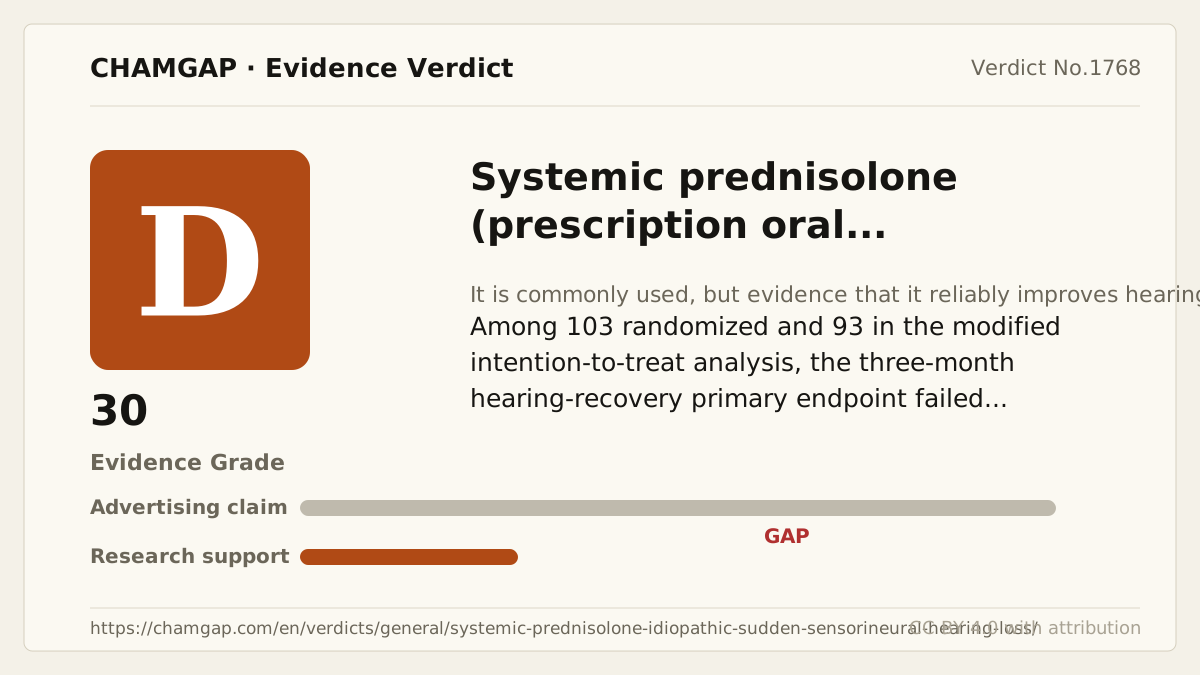
research showsSystemic prednisolone is rated D because hearing recovery over placebo remains unproved in sudden sensorineural hearing loss. Nosrati-Zarenoe 2012 (Otol Neurotol 33(4):523-531) was triple-blind and placebo-controlled, with 103 randomized and 93 analyzed; the three-month difference was 3.9 dB (95% CI -8.57 to 16.37). Crane 2015 (Laryngoscope 125(1):209-217) also failed to confirm significant benefit. Because the confidence interval still includes a clinically meaningful gain of about 10 to 15 dB, this is unproven efficacy rated D with 30 points, not repeated refutation rated F.
ads claimCustom and promotional language can imply that treatment during a golden window reliably restores hearing, but spontaneous recovery is common and placebo-controlled evidence has not shown a certain added benefit.
Useful facts when choosing a product
- Sudden unilateral hearing loss requires urgent specialist assessment and audiometry.
- Dose and taper must be selected by a clinician after considering diabetes, infection, gastrointestinal, and psychiatric risks.
- Systemic corticosteroids can cause hyperglycemia, insomnia, mood changes, gastrointestinal symptoms, and increased infection risk.
Chamgap Semantic Classification Code
Candidate index · review held
M.systemic-prednisolone.oral.hearing-recovery-in-idiopathic-sudden-sensorineural-hearing-loss.assess.placeboMedicinal interventions > Systemic prednisolone > Oral > Hearing recovery in idiopathic sudden sensorineural hearing loss > Association or change assessment > Placebo
An automated migration candidate, not an issued permanent code; exact claim scope remains under review. This machine-generated migration candidate helps retrieval but is not a permanent assignment. The original verdict ID and URL remain authoritative.
What the research actually shows
Nosrati-Zarenoe 2012 (Otol Neurotol 33(4):523-531) triple-masked and randomized 103 patients to prednisolone or placebo and analyzed 93. The three-month difference was 3.9 dB (95% CI -8.57 to 16.37). Crane 2015 (Laryngoscope 125(1):209-217) pooled three placebo-controlled reports and 181 participants and found OR 1.52 (95% CI 0.83 to 2.77). Because the trial confidence interval includes a gain of about 10 to 15 dB, the evidence supports D rather than F.
Why this is classified as D (30)
The triple-blind placebo-controlled trial randomized 103 and analyzed 93; the three-month difference was 3.9 dB (95% CI -8.57 to 16.37). Because this interval includes a clinically meaningful gain of about 10 to 15 dB, the result is unproven rather than repeatedly refuted, supporting D with 30 points.
Counterpoint. Despite weak evidence, delaying evaluation can itself be harmful, so sudden hearing loss should not be watched or self-treated without urgent care.
Rejudgment record. Cross-check applied — The three-month hearing-recovery primary endpoint failed among 103 randomized and 93 in the modified intention-to-treat primary analysis, a meta-analysis of three placebo-controlled reports and 181 participants was also nonsignificant, and evidence from other prednisolone indications was kept separate
Sub-claim grades by effect
This ingredient is marketed for several effects. A single overall grade blends strong and weak claims together, so each effect is graded separately here. The overall grade reflects the strongest disconfirming or core claim.
| Effect (sub-claim) | Grade | Basis |
|---|---|---|
| Pure-tone hearing recovery at three months | D | The primary endpoint failed in a modern placebo-controlled trial. |
| Complete hearing recovery | D | Complete recovery was 38.3% versus 39.1% and did not favor prednisolone. |
| Early hearing improvement after onset | D | Day-eight hearing improvement also did not differ significantly from placebo. |
Cross-check — AI research and Codex final gate
Evidence Table
| Study | Design | Sample | Funding | Endpoint | Result | Weight |
|---|---|---|---|---|---|---|
| Nosrati-Zarenoe R and Hultcrantz E. 2012 | Multicenter randomized triple-blind placebo-controlled trial | 103 randomized; 93 in the modified intention-to-treat primary analysis, 47 versus 46 | Academic study in Swedish public otolaryngology centers and Linkoping University; no manufacturer sponsorship reported | Three-month pure-tone hearing improvement | Improvement was 39.0 versus 35.1 dB, difference 3.9 dB with a 95% confidence interval from minus 8.57 to 16.37; the primary endpoint failed. | Pivotal modern placebo-controlled trial |
| Crane RA et al. 2015 | Systematic review and meta-analysis of randomized trials | Three steroid-versus-placebo reports and 181 participants | Funding source not reported in the abstract; no manufacturer-led role identified | Hearing-recovery rate | The odds ratio was 1.52 with a 95% confidence interval from 0.83 to 2.77 and was nonsignificant. | Independent synthesis |
Receipt — 2 References
All 2 cited sources were verified for existence at the original page (as of 2026-07-24).
Final verification and publication gate: Codex · Evidence date: 2026-07-24 · Corrections: none
Cite this verdict
[Chamgap] Systemic prednisolone x sudden sensorineural hearing loss — Evidence Grade D·30. 2 cited sources checked. Source: https://chamgap.com/en/verdicts/general/systemic-prednisolone-idiopathic-sudden-sensorineural-hearing-loss/ · CC BY 4.0CC BY 4.0 — free to use with attribution; do not distort grades, numbers, or verdict meaning.
What this document does and does not do
Chamgap is an information source. It reports what research has and has not confirmed; it does not tell readers what to take or buy. That decision belongs to readers and, when needed, medical or legal professionals. This verdict reflects literature available up to the search date and may change as new research appears. Nothing here is medical advice.