
Silver diamine fluoride,
does it really help with Arrest of existing active dentin caries lesions in early childhood?
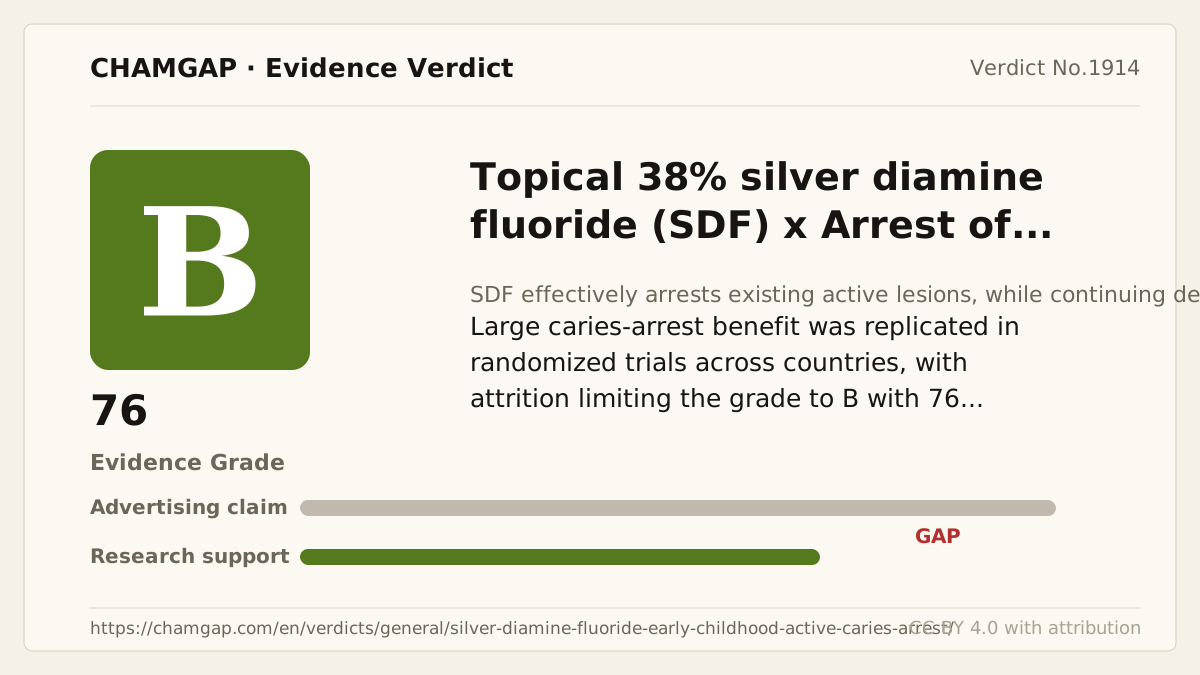
research showsThe grade is B. A US multicenter phase 3 trial included all 830 randomized children in a multiple-imputation intention-to-treat analysis. Six-month lesion arrest was 54.0% (99.9% CI 43.1 to 64.6) versus 22.5% (15.3 to 31.8), difference 31.5 points (99.9% CI 21.5 to 41.6). The US Fontana trial and the Hong Kong-Guangzhou Chu study pointed in the same direction; attrition limits the grade to B with 76 points.
ads claimThe accurate claim is arresting active lesions, not making cavities disappear. Children with pain, pulp exposure, or suspected abscess were excluded and should not have definitive dental care delayed.
Useful facts when choosing a product
- The US trial applied 38% SDF for about ten seconds and used six-month lesion arrest after one application as the primary endpoint.
- Lesion arrest is a binary clinical state in which hard dentin is not penetrated by gentle probing.
- Verdict 701 is A with 92 points for fluoride toothpaste prevention, while verdict 1563 is B with 72 points for professional fluoride-varnish prevention; this verdict concerns arrest of existing lesions.
Chamgap Semantic Classification Code
Candidate index · review held
UNK.38-percent-silver-diamine-fluoride.topical-skin.arrest-of-existing-active-dentin-caries-lesions-in-early-childhood.assess.placeboUnknown > 38% silver diamine fluoride > Topical skin > Arrest of existing active dentin caries lesions in early childhood > Association or change assessment > Placebo
An automated migration candidate, not an issued permanent code; exact claim scope remains under review. This machine-generated migration candidate helps retrieval but is not a permanent assignment. The original verdict ID and URL remain authoritative.
What the research actually shows
Fontana randomized 830 children, 414 to SDF and 416 to placebo. Actual six-month follow-up was completed by 584, while multiple-imputation intention-to-treat analysis included all 830. Arrest was 54.0% versus 22.5%, difference 31.5 points (99.9% CI 21.5 to 41.6), OR 4.06 (99.9% CI 2.54 to 6.48); these were 99.9%, not 95%, intervals. NIH/NIDCR grant UH3DE027372 funded the trial, and Elevate Oral Care supplied product and placebo. Chu's Hong Kong-Guangzhou study used sequential, periodic five-group allocation. Its source did not report a confidence interval for the SDF-control contrast.
Why this is classified as B (76)
A publicly funded multicenter randomized trial and an independent Hong Kong-Guangzhou study using sequential periodic allocation showed the same large clinical arrest direction, but substantial attrition yields B with 76 points.
Counterpoint. Reassessment, repeat application, and transition to restoration depend on lesion depth, symptoms, and pulp status.
Rejudgment record. Cross-check applied — Accepted the large caries-arrest effect in a publicly funded multicenter placebo-controlled trial and an independent long-term sequentially allocated study while accounting for substantial attrition
| Endpoint | H | Hard endpoint - actual events such as death |
| Replication | R2 | Independently replicated across trials |
| Independence | I2 | Decisive evidence is publicly or non-profit funded |
| Effect size | E+ | Meets the clinically important threshold |
Stored derived and displayed grades match; this is not a current recalculation or validity check (B).
Sub-claim grades by effect
This ingredient is marketed for several effects. A single overall grade blends strong and weak claims together, so each effect is graded separately here. The overall grade reflects the strongest disconfirming or core claim.
| Effect (sub-claim) | Grade | Basis |
|---|---|---|
| Arrest of active dentin caries lesions | B | A large effect direction recurred in a randomized trial and an independent sequentially allocated study. |
| Reduction of caries pain | D | Pain did not differ from placebo in the US trial. |
Cross-check — AI research and Codex final gate
Evidence Table
| Study | Design | Sample | Funding | Endpoint | Result | Weight |
|---|---|---|---|---|---|---|
| Fontana et al. 2026 | Multisite phase 3 randomized blinded placebo-controlled trial | 830 randomized, 414 versus 416; all 830 in multiple-imputation ITT; 584 completed | US NIH/NIDCR grant UH3DE027372; product and placebo supplied by Elevate Oral Care | Lesion arrest six months after one application | 54.0% (99.9% CI 43.1 to 64.6) versus 22.5% (15.3 to 31.8); difference 31.5 points (99.9% CI 21.5 to 41.6), OR 4.06 (99.9% CI 2.54 to 6.48). | Modern pivotal publicly funded trial |
| Chu et al. 2002 | Controlled study using sequential, periodic five-group allocation for topical fluorides | 375 assigned and 308 evaluated at 30 months | Independent University of Hong Kong team; no commercial sponsorship identified in the accessible record | Number of arrested dentin-caries surfaces per child | Mean arrested surfaces per child 2.82 (SE 0.30) with SDF versus 1.27 (0.19) with water control, overall P<0.001; no CI reported for the contrast. | Long-term replication by a separate country and team |
Receipt — 2 References
All 2 cited sources were verified for existence at the original page (as of 2026-08-01).
Final verification and publication gate: Codex · Evidence date: 2026-08-01 · Corrections: none
Cite this verdict
[Chamgap] Silver diamine fluoride x arrest of active early-childhood caries — Evidence Grade B·76. 2 cited sources checked. Source: https://chamgap.com/en/verdicts/general/silver-diamine-fluoride-early-childhood-active-caries-arrest/ · CC BY 4.0CC BY 4.0 — free to use with attribution; do not distort grades, numbers, or verdict meaning.
What this document does and does not do
Chamgap is an information source. It reports what research has and has not confirmed; it does not tell readers what to take or buy. That decision belongs to readers and, when needed, medical or legal professionals. This verdict reflects literature available up to the search date and may change as new research appears. Nothing here is medical advice.