
Icon resin infiltration,
does it really help with Reduced radiographic progression of non-cavitated proximal early caries?
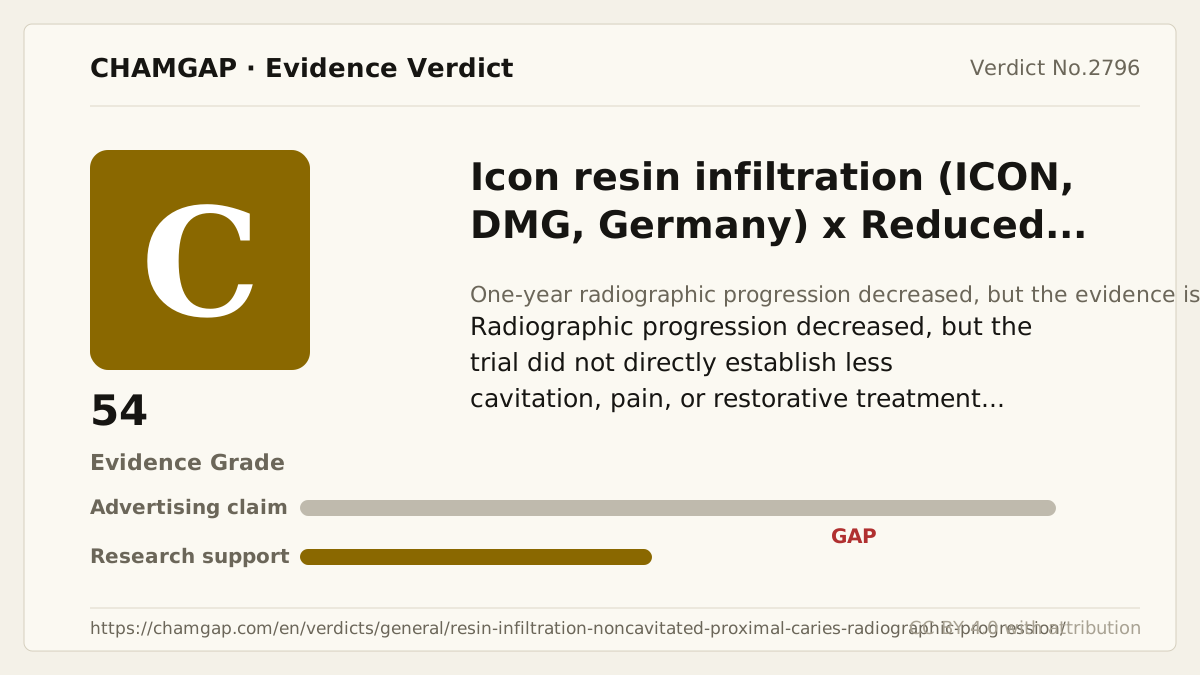
research showsThe grade is C. At one year, radiographic progression occurred in 1/45 infiltrated lesions (2.2%) versus 9/45 controls (20.0%), an absolute difference of -17.8 percentage points. This was a small, single-center study of a radiographic surrogate, and 15 of 56 enrolled participants did not attend the one-year assessment.
ads claimIcon physically infiltrates porous proximal lesions with resin to block diffusion pathways. A favorable radiographic surrogate does not by itself prove fewer future restorations or better long-term tooth survival.
Useful facts when choosing a product
- The trial product was ICON, DMG, Germany.
- Both test and control lesions received fluoridated toothpaste, flossing, oral-hygiene education, and dietary advice.
- Verdict 2789 is C with 50 points for biomimetic remineralization of early occlusal caries; this verdict concerns physical resin sealing between teeth.
- Verdict 1914 is B with 76 points for arresting active early-childhood caries with silver diamine fluoride, while verdict 2712 is B with 70 points for restoring carious primary molars with Hall crowns. They apply at different sites and stages.
Chamgap Semantic Classification Code
Candidate index · review held
UNK.icon-resin-infiltration.UNK.radiographic-progression-of-non-cavitated-proximal-early-caries.reduce.UNKUnknown > Icon resin infiltration > Unknown > radiographic progression of non-cavitated proximal early caries > Reduction claim > Unknown
An automated migration candidate, not an issued permanent code; exact claim scope remains under review. This machine-generated migration candidate helps retrieval but is not a permanent assignment. The original verdict ID and URL remain authoritative.
What the research actually shows
This was a two-author, single-center, split-mouth randomized trial. Fifty-six people enrolled, 15 declined follow-up, and 41 with 45 lesion pairs were assessed at one year. Patients were not given a mock procedure, but the radiographic examiner was blinded to lesion allocation. The Erciyes University Scientific Research Project Unit funded the study (TDH-2015-6060). The Funding, Acknowledgments, Conflict of Interest, and author-disclosure sections were reviewed; no statement said that DMG supplied trial materials. The two mechanically counted defects were total sample size below 200 and 26.8% attrition. Although the authors called one year short follow-up, it was not under the 12-week rule; lack of patient blinding was not counted again because the objective radiographic outcome had a blinded examiner.
Why this is classified as C (54)
A single small randomized trial found 17.8 points less radiographic progression, but only a surrogate was measured and attrition was substantial, giving C with 54 points.
Counterpoint. This grade concerns one-year radiographic progression of early proximal lesions, not occlusal remineralization, arrest of active cavitated disease, or restoration of carious primary molars.
Rejudgment record. Cross-check applied — A statistically favorable radiographic surrogate in one small trial with substantial attrition
| Endpoint | S | Surrogate marker - laboratory or imaging measures |
| Replication | R1 | Single confirmatory trial |
| Independence | I2 | Decisive evidence is publicly or non-profit funded |
| Effect size | E+ | Meets the clinically important threshold |
Stored derived and displayed grades match; this is not a current recalculation or validity check (C).
Sub-claim grades by effect
This ingredient is marketed for several effects. A single overall grade blends strong and weak claims together, so each effect is graded separately here. The overall grade reflects the strongest disconfirming or core claim.
| Effect (sub-claim) | Grade | Basis |
|---|---|---|
| Reduced radiographic lesion progression at one year | C | Rates were 2.2% versus 20.0%, but the outcome was radiographic. |
Cross-check — AI research and Codex final gate
Evidence Table
| Study | Design | Sample | Funding | Endpoint | Result | Weight |
|---|---|---|---|---|---|---|
| Arslan S and Kaplan MH. 2020 | Single-center split-mouth randomized clinical trial | 56 enrolled, 41 assessed; 45 lesion pairs | Erciyes University Scientific Research Project Unit (TDH-2015-6060) | Lesion progression on digital-subtraction radiography at one year | 1/45 (2.2%) versus 9/45 (20.0%), absolute difference -17.8 points, P<0.05; no confidence interval was reported | Single small trial of a radiographic surrogate |
Receipt — 1 References
All 1 cited sources were verified for existence at the original page (as of 2026-08-18).
Final verification and publication gate: Codex · Evidence date: 2026-08-18 · Corrections: none
Cite this verdict
[Chamgap] Benefit of Resin Infiltration for Radiographic Progression of Non-Cavitated Proximal Caries, a Surrogate Outcome — Evidence Grade C·54. 1 cited sources checked. Source: https://chamgap.com/en/verdicts/general/resin-infiltration-noncavitated-proximal-caries-radiographic-progression/ · CC BY 4.0CC BY 4.0 — free to use with attribution; do not distort grades, numbers, or verdict meaning.
What this document does and does not do
Chamgap is an information source. It reports what research has and has not confirmed; it does not tell readers what to take or buy. That decision belongs to readers and, when needed, medical or legal professionals. This verdict reflects literature available up to the search date and may change as new research appears. Nothing here is medical advice.