
Reengineered discharge,
does it really help with Reduced 30-day emergency visits and readmissions?
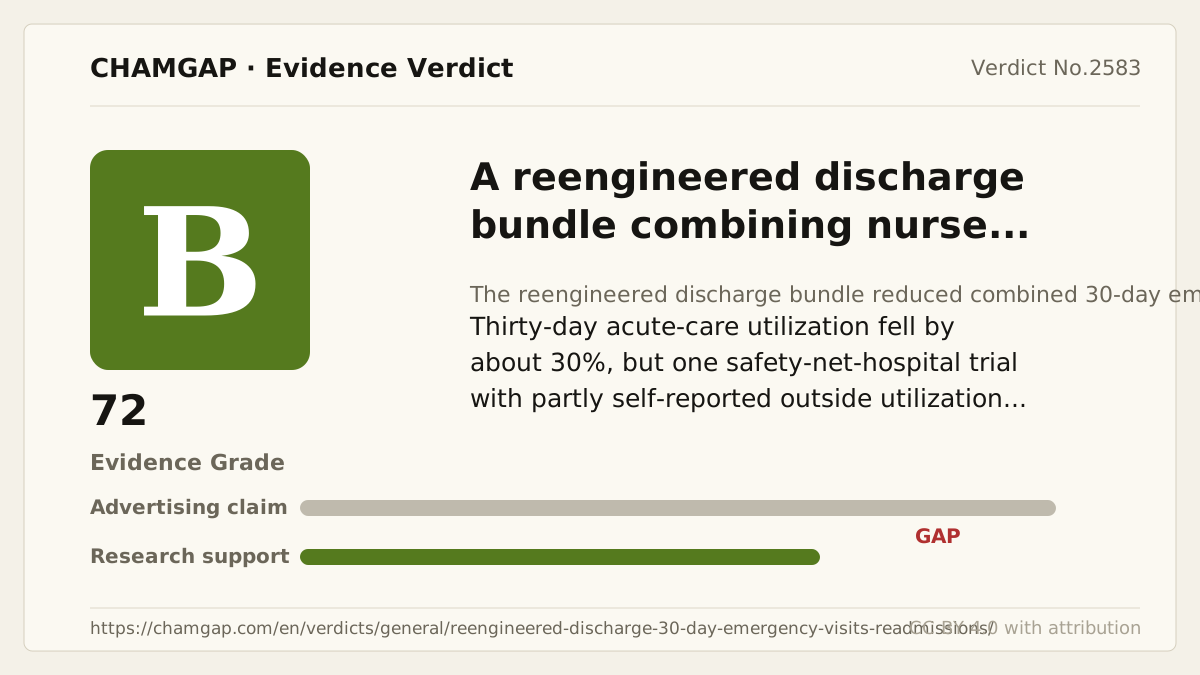
research showsThe grade is B. RED randomized 749 people and analyzed 370 versus 368 after predischarge exclusions. The combined 30-day count of emergency visits and readmissions was 116 events, 0.314 per person-month, with the intervention versus 166, 0.451 per person-month, with usual discharge, IRR 0.695 (95% CI 0.515 to 0.937). The prespecified event endpoint was positive in a publicly funded trial, but this was one single-center study with partly self-reported follow-up, giving B with 72 points.
ads claimA bundled redesign truly reduced combined 30-day emergency visits and readmissions at this hospital. It cannot be presented as the effect of one pharmacist call or as a proven reduction in readmission alone, and the same magnitude is not guaranteed in hospitals with different staffing and patients.
Useful facts when choosing a product
- The bundle combined appointment scheduling, medication reconciliation, education, a personalized discharge booklet, and a pharmacist call 2 to 4 days after discharge.
- Of 749 randomized participants, 738 entered the primary analysis and 615 provided 30-day telephone outcomes.
- Verdict 2563 is B with 72 points for pharmacist-led transition care and 180-day readmission; this verdict concerns a nurse-pharmacist discharge redesign and combined 30-day emergency visits plus readmissions.
Chamgap Semantic Classification Code
Candidate index · review held
X.reengineered-discharge-bundle-combining-nurse-coordination.behavioral.emergency-visits-and-readmissions.reduce.UNKBehaviors, exposures and policies > reengineered discharge bundle combining nurse coordination > Behavioral delivery > emergency visits and readmissions > Reduction claim > Unknown
An automated migration candidate, not an issued permanent code; exact claim scope remains under review. This machine-generated migration candidate helps retrieval but is not a permanent assignment. The original verdict ID and URL remain authoritative.
What the research actually shows
Jack BW, Chetty VK, Anthony D, Greenwald JL, Sanchez GM, Johnson AE, Forsythe SR, O'Donnell JK, Paasche-Orlow MK, Manasseh C, Martin S, and Culpepper L assigned 749 general-medicine inpatients at Boston Medical Center, 376 versus 373. The analysis included 368 versus 370, and telephone follow-up reached about 83% in each arm. Outcome staff were blinded. Funding came from AHRQ awards 1 UC1 HS14289-01 and 1 U18 HS015905-01 and NIH/NHLBI R01 HL081307.
Why this is classified as B (72)
A publicly funded randomized trial reduced the prespecified combined 30-day emergency-visit and readmission endpoint. One replication and incomplete outside-hospital follow-up give B with 72 points.
Counterpoint. Readmission alone was not significant, so the claim should not be narrowed or broadened beyond combined acute-care utilization.
Rejudgment record. Cross-check applied — The article and registry identifier were cross-checked for opaque-envelope allocation concealment, blinded outcome staff, the actual 738-person analysis, event counts, telephone follow-up, and public funding.
| Endpoint | H | Hard endpoint - actual events such as death |
| Replication | R1 | Single confirmatory trial |
| Independence | I2 | Decisive evidence is publicly or non-profit funded |
| Effect size | E+ | Meets the clinically important threshold |
Stored derived and displayed grades match; this is not a current recalculation or validity check (B).
Sub-claim grades by effect
This ingredient is marketed for several effects. A single overall grade blends strong and weak claims together, so each effect is graded separately here. The overall grade reflects the strongest disconfirming or core claim.
| Effect (sub-claim) | Grade | Basis |
|---|---|---|
| Reduced combined 30-day emergency visits and readmissions | B | The combined rate decreased significantly, IRR 0.695. |
| Reduced 30-day readmission alone | D | The IRR 0.720 interval included 1. |
Cross-check — AI research and Codex final gate
Evidence Table
| Study | Design | Sample | Funding | Endpoint | Result | Weight |
|---|---|---|---|---|---|---|
| Jack BW, Chetty VK, Anthony D, Greenwald JL, Sanchez GM, Johnson AE, Forsythe SR, O'Donnell JK, Paasche-Orlow MK, Manasseh C, Martin S, Culpepper L, 2009 RED | Single-center individually randomized trial with blinded outcome staff | 749 randomized, 376 and 373; primary analysis 738, 368 and 370 | AHRQ 1 UC1 HS14289-01 and 1 U18 HS015905-01; NIH/NHLBI R01 HL081307 | Combined rate of emergency visits and readmissions within 30 days after discharge | 116 events, 0.314 per person-month, versus 166 events, 0.451 per person-month; IRR 0.695 (95% CI 0.515 to 0.937), P=.009 | Single publicly funded health-care-utilization event trial |
Receipt — 2 References
All 2 cited sources were verified for existence at the original page (as of 2026-08-14).
Final verification and publication gate: Codex · Evidence date: 2026-08-14 · Corrections: none
Cite this verdict
[Chamgap] Reengineered discharge x 30-day emergency visits and readmissions — Evidence Grade B·72. 2 cited sources checked. Source: https://chamgap.com/en/verdicts/general/reengineered-discharge-30-day-emergency-visits-readmissions/ · CC BY 4.0CC BY 4.0 — free to use with attribution; do not distort grades, numbers, or verdict meaning.
What this document does and does not do
Chamgap is an information source. It reports what research has and has not confirmed; it does not tell readers what to take or buy. That decision belongs to readers and, when needed, medical or legal professionals. This verdict reflects literature available up to the search date and may change as new research appears. Nothing here is medical advice.