
Prophylactic onlay mesh,
does it really help with Prevention of incisional hernia at two years?
research showsThe grade is B. In PRIMA, two-year incisional hernia occurred in 25/188 (13%) with onlay mesh versus 33/107 (30%) with suture alone, adjusted OR 0.37 (95% CI 0.20 to 0.69).
ads claimMarketing must specify mesh plane, material, risk group, and seroma harm.
Useful facts when choosing a product
- This was a selected high-risk population, not all open abdominal surgery; both mesh arms used lightweight polypropylene Optilene mesh LP.
- Onlay and retrorectus sublay are different interventions.
- The original wording was ‘Funding: Baxter; B Braun Surgical SA.’
- The original material wording included ‘Optilene mesh LP, 6×35 cm; B Braun Surgical SA’ and ‘Tisseel; Baxter Healthcare.’
Chamgap Semantic Classification Code
Candidate index · review held
P.prophylactic-onlay-mesh-reinforcement-added-to-midline-closure-in-high-risk-adults.UNK.incisional-hernia-at.prevent.addonProcedures, devices and tests > Prophylactic onlay mesh reinforcement added to midline closure in high-risk adults > Unknown > incisional hernia at > Occurrence-prevention claim > Added intervention on common background care
An automated migration candidate, not an issued permanent code; exact claim scope remains under review. This machine-generated migration candidate helps retrieval but is not a permanent assignment. The original verdict ID and URL remain authoritative.
What the research actually shows
PRIMA randomized 480 adults undergoing elective midline laparotomy who had abdominal aortic aneurysm or BMI at least 27. It compared suture alone with fascial onlay and retrorectus sublay reinforcement. Hernia counts were 33/107, 25/188, and 34/185, respectively.
Why this is classified as B (76)
One large positive hard-outcome trial, interpreted only within its tested setting, gives B with 76 points.
Counterpoint. Other incisions, mesh planes, and ordinary-risk patients require separate evidence.
Rejudgment record. Cross-check applied — Reduced two-year incisional hernia with the tested onlay reinforcement in a high-risk trial
| Endpoint | H | Hard endpoint - actual events such as death |
| Replication | R1 | Single confirmatory trial |
| Independence | I0 | Evidence comes only from manufacturer studies |
| Effect size | E+ | Meets the clinically important threshold |
Stored derived and displayed grades match; this is not a current recalculation or validity check (B).
Sub-claim grades by effect
This ingredient is marketed for several effects. A single overall grade blends strong and weak claims together, so each effect is graded separately here. The overall grade reflects the strongest disconfirming or core claim.
| Effect (sub-claim) | Grade | Basis |
|---|---|---|
| Two-year hernia prevention with onlay reinforcement | B | Rates were 13% versus 30%, adjusted OR 0.37. |
Cross-check — AI research and Codex final gate
Evidence Table
| Study | Design | Sample | Funding | Endpoint | Result | Weight |
|---|---|---|---|---|---|---|
| Jairam AP et al. 2017 PRIMA | Multicenter double-blind randomized trial | 480 in the primary analysis | Baxter; B Braun Surgical SA | Incisional hernia by two years | Onlay 25/188 (13%) versus suture 33/107 (30%), adjusted OR 0.37 (95% CI 0.20-0.69) | Pivotal hard-outcome trial |
Receipt — 1 References
All 1 cited sources were verified for existence at the original page (as of 2026-08-07).
Final verification and publication gate: Codex · Evidence date: 2026-08-07 · Corrections: none
Cite this verdict
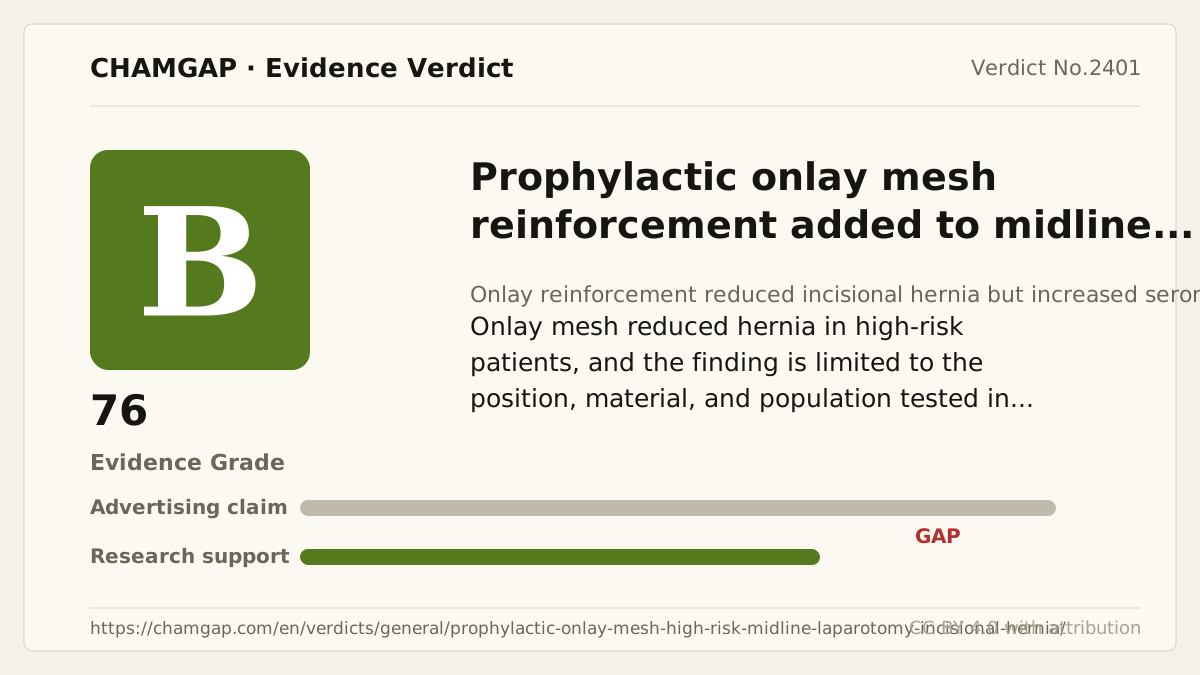
[Chamgap] Prophylactic onlay mesh x prevention of incisional hernia after high-risk midline laparotomy — Evidence Grade B·76. 1 cited sources checked. Source: https://chamgap.com/en/verdicts/general/prophylactic-onlay-mesh-high-risk-midline-laparotomy-incisional-hernia/ · CC BY 4.0CC BY 4.0 — free to use with attribution; do not distort grades, numbers, or verdict meaning.
What this document does and does not do
Chamgap is an information source. It reports what research has and has not confirmed; it does not tell readers what to take or buy. That decision belongs to readers and, when needed, medical or legal professionals. This verdict reflects literature available up to the search date and may change as new research appears. Nothing here is medical advice.