
Pregabalin,
does it really help with Patient-reported pain reduction in painful diabetic peripheral neuropathy?
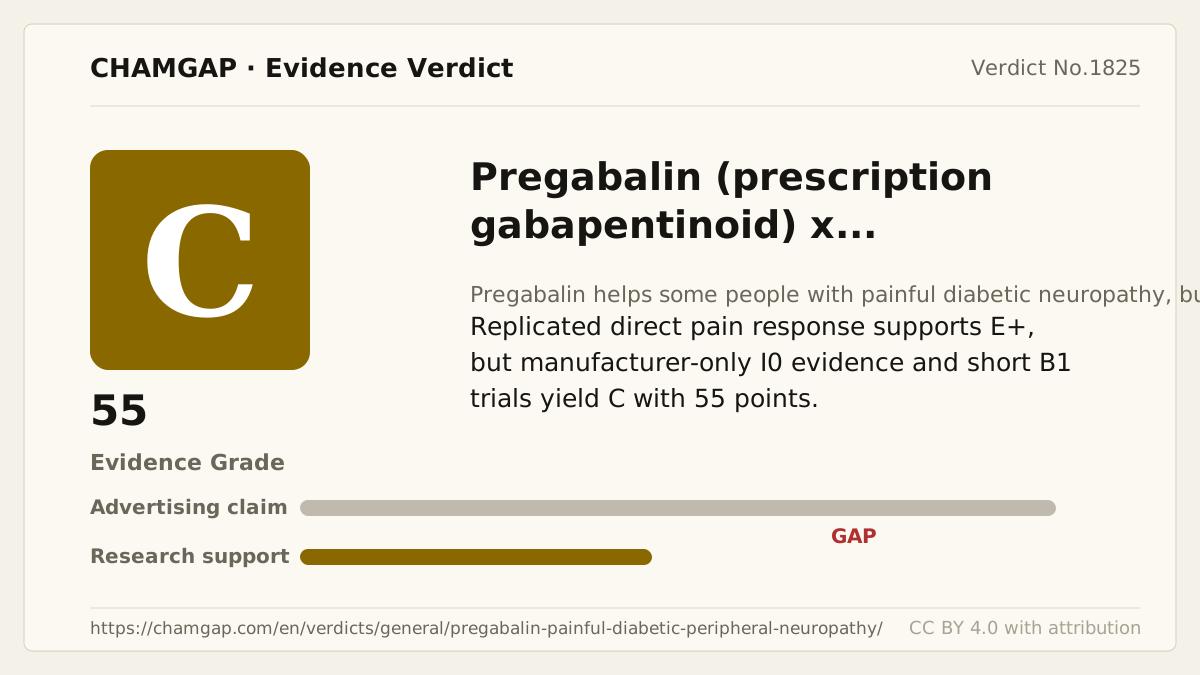
research showsPregabalin produces a replicated direct pain response in some patients with painful diabetic peripheral neuropathy and is graded C. At 300 mg/day, at least 50% pain reduction occurred in 31% versus 24% across 11 trials and 2,931 participants, NNTB 14 (95% CI 9.7 to 26). NNTB 22 (12 to 200) belongs to the separate endpoint of at least 30% reduction across eight trials and 2,320 participants. At 600 mg/day, the at-least-50% response was 41% versus 28% across five trials and 1,015 participants, NNTB 7.8 (5.4 to 14). This direct clinical endpoint supports E+, but manufacturer-only I0 evidence keeps the C ceiling.
ads claimClaims that pregabalin strongly eliminates nerve pain turn a modest increase in responders into major relief for most patients.
Useful facts when choosing a product
- Cochrane trials lasted two to 16 weeks, and a roughly four-week treatment trial can identify individual response.
- Verdict 730, which is D with 25 points, concerns sciatica, while verdict 924, which is B with 74 points, concerns restless legs syndrome. Their evidence was not transferred to diabetic neuropathy.
- Verdict 1682, which is C with 58 points, concerns gabapentin for postherpetic neuralgia, and verdict 780, which is F with 13 points, concerns gabapentin for sciatica. Evidence from another drug and indication was not pooled.
Chamgap Semantic Classification Code
Candidate index · review held
M.pregabalin.UNK.patient-reported-pain-reduction-in-painful-diabetic-peripheral-neuropathy.reduce.placeboMedicinal interventions > Pregabalin > Unknown > Patient-reported pain reduction in painful diabetic peripheral neuropathy > Reduction claim > Placebo
An automated migration candidate, not an issued permanent code; exact claim scope remains under review. This machine-generated migration candidate helps retrieval but is not a permanent assignment. The original verdict ID and URL remain authoritative.
What the research actually shows
Lesser and colleagues randomized and analyzed 338 participants by intention to treat. The five-week mean daily pain-score primary endpoint succeeded at 300 and 600 mg, P=0.0001, in a Pfizer-supported study. The 2019 Derry Cochrane review found at least 50% reduction with 300 mg/day in 31% versus 24% across 11 trials and 2,931 participants, NNTB 14 (9.7 to 26). NNTB 22 (12 to 200) was for at least 30% reduction across eight trials and 2,320 participants. At 600 mg/day, five trials and 1,015 participants yielded a 41% versus 28% at-least-50% response and NNTB 7.8 (5.4 to 14). Cheng 2023 included 38 published trials and 9,038 participants; 32 of 37 trials with known funding were industry-funded, and the overall mean difference was 0.6 points (95% CI 0.4 to 0.8).
Why this is classified as C (54)
The profile is P, R2, I0, E+, and B1. Replicated direct at-least-50% pain responses are accepted, but manufacturer-only evidence and short trials cap the derived grade at C with 54 points.
Counterpoint. If meaningful benefit is absent, tapering or discontinuation should be discussed with the prescriber rather than stopping abruptly.
Rejudgment record. Cross-check applied — Accepted replicated direct at-least-50% pain response as E+ while applying the manufacturer-only I0 and short-duration B1 ceilings
| Endpoint | P | Symptom or function itself is the target - including patient reports and performance tests |
| Replication | R2 | Independently replicated across trials |
| Independence | I0 | Evidence comes only from manufacturer studies |
| Effect size | E+ | Meets the clinically important threshold |
Stored derived and displayed grades match; this is not a current recalculation or validity check (C).
Sub-claim grades by effect
This ingredient is marketed for several effects. A single overall grade blends strong and weak claims together, so each effect is graded separately here. The overall grade reflects the strongest disconfirming or core claim.
| Effect (sub-claim) | Grade | Basis |
|---|---|---|
| At least 50% pain reduction with 300 mg/day | C | The difference was 31% versus 24%, with NNTB 14 (9.7 to 26). |
| At least 50% pain reduction with 600 mg/day | C | NNTB was 7.8 (5.4 to 14), but certainty was lower. |
| Reduction in five-week mean daily pain score | C | The primary endpoint succeeded, but it was manufacturer-funded and the mean difference had limited clinical importance. |
Cross-check — AI research and Codex final gate
Evidence Table
| Study | Design | Sample | Funding | Endpoint | Result | Weight |
|---|---|---|---|---|---|---|
| Lesser H et al. 2004 | Multicenter randomized double-blind placebo-controlled dose-ranging trial | 338 randomized and 338 analyzed by intention to treat | Manufacturer funding from Pfizer with company researchers as coauthors | Five-week mean daily pain score | The 300- and 600-mg/day groups were significantly lower than placebo, P=0.0001; primary endpoint successful. | Pivotal product trial |
| Derry S et al. 2019 Cochrane | Systematic review and meta-analysis of randomized double-blind trials | At 300 mg, at least 50%: 11 trials and 2,931 participants; at least 30%: eight trials and 2,320 participants; at 600 mg, at least 50%: five trials and 1,015 participants | Oxford Pain Relief Trust and NIHR support; many component trials funded by Pfizer or other industry sources | At least 30% and at least 50% patient-reported pain reduction | At 300 mg, at least 50% was 31% versus 24%, NNTB 14 (9.7 to 26); at least 30% had NNTB 22 (12 to 200). At 600 mg, at least 50% was 41% versus 28%, NNTB 7.8 (5.4 to 14). | Core direct responder synthesis |
| Cheng ETL et al. 2023 | Meta-epidemiologic analysis of pregabalin randomized trials | 38 published trials and 9,038 participants; 32 of 37 trials with known funding (86%) industry-funded | No specific funding for the analysis and no declared competing interests | Mean difference on an 11-point pain scale versus a 1.7-point MCID | Overall MD 0.6 points (95% CI 0.4 to 0.8), below MCID. | Clinical-significance and funding-bias assessment |
Receipt — 4 References
All 4 cited sources were verified for existence at the original page (as of 2026-07-24).
Final verification and publication gate: Codex · Evidence date: 2026-07-24 · Corrections: none
Cite this verdict
[Chamgap] Pregabalin x pain reduction in painful diabetic peripheral neuropathy — Evidence Grade C·54. 4 cited sources checked. Source: https://chamgap.com/en/verdicts/general/pregabalin-painful-diabetic-peripheral-neuropathy/ · CC BY 4.0CC BY 4.0 — free to use with attribution; do not distort grades, numbers, or verdict meaning.
What this document does and does not do
Chamgap is an information source. It reports what research has and has not confirmed; it does not tell readers what to take or buy. That decision belongs to readers and, when needed, medical or legal professionals. This verdict reflects literature available up to the search date and may change as new research appears. Nothing here is medical advice.