
Pit-and-fissure sealant,
does it really help with Prevention of occlusal caries in permanent teeth?
research showsPit-and-fissure sealants are rated A because independent, replicated randomized evidence shows a large reduction in clinically detected dentinal caries. Seven no-treatment-controlled trials in Cochrane produced an odds ratio of 0.12 at 24 months (95% CI 0.08 to 0.19).
ads claimMarketing can imply that one coating prevents all decay permanently, whereas the evidence concerns reduced incidence in susceptible fissures with retention checks and reapplication when needed.
Useful facts when choosing a product
- Liu randomized 124 children to sealant, 124 to fluoride varnish, 125 to silver diamine fluoride, and 128 to no treatment; 485 were examined at 24 months.
- The key Cochrane odds ratio of 0.12 compares resin sealant with no treatment, not active fluoride varnish.
Chamgap Semantic Classification Code
Candidate index · review held
P.pit-and-fissure-sealant.procedural.occlusal-caries-in-permanent-teeth.prevent.noneProcedures, devices and tests > Pit-and-fissure sealant > Procedural > occlusal caries in permanent teeth > Occurrence-prevention claim > No intervention
An automated migration candidate, not an issued permanent code; exact claim scope remains under review. This machine-generated migration candidate helps retrieval but is not a permanent assignment. The original verdict ID and URL remain authoritative.
What the research actually shows
Liu 2012 randomized 501 children to sealant, fluoride varnish, silver diamine fluoride, or no treatment and analyzed 485 at 24 months. Dentinal caries occurred at 1.6%, 2.4%, 2.2%, and 4.6%, respectively, so the primary clinical endpoint succeeded. Cochrane 2017 reviewed 38 studies with 7,924 participants; seven resin-sealant versus no-treatment or no-sealant trials randomized 1,548 and evaluated 1,322, giving odds ratios of 0.12 at 24 months, 0.17 at 36 months, and 0.21 at 48 to 54 months. The key pooled control was no treatment or no sealant, not active fluoride varnish, and caries was an objective dental-examination event. The prevention landscape also includes verdict 701, which is A with 92 points, and verdict 1563, which is B with 72 points, for fluoride toothpaste and professional fluoride varnish; verdict 748, which is C with 45 points, and verdict 726, which is C with 54 points, concern xylitol gum and hydroxyapatite toothpaste. Their evidence was not transferred here.
Why this is classified as A (86)
Hard endpoint H, independent replication R2, public or academic evidence I2, large effect E+, and no counted avoidable flaw B0 derive A with 86 points.
Counterpoint. Sealants add to rather than replace fluoride toothpaste, brushing, and dental review.
Rejudgment record. Cross-check applied — Independent replicated randomized trials showed a large and consistent reduction in objectively verified caries events versus no treatment
| Endpoint | H | Hard endpoint - actual events such as death |
| Replication | R2 | Independently replicated across trials |
| Independence | I2 | Decisive evidence is publicly or non-profit funded |
| Effect size | E+ | Meets the clinically important threshold |
Stored derived and displayed grades match; this is not a current recalculation or validity check (A).
Sub-claim grades by effect
This ingredient is marketed for several effects. A single overall grade blends strong and weak claims together, so each effect is graded separately here. The overall grade reflects the strongest disconfirming or core claim.
| Effect (sub-claim) | Grade | Basis |
|---|---|---|
| Prevention of dentinal caries in permanent molars at 24 months | A | Seven no-treatment-controlled trials produced an odds ratio of 0.12. |
| Prevention of permanent-molar caries at 36 months | A | Seven studies showed persistence with an odds ratio of 0.17. |
| Prevention of permanent-molar caries at 48 to 54 months | A | Four studies retained benefit with an odds ratio of 0.21. |
Cross-check — AI research and Codex final gate
Evidence Table
| Study | Design | Sample | Funding | Endpoint | Result | Weight |
|---|---|---|---|---|---|---|
| Liu BY et al. 2012 | Four-group randomized controlled trial | 501 randomized; 485 analyzed at 24 months | Public funding from the Hong Kong Research Grants Council (#HKU/771207M); authors declared no conflicts of interest and the article carries no industry-support statement | Dentinal fissure caries at 24 months | 1.6% with sealant versus 4.6% with no treatment; primary endpoint succeeded | Direct clinical-event randomized trial |
| Ahovuo-Saloranta A et al. 2017 | Cochrane systematic review and meta-analysis | 38 studies and 7,924 participants overall; seven no-treatment trials randomized 1,548 and evaluated 1,322 at 24 months | Public NIHR Cochrane Infrastructure funding | Dentinal caries in permanent molars | OR 0.12 at 24 months (95% CI 0.08 to 0.19), with positive results at 36 and 48 to 54 months | Key independent replicated evidence |
| Bravo M et al. 2005 | Three-group randomized controlled trial (four program years plus five discontinuation years, nine-year follow-up) | 120 schoolchildren aged 6 to 8 (45 control, 37 sealant, 38 varnish); 129 control, 113 sealant, and 129 varnish first molars met inclusion criteria | Funding statement not confirmed; conducted by Spanish investigators (PubMed type: Research Support, Non-U.S. Gov't) | Occlusal caries in permanent first molars at nine years | 26.6% with sealant versus 76.7% with no treatment, a 65.4% caries reduction (SE 8.5%); fluoride varnish reduced caries only 27.3% and was not effective during discontinuation | Independent replication randomized trial by a different team in a different country |
Receipt — 3 References
All 3 cited sources were verified for existence at the original page (as of 2026-08-11).
Final verification and publication gate: Codex · Evidence date: 2026-08-11 · Corrections: none
Cite this verdict
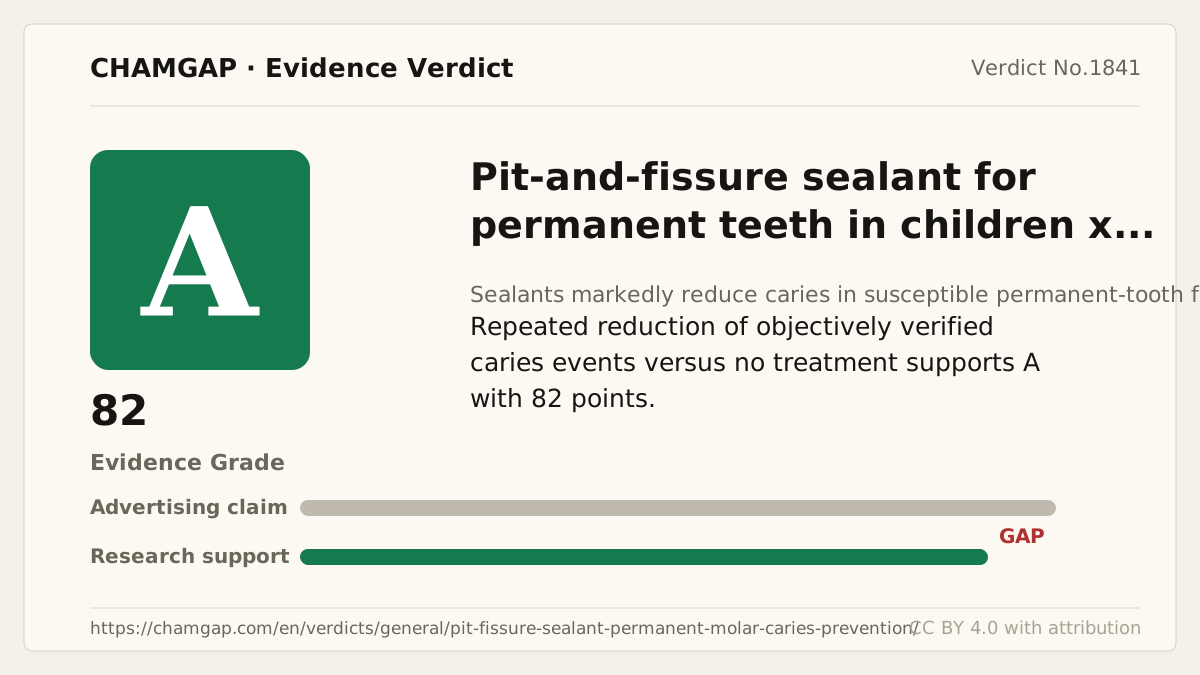
[Chamgap] Pit-and-fissure sealant x prevention of caries in children's permanent teeth — Evidence Grade A·86. 3 cited sources checked. Source: https://chamgap.com/en/verdicts/general/pit-fissure-sealant-permanent-molar-caries-prevention/ · CC BY 4.0CC BY 4.0 — free to use with attribution; do not distort grades, numbers, or verdict meaning.
What this document does and does not do
Chamgap is an information source. It reports what research has and has not confirmed; it does not tell readers what to take or buy. That decision belongs to readers and, when needed, medical or legal professionals. This verdict reflects literature available up to the search date and may change as new research appears. Nothing here is medical advice.