
Ordinary thiamine ; actual salt not reported,
does it really help with Three-month Cockcroft–Gault-derived renal-function readout in early diabetic nephropathy?
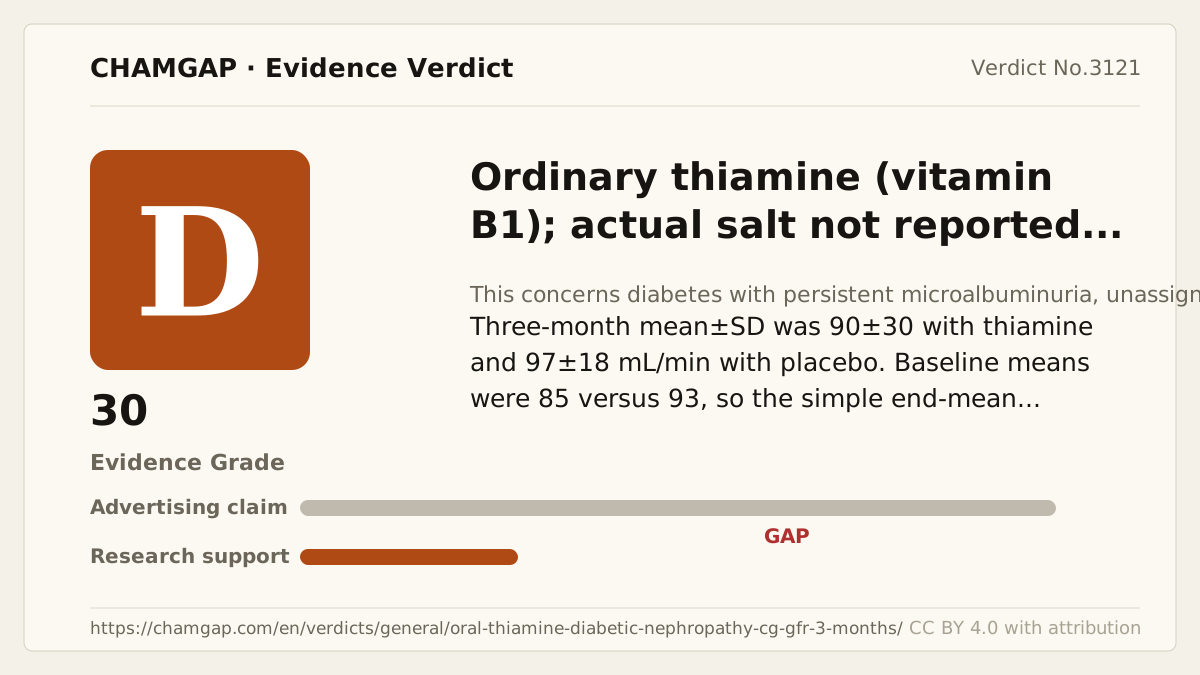
research showsThe current value is D, score 30. A small placebo-controlled trial in adults aged 35–65 with type 2 diabetes and persistent microalbuminuria did not demonstrate a statistically significant three-month renal-function improvement. This establishes neither an exactly zero effect nor exclusion of long-term CKD-progression benefit. [S01]
ads claimNo specific advertisement or product was separately investigated. Albuminuria, HbA1c, thiamine repletion or derivative results do not establish this locked renal-function claim.
Four separate assessment dimensions
| Effect direction and size | The current value is D, score 30. A small placebo-controlled trial in adults aged 35–65 with type 2 diabetes and persistent microalbuminuria did not demonstrate a statistically significant three-month renal-function improvement. This establishes neither an exactly zero effect nor exclusion of long-term CKD-progression benefit. [S01] |
|---|---|
| Evidence certainty | Confidence in the causal magnitude of the three-month renal-function effect is low. Long-term slowing of CKD progression is not established by these data. |
| Applicability | This concerns diabetes with persistent microalbuminuria, unassigned CKD stage and a three-month renal-function quantity—not all CKD. It is not a verdict on dialysis, transplantation, non-diabetic CKD, kidney-failure events, mortality or annual eGFR slope. |
| Safety | Caution reflects unresolved high-dose CKD safety, denominators and dose adjustment, with separate oral-product warnings. It means neither established serious harm nor established safety. |
The axes are B/S/R1/I2/E0/CX/B2. B is the claim type; S is a surrogate; R1 records one family. Public/nonprofit support was verified in the original (I2); the reported nonsignificant result is E0 and the unverified interval is CX. Small size and analysis/missing-data reporting defects give B2. The unmodified calculator returns D; one strength yields the fixed score 30.
Useful facts when choosing a product
- Oral route and nominal 3 × 100 mg/day are original-source verified. A three-times-daily administration schedule and meal timing were not verified. [S01]
- Thiamine is the single study-active ingredient. Salt, manufacturer, excipients and free-thiamine equivalent amount are not reported. [S01]
- The abstract says capsules and Methods says tablets; physical dosage form remains conflicting. [S01]
Chamgap Semantic Classification Code
Permanent code issued
S.thiamine.oral-single-ingredient-salt-unverified-nominal-300mg-day.adults-35-65-t2d-persistent-microalbuminuria-cg-gfr-post-3months.improve.placebo-plus-usual-diabetes-bp-careSubstances > Ordinary thiamine (vitamin B1) > Oral single ingredient, salt unverified, nominal 300 mg/day > Three-month Cockcroft–Gault renal function in adults 35–65 with T2D and persistent microalbuminuria > Improve > Placebo plus usual diabetes/BP care
The −7 mL/min contrast between end means of 90 and 97 is unadjusted and descriptive; it is not converted into causal benefit/harm, equivalence, an eGFR slope or long-term slowing. The code identifies the intervention and claim; it never contains the evidence grade, score, or safety result.
Exact Claim Classification
These independent facets prevent evidence from different forms, routes, populations, effects, and comparators from being mixed.
| Intervention class | S · Supplement or nutraceutical |
|---|---|
| Canonical ingredient or intervention | Ordinary thiamine (vitamin B1) |
| Source or part used | Manufacturing origin unreported; botanical part not applicable |
| Formulation or processing | Single study-active thiamine; salt unreported; capsule/tablet wording conflicts |
| Route | oral |
| Dose | Nominal 3 × 100 mg/day, 300 mg/day; free-thiamine equivalent unverified |
| Duration | 3-month treatment and principal time; separate 2-month washout |
| Population | Adults 35–65 with T2D and persistent microalbuminuria; CKD stage and uniform deficiency classification unverified |
| Effect or condition | Incremental three-month renal-function readout, not established long-term progression benefit |
| Primary endpoint | 3-month post-treatment mean Cockcroft–Gault quantity labelled GFR (mL/min); unadjusted descriptive contrast |
| Comparator | Placebo plus usual diabetes/BP care; insulin and background-care imbalance disclosed |
| Duplicate-detection key | S|thiamine|oral-single-ingredient-salt-unverified-nominal-300mg-day|adults-35-65-t2d-persistent-microalbuminuria-stage-unassigned|cg-gfr-post-mean-ml-min-3months|placebo-plus-usual-diabetes-bp-care |
What the research actually shows
Three-month mean±SD was 90±30 with thiamine and 97±18 mL/min with placebo. Baseline means were 85 versus 93, so the simple end-mean difference of −7 mL/min is not interpreted as a causal effect or harm. Exact P, CI and analyzed denominators are unverified. [S01, CALC01–03] No eGFR slope was verified. The boundary was narrowed to the three-month Cockcroft–Gault quantity with original verification of oral treatment, adults, control and the renal table. The authors call it GFR, but it is not indexed eGFR or measured GFR. [S01] The decisive evidence is one 40-person randomized, blinded placebo-controlled pilot with 20/20 assignment. The nominal regimen was 3 × 100 mg/day for 3 months; a 2-month washout is separate. Reduction of the trial primary endpoint, urinary albumin, is not translated into slower renal-function progression. [S01]
Why this is classified as D (30)
The axes are B/S/R1/I2/E0/CX/B2. B is the claim type; S is a surrogate; R1 records one family. Public/nonprofit support was verified in the original (I2); the reported nonsignificant result is E0 and the unverified interval is CX. Small size and analysis/missing-data reporting defects give B2. The unmodified calculator returns D; one strength yields the fixed score 30.
Counterpoint. The precise causal magnitude and exclusion of clinically important benefit cannot be established. The original nonsignificance report is not strengthened into proof of no effect. Low plasma thiamine and an adequate-intake urinary marker coexist; participants are not all declared deficient or replete. [S01]
Rejudgment record. Single-assistant self-review; no independent reviewer agreement is claimed. — Supplied rubric and unmodified calculator: E0 + R1 + CX → D; one I2 strength → 30.
| Endpoint | S | Surrogate marker - laboratory or imaging measures Case application: A creatinine-derived renal-function quantity is surrogate S, not kidney failure, dialysis, mortality or a patient-reported endpoint. |
| Replication | R1 | Single confirmatory trial Case application: R1 records one decisive family for this exact endpoint/time. The rubric label “single confirmatory trial” is not a claim that this pilot was formally confirmatory. |
| Independence | I2 | Decisive evidence is publicly or non-profit funded Case application: The original funding/conflict sections were opened: public, university and nonprofit support and no-duality declaration were verified. Product provision remains unknown. |
| Effect size | E0 | Null Case application: E0 is the supplied-rule code for the reported nonsignificant renal-function result. It does not establish a true zero effect, equivalence or exclusion of clinically important benefit. |
| Precision | CX | No pooled confidence interval could be confirmed Case application: CX reflects an unverified exact interval and analyzed denominators. C1 benefit exclusion is not used. |
Stored derived and displayed grades match; this is not a current recalculation or validity check (D).
Review performed and remaining limitations
The precise causal magnitude and exclusion of clinically important benefit cannot be established. The original nonsignificance report is not strengthened into proof of no effect. Low plasma thiamine and an adequate-intake urinary marker coexist; participants are not all declared deficient or replete. [S01]
Preliminary RoB 2-informed review — not a complete formal assessment
| Randomization | Random-number generation, central allocation and numbered opaque envelopes are reported; implementation was not independently audited. |
|---|---|
| Deviations from assigned interventions | Participant/caregiver/assessor blinding is reported; adherence and blinding success are unverified. Insulin use is imbalanced. |
| Missing outcome data | One analysis exclusion is reported without its arm, GFR denominators or missing-data method. Analyzed 20/20 is not assumed. |
| Outcome measurement | A creatinine-derived formula quantity. Table SD and units were verified; it is not relabeled as measured or body-surface-indexed GFR. |
| Selection of the reported result | The article primary endpoint is urinary albumin. Registration/protocol concordance was not verified; exact GFR P/CI are absent. |
Reasons for the certainty judgment — not formal GRADE
| Risk of bias | One analysis exclusion is reported without its arm, GFR denominators or missing-data method. Analyzed 20/20 is not assumed. |
|---|---|
| Inconsistency | Only one independent family supplies the same locked endpoint/time/boundary. The different eGFR study was not pooled as the same outcome. |
| Indirectness | A short-term surrogate in adults aged 35–65 with diabetes and persistent microalbuminuria; it does not represent every CKD cause/stage, dialysis, transplantation or long-term kidney-failure events. |
| Imprecision | Arm SDs are available, but analyzed denominators and exact P/CI are not. C1 benefit exclusion and equivalence conclusions are not justified. |
| Publication bias | A small single trial and access-limited search cannot rule out publication bias. No funnel-plot test was performed. |
Search scope and limitations. 41 general-web queries through 2026-09-16; not a completed native database search or exhaustive-search assurance.
Evidence Table
| Study | Design | Sample | Funding | Endpoint | Result | Weight |
|---|---|---|---|---|---|---|
| Rabbani et al. 2009 oral-thiamine placebo-controlled pilot in adults with T2D and microalbuminuria | 40 adults aged 35–65 randomized double-blind; thiamine 20 versus placebo 20 for three months | 20/20 randomized; arm of one analysis exclusion and GFR analyzed/completed denominators unverified | Pakistan Higher Education Commission grant, Warwick PhD support and British Heart Foundation fellowship; authors declared no duality; product provision unverified | Three-month post-treatment mean Cockcroft–Gault quantity labelled GFR (mL/min); urinary albumin was the trial primary endpoint | Thiamine 90±30 versus placebo 97±18 mL/min; unadjusted end-mean contrast −7 mL/min. Significant improvement was not reported; exact CI and P are unverified | Only direct family for the locked endpoint; not extended to causal effect, equivalence or long-term slowing |
| Phrawong et al. accessible abstract of a 24-week randomized trial in T2D with stage-3 CKD | 35 randomized (thiamine 18, placebo 17); actual oral route, adult age criteria, salt/composition and analyzed denominators unverified | 18/17 randomized; analyzed and completed denominators unverified | Funding, product provision and author conflicts unverified | Median eGFR change at 24 weeks, not a slope | 1.59 versus 1.78 mL/min/1.73 m², difference −0.19, P=0.61; CI unverified | Different endpoint, time and eligibility boundary; not pooled as direct replication and no efficacy axes borrowed |
Receipt — 8 References
Evidence access cutoff: 2026-09-16. Each citation states its actual access level (full-text transcription, abstract, index, or other) and remaining limitations. Bibliographic checking does not certify the study results or treatment efficacy.
Technical integration by: Codex · Evidence date: 2026-09-16 · Corrections: none
Cite this verdict
[Chamgap] Does oral ordinary thiamine improve three-month renal function in early diabetic nephropathy? — Evidence Grade D·30. 8 cited sources checked. Source: https://chamgap.com/en/verdicts/general/oral-thiamine-diabetic-nephropathy-cg-gfr-3-months/ · CC BY 4.0CC BY 4.0 — free to use with attribution; do not distort grades, numbers, or verdict meaning.
What this document does and does not do
Chamgap is an information source. It reports what research has and has not confirmed; it does not tell readers what to take or buy. That decision belongs to readers and, when needed, medical or legal professionals. This verdict reflects literature available up to the search date and may change as new research appears. Nothing here is medical advice.