
Inpatient comprehensive geriatric assessment,
does it really help with Higher probability of being alive and living at home three to twelve months after admission?
research showsThe grade is C. A Cochrane review included 29 randomized trials with 13,766 participants. At three to twelve months, 2,079/3,498 (59.4%) receiving CGA versus 1,852/3,301 (56.1%) receiving usual care were alive at home, RR 1.06 (95% CI 1.01 to 1.10). Mortality was unchanged at about 23.0% in both groups, while nursing-home admission fell from 18.6% to 15.1%. Evidence was clear for dedicated wards, but the mobile-team subgroup was RR 0.97 (0.88 to 1.07), and reporting limitations were widespread, giving C with 56 points.
ads claimCGA is not a one-time questionnaire. The evidence concerns an organized multidisciplinary service that acts on the assessment through treatment, rehabilitation, and discharge planning; screening alone cannot claim the same effect.
Useful facts when choosing a product
- Living at home means alive and residing in one's own home rather than a nursing home.
- Absolute rates at three to twelve months were 56.1% with usual care and 59.5% with CGA.
- Mortality was unchanged, while nursing-home admission fell from 18.6% to 15.1%.
Chamgap Semantic Classification Code
Candidate index · review held
UNK.inpatient-comprehensive-geriatric-assessment-centered-on-dedicated-geriatric-wards.UNK.higher-probability-of-being-alive-and-living-at-home-after-admission.increase.usual-careUnknown > Inpatient comprehensive geriatric assessment centered on dedicated geriatric wards > Unknown > Higher probability of being alive and living at home after admission > Increase claim > Usual care
An automated migration candidate, not an issued permanent code; exact claim scope remains under review. This machine-generated migration candidate helps retrieval but is not a permanent assignment. The original verdict ID and URL remain authoritative.
What the research actually shows
CGA is a multidisciplinary bundle assessing medical, functional, cognitive, emotional, nutritional, medication, caregiver, and social needs and linking findings to treatment, rehabilitation, complication prevention, and discharge planning. Twenty trials used dedicated geriatric wards and eight used mobile teams. Dedicated wards gave RR 1.07 (1.03 to 1.12), while mobile teams gave 0.97 (0.88 to 1.07). The review included 29 trials and 13,766 participants; living at home at three to twelve months used 16 trials and 6,799 participants. Participant and clinician masking was infeasible, and residence status was relatively objective. Allocation concealment was high risk in two trials, unclear in 13, low in 12, and not separately assessable in two. Incomplete-data handling was high risk in three, unclear in 18, low in six, and not separately assessable in two. Selective reporting was high risk in none, unclear in 25, and low in four.
Why this is classified as C (56)
The pooled living-at-home benefit was present, but direct replication was not established and allocation, missing-data, and selective-reporting problems were widespread, giving C with 56 points.
Counterpoint. The effect was clear for dedicated wards but not for mobile consultation teams. Definitions of usual care and institutional placement varied by country and era.
Rejudgment record. Cross-check applied — Components of living at home, ward and mobile-team subgroups, trial populations, interventions, endpoints, funding, and domain-level risks were cross-checked
| Endpoint | H | Hard endpoint - actual events such as death |
| Replication | R1 | Single confirmatory trial |
| Independence | I2 | Decisive evidence is publicly or non-profit funded |
| Effect size | E+ | Meets the clinically important threshold |
Stored derived and displayed grades match; this is not a current recalculation or validity check (C).
Sub-claim grades by effect
This ingredient is marketed for several effects. A single overall grade blends strong and weak claims together, so each effect is graded separately here. The overall grade reflects the strongest disconfirming or core claim.
| Effect (sub-claim) | Grade | Basis |
|---|---|---|
| Increased living at home at three to twelve months | C | Rates were 59.4% versus 56.1%, RR 1.06 (1.01 to 1.10). |
| Reduced mortality at three to twelve months | D | Both groups were about 23.0%, RR 1.00 (0.93 to 1.07). |
| Reduced nursing-home admission at three to twelve months | C | Rates were 15.1% versus 18.6%, RR 0.80 (0.72 to 0.89). |
Cross-check — AI research and Codex final gate
Evidence Table
| Study | Design | Sample | Funding | Endpoint | Result | Weight |
|---|---|---|---|---|---|---|
| Ellis et al. 2017 Cochrane review | Systematic review of randomized trials of inpatient CGA versus usual care | 29 trials and 13,766 participants; 16 trials and 6,799 for living at home at 3 to 12 months | NIHR public funding for the review and multiple public or nonprofit trial funders | Living at home, mortality, and nursing-home admission at 3 to 12 months | Living at home 2,079/3,498 versus 1,852/3,301, RR 1.06 (1.01 to 1.10); mortality RR 1.00; nursing-home admission RR 0.80 | Pooled hard-outcome evidence |
| Rubenstein et al. 1984 | Randomized trial of a dedicated VA geriatric unit plus specialist outpatient follow-up | 123 participants, 63 versus 60 | The original funding statement could not be verified | One-year mortality, nursing-home use, and living at home | Deaths 15/63 versus 29/60; any nursing-home residence during one year 26.9% versus 46.7% | Individual trial with a different population, follow-up intervention, and endpoints |
| Applegate et al. 1990 | Randomized trial of a ten-bed geriatric assessment and rehabilitation unit in a community hospital | 155 participants, 78 versus 77 | Supported by a grant from the Robert Wood Johnson Foundation. | Function, institutionalization, mortality, and community residence at six months and one year | Community residence 79% versus 61% at six months; prolonged nursing-home stays 3 versus 10 | Individual trial with a different population, post-discharge intervention, and detailed endpoints |
Receipt — 3 References
All 3 cited sources were verified for existence at the original page (as of 2026-08-05).
Final verification and publication gate: Codex · Evidence date: 2026-08-05 · Corrections: none
Cite this verdict
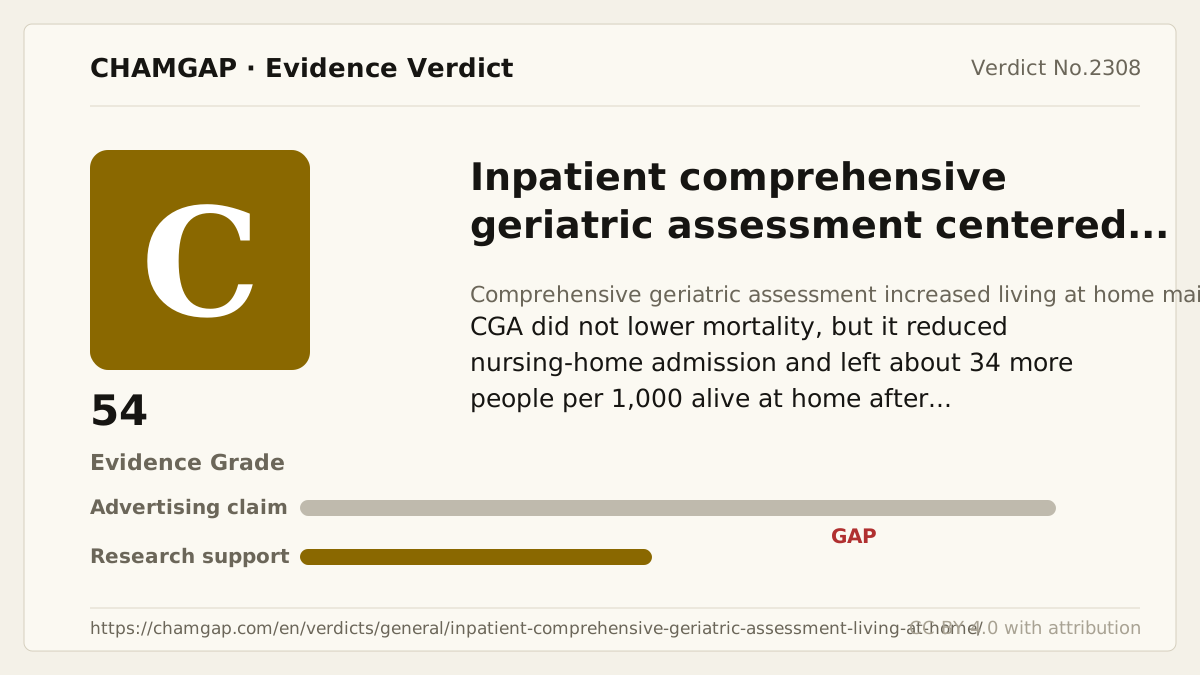
[Chamgap] Inpatient comprehensive geriatric assessment x living at home — Evidence Grade C·56. 3 cited sources checked. Source: https://chamgap.com/en/verdicts/general/inpatient-comprehensive-geriatric-assessment-living-at-home/ · CC BY 4.0CC BY 4.0 — free to use with attribution; do not distort grades, numbers, or verdict meaning.
What this document does and does not do
Chamgap is an information source. It reports what research has and has not confirmed; it does not tell readers what to take or buy. That decision belongs to readers and, when needed, medical or legal professionals. This verdict reflects literature available up to the search date and may change as new research appears. Nothing here is medical advice.