
Home intravaginal neuromuscular electrostimulation,
does it really help with Improved female urinary-incontinence symptoms and quality of life?
research showsThe grade is C with 50 points. Although 86 women were randomized, the 12-week primary analysis included only 30 Pelviva and 33 usual-care participants. The adjusted ICIQ-UI-SF difference was -1.81 points (95% CI -3.49 to -0.14). The cited two-point value describes individual change and was not treated as a between-group mean threshold. An approximate standardized difference reconstructed from the interval was 0.53, but early termination, 26.7% missing outcome data, unblinded self-report, and manufacturer-only funding substantially weaken confidence.
ads claimIt is reasonable to report an adjusted 1.81-point advantage at 12 weeks when the device was added to usual care. Calling it an independently established standard for every urinary-incontinence type would overstate the evidence. Verdict 1044 is B with 68 points and verdict 2461 is C with 50 points for different treatment approaches in the same indication.
Useful facts when choosing a product
- Pelviva was used for 30 minutes every other day and superimposed 50-Hz bursts and a 125-Hz doublet on 2-Hz stimulation.
- Only 63 of 86 randomized participants entered the 12-week primary analysis.
- Verdict 1044 is B with 68 points for mirabegron and verdict 2461 is C with 50 points for posterior tibial nerve stimulation.
Chamgap Semantic Classification Code
Candidate index · review held
P.pelviva.vaginal.female-urinary-incontinence-symptoms-and-quality-of-life.improve.MULTIProcedures, devices and tests > Pelviva > Vaginal > female urinary-incontinence symptoms and quality of life > Improvement claim > Multiple: primary unresolved
An automated migration candidate, not an issued permanent code; exact claim scope remains under review. This machine-generated migration candidate helps retrieval but is not a permanent assignment. The original verdict ID and URL remain authoritative.
What the research actually shows
The 2021 open randomized trial by Oldham J, Herbert J, Garnett J, and Roberts SA used the sealedEnvelope online service with random blocks of four to eight. Participants were unblinded; trial management, oversight, and analysis remained blinded until data lock. COVID-19 stopped recruitment at 86 rather than 264, and 63 participants, 30 versus 33, entered the 12-week available-case analysis. Femeda funded the project; all authors received company grant funding, Oldham J held the stimulation-regimen patent, and Herbert J had company executive and consultancy relationships. NCT04059653 and the article agree on ICIQ-UI-SF total score as primary.
Why this is classified as C (50)
The patient-reported primary result was of medium statistical magnitude, but early stopping, substantial missingness, unblinded self-report, and manufacturer-only evidence give C with 50 points.
Counterpoint. People with difficult insertion, pregnancy, implanted pelvic devices, active infection, or unexplained bleeding should seek professional advice before use.
Rejudgment record. Cross-check applied — Cross-checked the article and NCT record for central randomization, participant unmasking, randomized and available-case counts, adjusted difference and interval, early stopping, primary-endpoint agreement, and Femeda funding, patent, and executive relationships
| Endpoint | P | Symptom or function itself is the target - including patient reports and performance tests |
| Replication | R1 | Single confirmatory trial |
| Independence | I0 | Evidence comes only from manufacturer studies |
| Effect size | E+ | Meets the clinically important threshold |
Stored derived and displayed grades match; this is not a current recalculation or validity check (C).
Sub-claim grades by effect
This ingredient is marketed for several effects. A single overall grade blends strong and weak claims together, so each effect is graded separately here. The overall grade reflects the strongest disconfirming or core claim.
| Effect (sub-claim) | Grade | Basis |
|---|---|---|
| Improved urinary-incontinence symptoms at 12 weeks | C | The adjusted between-group difference was -1.81 points. |
| Improved sexual function | D | PISQ-IR and FSFI did not show significant between-group differences. |
Cross-check — AI research and Codex final gate
Evidence Table
| Study | Design | Sample | Funding | Endpoint | Result | Weight |
|---|---|---|---|---|---|---|
| Oldham J, Herbert J, Garnett J, Roberts SA. 2021 | Open community randomized add-on-to-usual-care trial | 86 randomized, 44/42; 63 in the 12-week primary analysis, 30/33 | Funded by Femeda; all authors funded, with patent, executive, and consultancy relationships | ICIQ-UI-SF total score at 12 weeks | Adjusted difference -1.81 points, 95% CI -3.49 to -0.14, P=.033; approximate standardized difference 0.53 | Positive but limited by early stopping, 26.7% missingness, unblinded assessment, and manufacturer-only evidence |
Receipt — 3 References
All 3 cited sources were verified for existence at the original page (as of 2026-08-15).
Final verification and publication gate: Codex · Evidence date: 2026-08-15 · Corrections: none
Cite this verdict
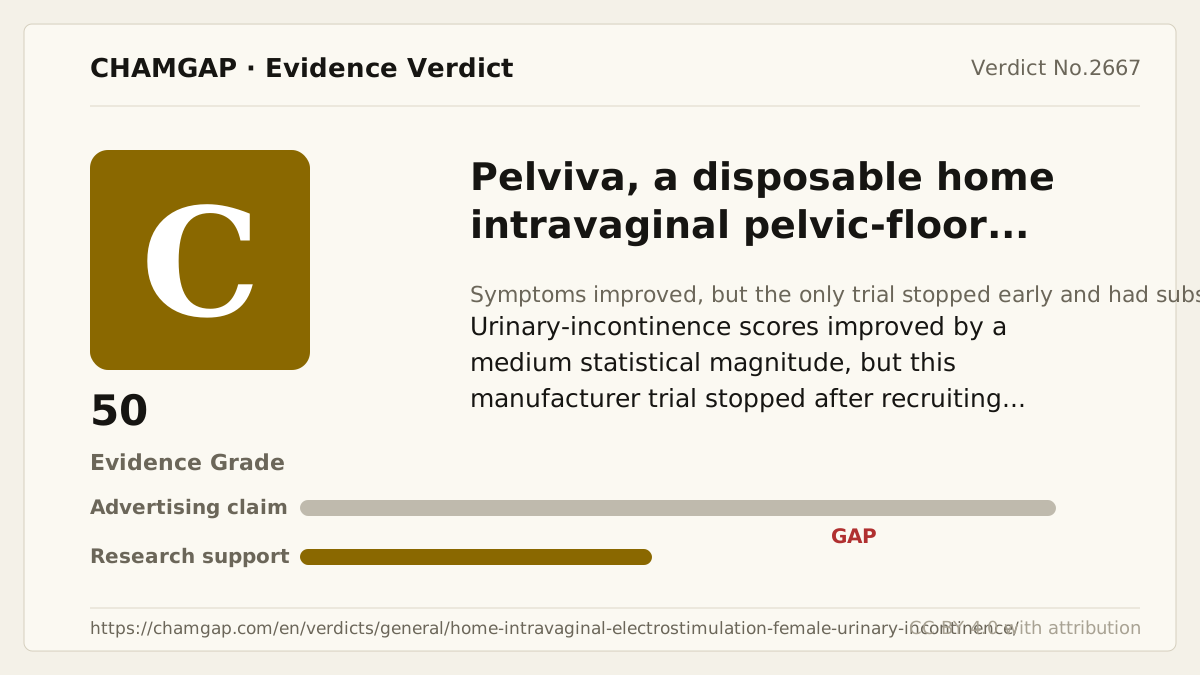
[Chamgap] Home intravaginal neuromuscular electrostimulation x female urinary incontinence — Evidence Grade C·50. 3 cited sources checked. Source: https://chamgap.com/en/verdicts/general/home-intravaginal-electrostimulation-female-urinary-incontinence/ · CC BY 4.0CC BY 4.0 — free to use with attribution; do not distort grades, numbers, or verdict meaning.
What this document does and does not do
Chamgap is an information source. It reports what research has and has not confirmed; it does not tell readers what to take or buy. That decision belongs to readers and, when needed, medical or legal professionals. This verdict reflects literature available up to the search date and may change as new research appears. Nothing here is medical advice.