
Filtered sunlight phototherapy,
does it really help with Bilirubin control noninferior to conventional electric phototherapy in term and late-preterm neonatal jaundice?
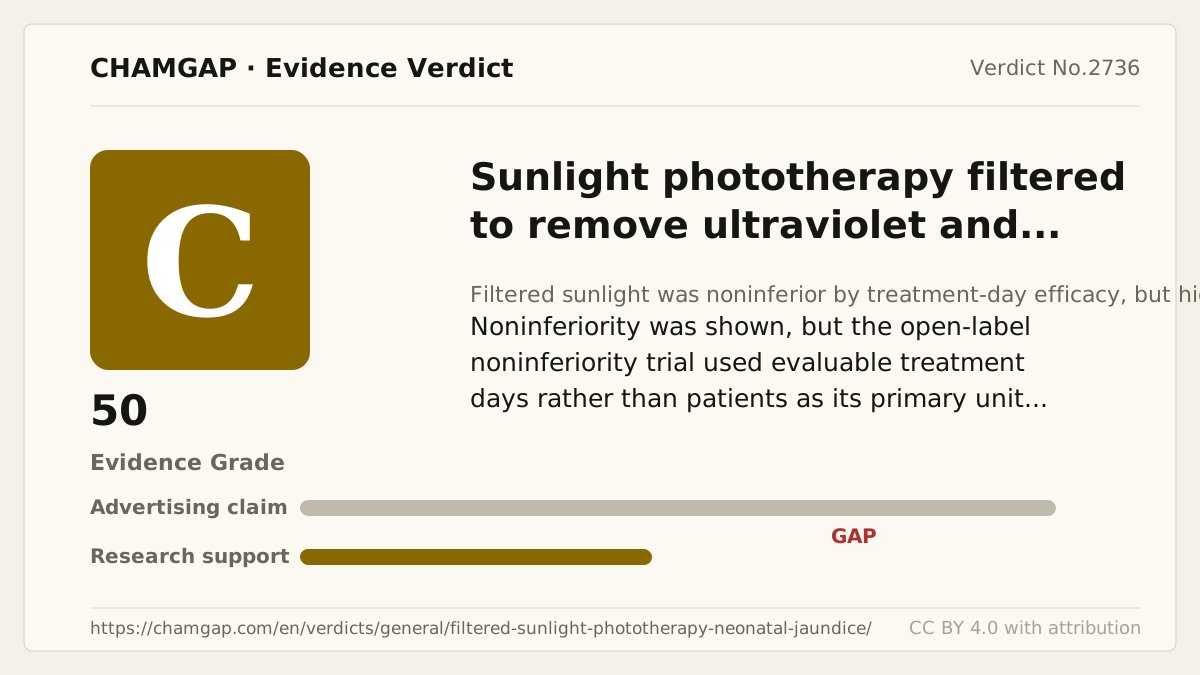
research showsThe grade is C with 50 points. A single Nigerian hospital trial randomized 447 infants and found efficacy on 93% versus 90% of evaluable treatment days with at least five hours of therapy, meeting the prespecified 10% noninferiority margin. The primary efficacy unit, however, was a treatment day rather than an infant, and the trial was open-label and noninferiority-designed. Temperature above 38.0°C was more frequent, 5% versus 1%.
ads claimFiltered sunlight may be an option where electric phototherapy is unreliable, but this was not ordinary sun exposure. The intervention required UV and heat-filtering films, repeated bilirubin and temperature measurements, and clinical supervision.
Useful facts when choosing a product
- The registration is NCT01434810.
- The films removed most ultraviolet and some infrared radiation while transmitting therapeutic blue light.
- The primary efficacy unit was an evaluable treatment day with at least five hours of therapy, not a patient.
Chamgap Semantic Classification Code
Candidate index · review held
P.sunlight-phototherapy-filtered-to-remove-ultraviolet-and-infrared-radiation.UNK.bilirubin-control-noninferior-to-conventional-electric-phototherapy-in-term-and-late-preterm-neonatal-jaundice.noninferior.noneProcedures, devices and tests > Sunlight phototherapy filtered to remove ultraviolet and infrared radiation > Unknown > Bilirubin control noninferior to conventional electric phototherapy in term and late-preterm neonatal jaundice > Noninferiority claim > No intervention
An automated migration candidate, not an issued permanent code; exact claim scope remains under review. This machine-generated migration candidate helps retrieval but is not a permanent assignment. The original verdict ID and URL remain authoritative.
What the research actually shows
The trial randomized 447 infants, 224 to filtered sunlight and 223 to conventional phototherapy. Fourteen received no treatment, and 49 of 433 treated infants withdrew early because of nighttime phototherapy, 30; parental request, 10; heavy rain, 5; or illness, 4. Although the paper describes intention-to-treat comparisons, the primary efficacy denominator was evaluable treatment days with 'at least 5 hours of phototherapy.' Efficacy was 93% versus 90% and met the 10% margin. Allocation used 'sequentially numbered sheets of paper, enclosed in opaque, sealed, matching, numbered envelopes.' The Thrasher Research Fund and NIH National Center for Advancing Translational Sciences supported the trial, while Draeger Medical loaned the JM-103 bilirubinometer and CPFilms donated the films, so the support was not exclusively public or nonprofit.
Why this is classified as C (50)
A surrogate bilirubin endpoint, one trial, mixed material support, an open-label noninferiority design, and treatment-day analysis give C with 50 points.
Counterpoint. The margin was prespecified and efficacy was 93% versus 90%. C does not mean no activity; it reflects reliance on a treatment-day laboratory endpoint rather than patient-level clinical outcomes.
Rejudgment record. Cross-check applied — A treatment-day bilirubin endpoint rather than patient-level clinical events, one open-label noninferiority trial, and mixed nonprofit/public and manufacturer material support
| Endpoint | S | Surrogate marker - laboratory or imaging measures |
| Replication | R1 | Single confirmatory trial |
| Independence | I1 | Mixed funding sources |
| Effect size | E+ | Meets the clinically important threshold |
Stored derived and displayed grades match; this is not a current recalculation or validity check (C).
Sub-claim grades by effect
This ingredient is marketed for several effects. A single overall grade blends strong and weak claims together, so each effect is graded separately here. The overall grade reflects the strongest disconfirming or core claim.
| Effect (sub-claim) | Grade | Basis |
|---|---|---|
| Bilirubin control noninferior to conventional phototherapy | C | Efficacy was 93% versus 90%, but the unit was a treatment day rather than a patient. |
Cross-check — AI research and Codex final gate
Evidence Table
| Study | Design | Sample | Funding | Endpoint | Result | Weight |
|---|---|---|---|---|---|---|
| Slusher TM et al. 2015 | Single-center open-label randomized noninferiority trial in Nigeria | 447 randomized, 224 versus 223; 433 treated; 49 withdrew early | Support from the Thrasher Research Fund and NIH NCATS; device loan from Draeger Medical and film donation from CPFilms | Bilirubin-control efficacy on evaluable treatment days with at least five hours of therapy | Efficacious on 93% versus 90% of days, meeting the prespecified 10% margin; temperature above 38.0°C in 5% versus 1% (P<.001) | Single noninferiority trial using treatment days as the analysis unit |
Receipt — 1 References
All 1 cited sources were verified for existence at the original page (as of 2026-08-18).
Final verification and publication gate: Codex · Evidence date: 2026-08-18 · Corrections: none
Cite this verdict
[Chamgap] Filtered sunlight phototherapy x neonatal jaundice — Evidence Grade C·50. 1 cited sources checked. Source: https://chamgap.com/en/verdicts/general/filtered-sunlight-phototherapy-neonatal-jaundice/ · CC BY 4.0CC BY 4.0 — free to use with attribution; do not distort grades, numbers, or verdict meaning.
What this document does and does not do
Chamgap is an information source. It reports what research has and has not confirmed; it does not tell readers what to take or buy. That decision belongs to readers and, when needed, medical or legal professionals. This verdict reflects literature available up to the search date and may change as new research appears. Nothing here is medical advice.