
Duloxetine,
does it really help with Relief of widespread pain and patient-perceived symptoms in fibromyalgia?
research showsDuloxetine improves fibromyalgia pain and patient global assessment but is rated C. Across six trials with 2,249 participants, at least 50% pain reduction had a risk ratio of 1.57 and an NNT of 8, so the effect itself is clear. All six trials were conducted and sponsored by Eli Lilly, however, with zero non-Lilly independent sponsor trials (0/6). Rule ②-b therefore directly caps an all-positive manufacturer-only evidence base at C with 58 points.
ads claimPromotion can expand the result into near-complete relief of pain, fatigue, sleep, and cognitive symptoms. The average benefit is modest to moderate, with about eight people treated for one additional person to obtain at least 50% pain reduction over placebo, and response and tolerability vary substantially.
Useful facts when choosing a product
- The principal evidence in fibromyalgia concerns doses of 60 to 120 mg daily, with initiation and titration directed by a prescriber.
- Benefit is assessed over several weeks, and treatment should be reconsidered when meaningful pain or functional improvement does not occur.
- Abrupt discontinuation can cause dizziness, anxiety, sensory symptoms, and other withdrawal effects, so tapering is commonly required.
- Blood pressure, liver disease, other serotonergic drugs, and suicide-risk considerations require clinical assessment before and during treatment.
Chamgap Semantic Classification Code
Candidate index · review held
M.duloxetine.UNK.widespread-pain-and-patient-perceived-symptoms-in-fibromyalgia.relieve.placeboMedicinal interventions > Duloxetine > Unknown > widespread pain and patient-perceived symptoms in fibromyalgia > Symptom-relief claim > Placebo
An automated migration candidate, not an issued permanent code; exact claim scope remains under review. This machine-generated migration candidate helps retrieval but is not a permanent assignment. The original verdict ID and URL remain authoritative.
What the research actually shows
The 520-person Russell trial met both three-month co-primary endpoints for the 120-mg group. Across six fibromyalgia trials with 2,249 participants, the risk ratio for at least 50% pain reduction was 1.57 and the NNT was 8. Every trial was conducted and sponsored by Eli Lilly, and there were no non-Lilly independent sponsor trials (0/6).
Why this is classified as C (58)
Six trials with 2,249 participants found a risk ratio of 1.57 and NNT of 8 for at least 50% pain reduction, but all six were conducted and sponsored by Eli Lilly and zero had a non-Lilly independent sponsor. Rule ②-b gives C with 58 points.
Counterpoint. Exercise, sleep management, psychological care, and rehabilitation are commonly combined with medication. Lack of response or poor tolerability calls for reassessment rather than automatic dose escalation.
Rejudgment record. Cross-check applied — Accepted the risk ratio of 1.57 and NNT of 8 for at least 50% pain reduction across six trials with 2,249 participants, but applied the rule ②-b maximum of C because Eli Lilly conducted and sponsored all six and independent sponsor trials numbered 0/6.
Sub-claim grades by effect
This ingredient is marketed for several effects. A single overall grade blends strong and weak claims together, so each effect is graded separately here. The overall grade reflects the strongest disconfirming or core claim.
| Effect (sub-claim) | Grade | Basis |
|---|---|---|
| Reduced average pain in fibromyalgia | C | The direct BPI co-primary endpoint was positive, but evidence was manufacturer-only. |
| Achievement of at least 50% pain reduction in fibromyalgia | C | The six-trial synthesis found RR 1.57 and NNT 8, but independent sponsor trials numbered 0/6. |
| Patient-rated global improvement in fibromyalgia | C | PGI-I was positive, but the rule ②-b ceiling applies. |
Cross-check — AI research and Codex final gate
Evidence Table
| Study | Design | Sample | Funding | Endpoint | Result | Weight |
|---|---|---|---|---|---|---|
| Russell IJ et al. 2008 | Six-month multicenter randomized double-blind placebo-controlled fixed-dose trial | 520 randomized and 520 in the intent-to-treat mixed model; 325 remained at three months and 278 completed six months | Co-sponsored by Eli Lilly and Company and Boehringer Ingelheim GmbH; manufacturer-led development trial | Co-primary endpoints of BPI average pain and PGI-I | At three months, the 120-mg group achieved BPI -2.31 versus -1.39 (P<0.001) and PGI-I 2.89 versus 3.39 (P=0.004); both succeeded. | Key direct efficacy trial |
| Lunn MPT et al. 2014 Cochrane review | Systematic review and meta-analysis of randomized trials | Six fibromyalgia trials with 2,249 participants | Cochrane review supported by the National Institute for Health Research; Eli Lilly conducted and sponsored all six included fibromyalgia trials, with 0/6 non-Lilly independent sponsor trials | At least 50% pain reduction at 12 weeks | Positive with RR 1.57 (95% CI 1.20 to 2.06) and NNT 8, with low-to-moderate certainty. | Key synthesis |
Receipt — 2 References
All 2 cited sources were verified for existence at the original page (as of 2026-07-24).
Final verification and publication gate: Codex · Evidence date: 2026-07-24 · Corrections: none
Cite this verdict
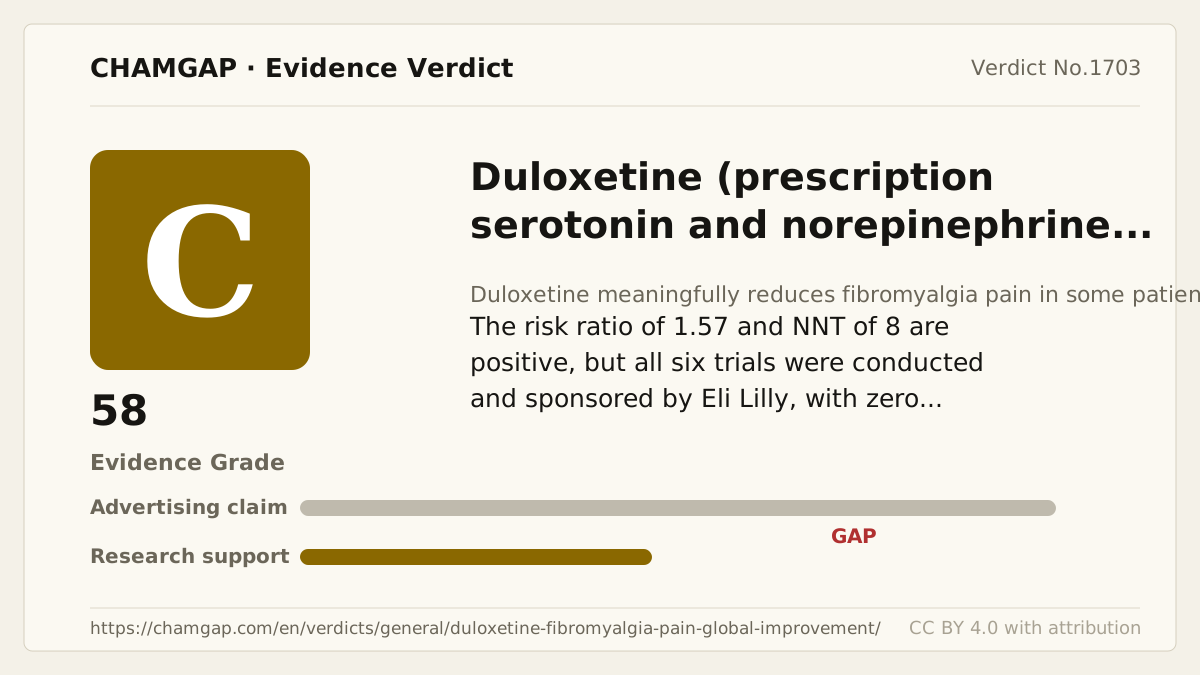
[Chamgap] Duloxetine x relief of pain and patient-perceived symptoms in fibromyalgia — Evidence Grade C·58. 2 cited sources checked. Source: https://chamgap.com/en/verdicts/general/duloxetine-fibromyalgia-pain-global-improvement/ · CC BY 4.0CC BY 4.0 — free to use with attribution; do not distort grades, numbers, or verdict meaning.
What this document does and does not do
Chamgap is an information source. It reports what research has and has not confirmed; it does not tell readers what to take or buy. That decision belongs to readers and, when needed, medical or legal professionals. This verdict reflects literature available up to the search date and may change as new research appears. Nothing here is medical advice.