
Amygdalin and laetrile,
does it really help with Shrinking or treating cancer and extending survival with an apricot-kernel-derived substance?
research showsAmygdalin and laetrile derived from apricot kernels are rated F for shrinking or treating cancer or extending survival. In the NCI clinical study, only one of 175 evaluable patients met response criteria, and that partial response lasted only ten weeks; every patient had progressive disease by seven months. The publication concluded that there was no substantive benefit for cancer treatment, stabilization, symptoms, or survival. A 2015 Cochrane review also found no reliable controlled-trial evidence and judged the risk-benefit balance unambiguously negative because of cyanide poisoning. Lack of efficacy and recommendations against use have been repeatedly confirmed. The risk of cyanide poisoning and death, especially with oral use and vitamin C, is recorded separately under safety.
ads claimMarketing claims that natural vitamin B17 releases cyanide only inside cancer cells or that an effective cure was suppressed by industry. Amygdalin is not a vitamin, selective protection of normal tissue is unproven, and replacing standard care adds a risk of disease progression.
Useful facts when choosing a product
- NCI terminology states that amygdalin and laetrile are often used interchangeably but are different related agents. Amygdalin is a cyanogenic glycoside in kernels of Prunus species such as apricot, whereas United States-patented laetrile is a related semisynthetic derivative and is not chemically identical.
- Vitamin B17 is not a recognized vitamin designation, and no human essential-nutrient deficiency syndrome has been defined for it.
- The United States FDA has not approved laetrile for cancer or any other disease, and unregulated products can vary in purity and content.
- Oral use can increase cyanide exposure through intestinal metabolism, and raw kernels or almonds and high-dose vitamin C can further increase poisoning risk.
Chamgap Semantic Classification Code
Candidate index · review held
S.amygdalin-and-laetrile.UNK.shrinking-or-treating-cancer-and-extending-survival-with-an-apricot-kernel-derived-substance.treat.UNKSupplements and nutraceuticals > Amygdalin and laetrile > Unknown > Shrinking or treating cancer and extending survival with an apricot-kernel-derived substance > Treatment or remission claim > Unknown
An automated migration candidate, not an issued permanent code; exact claim scope remains under review. This machine-generated migration candidate helps retrieval but is not a permanent assignment. The original verdict ID and URL remain authoritative.
What the research actually shows
Moertel and colleagues treated 178 patients with diverse advanced cancers using 21 days of intravenous amygdalin followed by oral maintenance, plus a metabolic program of diet, enzymes, and vitamins. Only one of 175 evaluable patients had a ten-week partial response, every patient had progressed within seven months, and survival was not extended. Some patients developed symptoms of cyanide toxicity or blood cyanide concentrations near the lethal range. The Cochrane review by Milazzo and Horneber searched eight databases and registries and screened more than 200 references but found zero eligible randomized or quasi-randomized trials. The randomized-trial gap alone would imply uncertainty, but the large uncontrolled clinical failure, toxicity, and negative NCI assessment together provide no basis for use.
Why this is classified as F (5)
The study of 175 evaluable patients found no substantive tumor, symptom, or survival benefit and progression in all patients by seven months. Cochrane and NCI confirmed the absence of sound anticancer evidence and a negative risk-benefit balance. Repeated refutation supports F with 5 points. Cyanide poisoning is a separate major safety issue.
Counterpoint. People with cancer should not use laetrile as a substitute for standard treatment and should discuss validated treatment or legitimate clinical trials with an oncology team. Headache, vomiting, dizziness, cyanosis, or confusion during use requires urgent evaluation for possible cyanide poisoning.
Rejudgment record. New verdict — Applied F because the NCI study of 175 evaluable patients found no substantive tumor, symptom, or survival benefit and progression in all patients by seven months, while the Cochrane review and NCI confirmed no sound efficacy evidence, an unambiguously negative risk-benefit balance from cyanide toxicity, and recommendations against use
Sub-claim grades by effect
This ingredient is marketed for several effects. A single overall grade blends strong and weak claims together, so each effect is graded separately here. The overall grade reflects the strongest disconfirming or core claim.
| Effect (sub-claim) | Grade | Basis |
|---|---|---|
| Tumor shrinkage and cancer treatment | F | Only one of 175 evaluable patients had a temporary partial response in the NCI study, and all had progressed by seven months. Amygdalin and laetrile are related but chemically nonidentical agents that are often used interchangeably. |
| Extension of survival | F | The clinical study found no survival extension, and the evidence synthesis found no sound efficacy data. Terminology variation between the related agents does not change this failure conclusion. |
Cross-check — AI research and Codex final gate
Evidence Table
| Study | Design | Sample | Funding | Endpoint | Result | Weight |
|---|---|---|---|---|---|---|
| Moertel CG et al. 1982 NCI clinical study | Multicenter uncontrolled phase II clinical study | 178 treated and 175 evaluable patients | United States National Cancer Institute | Tumor response, stabilization, cancer symptoms, performance, and survival | Only one temporary partial response occurred, with no substantive treatment, symptom, or survival benefit and progression in all patients by seven months. | Key human clinical failure evidence |
| Milazzo S and Horneber M. 2015 Cochrane review | Systematic review | More than 200 references; zero eligible randomized or quasi-randomized trials | Cochrane systematic review | Cancer-treatment efficacy and adverse effects | The review found no sound clinical evidence of efficacy and judged the risk-benefit balance unambiguously negative because of cyanide poisoning. | Key evidence synthesis and recommendation against use |
| NCI Drug Dictionary and Laetrile/Amygdalin PDQ | Official cancer information and ingredient terminology review | Not applicable | United States National Cancer Institute | Terminology and chemical distinction between amygdalin and laetrile | Explained that the names are often used interchangeably but refer to different related agents, with United States-patented laetrile being a semisynthetic amygdalin derivative. | Correction of ingredient terminology |
Receipt — 3 References
All 3 cited sources were verified for existence at the original page (as of 2026-07-20).
Final verification and publication gate: Codex · Evidence date: 2026-07-20 · Corrections: none
Cite this verdict
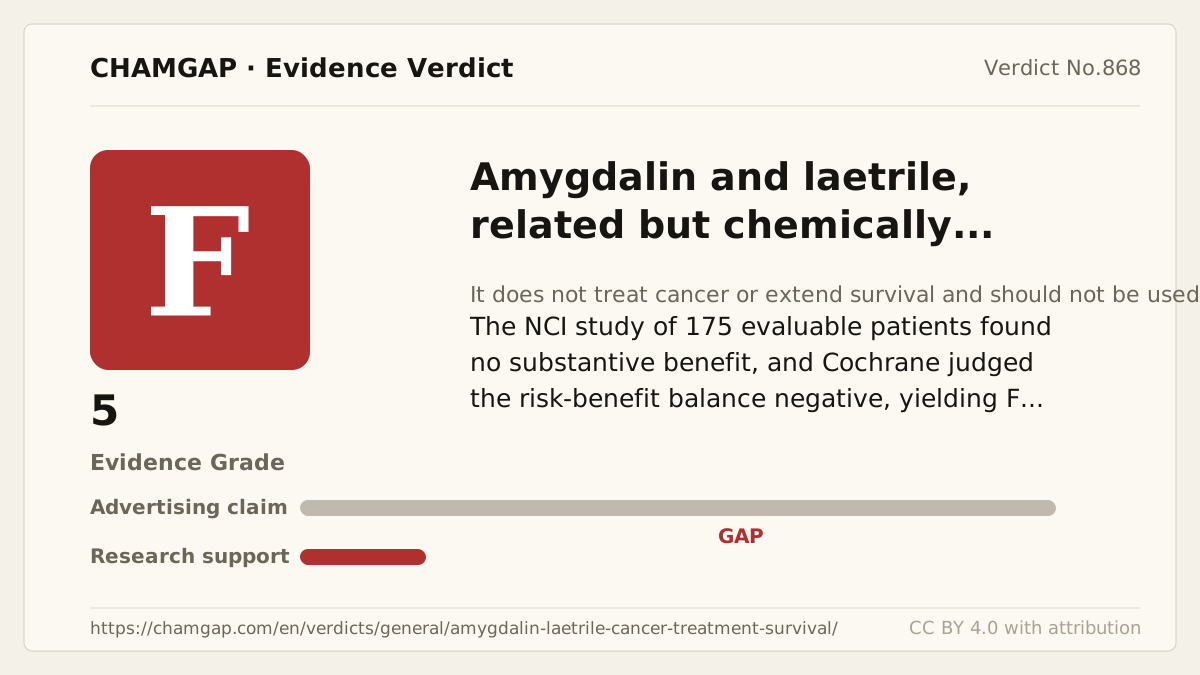
[Chamgap] Amygdalin and laetrile x cancer shrinkage, treatment, and longer survival — Evidence Grade F·5. 3 cited sources checked. Source: https://chamgap.com/en/verdicts/general/amygdalin-laetrile-cancer-treatment-survival/ · CC BY 4.0CC BY 4.0 — free to use with attribution; do not distort grades, numbers, or verdict meaning.
What this document does and does not do
Chamgap is an information source. It reports what research has and has not confirmed; it does not tell readers what to take or buy. That decision belongs to readers and, when needed, medical or legal professionals. This verdict reflects literature available up to the search date and may change as new research appears. Nothing here is medical advice.