
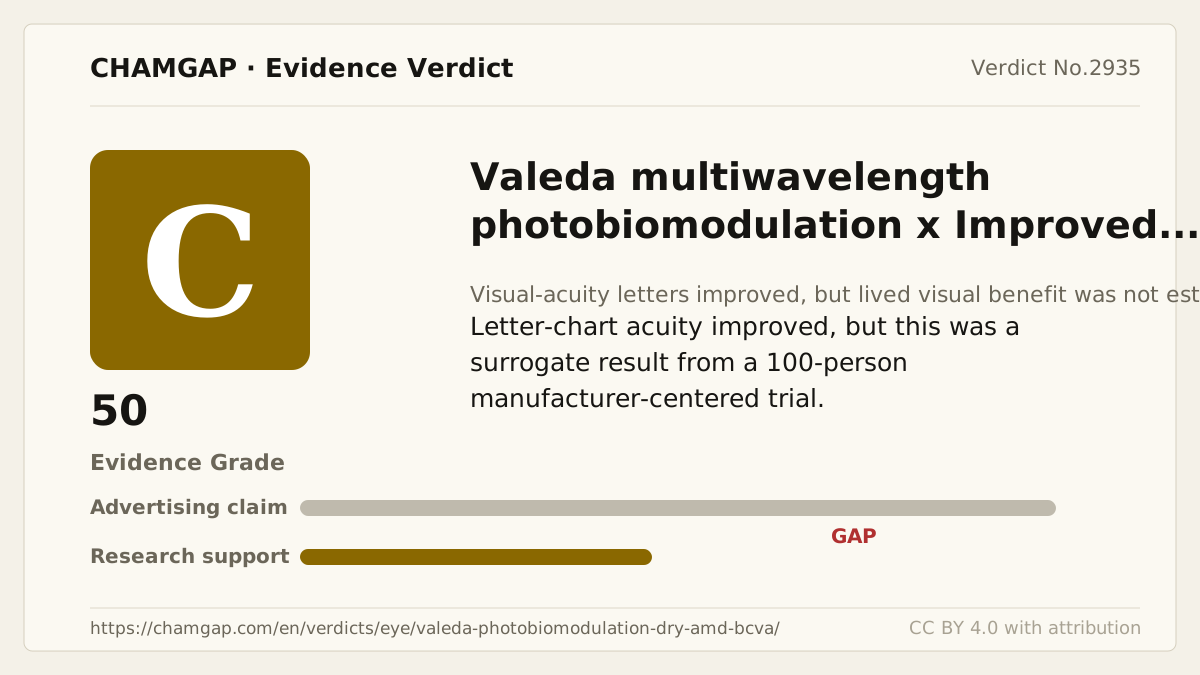
Valeda multiwavelength photobiomodulation,
does it really help with Improved ETDRS best-corrected visual-acuity letters in dry age-related macular degeneration?
research showsGrade C. At month 21, LS mean BCVA change was +6.2 letters (95% CI 4.2 to 8.2) with PBM versus +2.4 (-0.1 to 4.9) with sham, between-group P=.0036. At month 24 it was +5.6 versus +1.3, P=.0024. Letter-chart acuity is a surrogate for lived visual function, and no prespecified clinically important letter difference was identified.
ads claimA chart-letter change must not be expanded into proven blindness prevention or independent-living benefit. Longer clinical outcomes and independent replication are needed.
Useful facts when choosing a product
- Valeda delivered 590, 660, and 850 nm light.
- Nine sessions over 3 to 5 weeks were repeated every 4 months.
- The sham delivered low-fluence active light.
Chamgap Semantic Classification Code
Candidate index · review held
UNK.valeda-multiwavelength-photobiomodulation.UNK.etdrs-best-corrected-visual-acuity-letters-in-dry-age-related-macular-degeneration.improve.shamUnknown > Valeda multiwavelength photobiomodulation > Unknown > ETDRS best-corrected visual-acuity letters in dry age-related macular degeneration > Improvement claim > Sham procedure or device
An automated migration candidate, not an issued permanent code; exact claim scope remains under review. This machine-generated migration candidate helps retrieval but is not a permanent assignment. The original verdict ID and URL remain authoritative.
What the research actually shows
LIGHTSITE III randomized 100 participants and 148 eyes 2:1 at 10 US centers. Month 13 and 21 BCVA were prespecified primary time points. Results were +6.2 versus +2.4 letters at month 21 and +5.6 versus +1.3 at month 24. Twenty of 100 participants discontinued. LumiThera and NEI grant 1R43EY025508-03 supported the study; S. E. Tedford, C. L. Croissant, M. R. Munk, R. Rückert, and C. E. Tedford were LumiThera employees or consultants. No prespecified clinically important BCVA letter threshold was identified.
Why this is classified as C (50)
A manufacturer-centered 100-person trial improved a BCVA surrogate, but 20% attrition and small size give C with 50 points.
Counterpoint. Statistical chart improvement is real but is not equivalent to improved daily-life function.
Rejudgment record. Cross-check applied — Sham-controlled BCVA improvement was balanced against manufacturer-centered funding, a 100-person sample, 20% attrition, and a surrogate endpoint
| Endpoint | S | Surrogate marker - laboratory or imaging measures |
| Replication | R1 | Single confirmatory trial |
| Independence | I0 | Evidence comes only from manufacturer studies |
| Effect size | E+ | Meets the clinically important threshold |
Stored derived and displayed grades match; this is not a current recalculation or validity check (C).
Sub-claim grades by effect
This ingredient is marketed for several effects. A single overall grade blends strong and weak claims together, so each effect is graded separately here. The overall grade reflects the strongest disconfirming or core claim.
| Effect (sub-claim) | Grade | Basis |
|---|---|---|
| Improved ETDRS BCVA letters | C | Between-group differences were statistically significant at months 21 and 24. |
| Improved daily visual function and independence | ? | This was not the primary endpoint and remains unestablished. |
Cross-check — AI research and Codex final gate
Evidence Table
| Study | Design | Sample | Funding | Endpoint | Result | Weight |
|---|---|---|---|---|---|---|
| LIGHTSITE III 24-month report | Double-masked sham-controlled multicenter randomized trial | 100 participants and 148 eyes randomized; 20 participants discontinued | LumiThera, Inc. and US National Eye Institute grant 1R43EY025508-03; five authors were manufacturer employees or consultants | Change in ETDRS BCVA at months 13 and 21 | Month 21 +6.2 (95% CI 4.2-8.2) vs +2.4 (-0.1 to 4.9), P=.0036; month 24 +5.6 vs +1.3, P=.0024 | Manufacturer-centered surrogate pivotal trial |
Receipt — 1 References
All 1 cited sources were verified for existence at the original page (as of 2026-08-26).
Final verification and publication gate: Codex · Evidence date: 2026-08-26 · Corrections: none
Cite this verdict
[Chamgap] Benefit of Valeda Photobiomodulation for Best-Corrected Visual Acuity, a Surrogate Marker, in Dry AMD — Evidence Grade C·50. 1 cited sources checked. Source: https://chamgap.com/en/verdicts/eye/valeda-photobiomodulation-dry-amd-bcva/ · CC BY 4.0CC BY 4.0 — free to use with attribution; do not distort grades, numbers, or verdict meaning.
What this document does and does not do
Chamgap is an information source. It reports what research has and has not confirmed; it does not tell readers what to take or buy. That decision belongs to readers and, when needed, medical or legal professionals. This verdict reflects literature available up to the search date and may change as new research appears. Nothing here is medical advice.