
Ranibizumab,
does it really help with Improved vision and reduced vision loss in center-involved diabetic macular edema?
research showsRanibizumab is rated A because strong evidence shows improved vision and reduced further loss in eyes with visual impairment from center-involved diabetic macular edema. In the identically designed RISE and RIDE phase 3 trials involving 759 participants, the proportion gaining at least 15 letters at 24 months was markedly higher than with sham in both trials. A public-network-led Diabetic Retinopathy Clinical Research Network trial of 854 eyes also found an approximately six-letter greater mean one-year improvement than laser alone. ETDRS best-corrected visual acuity is a patient-performed functional vision endpoint, not an anatomical surrogate such as OCT thickness. It does not cover contrast sensitivity, near vision, or all daily visual functioning, however; RISE and RIDE were manufacturer trials, repeated injections are required, and the DRCR trial received ranibizumab and some site funding from the manufacturer. A score of 91 above warfarin at A 90 was excessive, giving A with 88 points.
ads claimClaims that one injection restores vision, completely prevents blindness, or treats every form of diabetic retinopathy are overstated. The evidence concerns improved average visual outcomes with repeated treatment in eyes with vision-impairing center-involved DME, and not every eye gains at least 15 letters.
Useful facts when choosing a product
- Ranibizumab is a prescription biologic injected into the vitreous cavity by an ophthalmologist under aseptic conditions; it is not an oral medicine or eye drop.
- Monthly or frequent injections are common initially, followed by interval adjustment based on vision and optical coherence tomography, so treatment rarely ends after one injection.
- Pain, redness, new floaters, or sudden visual decline after injection requires urgent ophthalmic assessment for endophthalmitis, retinal detachment, increased intraocular pressure, or another complication.
- Possible systemic arterial thromboembolic events remain under surveillance, but injection-related ocular risks and systemic risks should be assessed separately from visual efficacy.
Chamgap Semantic Classification Code
Candidate index · review held
M.ranibizumab.intravitreal.vision-and-reduced-vision-loss-in-center-involved-diabetic-macular-edema.reduce.MULTIMedicinal interventions > Ranibizumab > Intravitreal > vision and reduced vision loss in center-involved diabetic macular edema > Reduction claim > Multiple: primary unresolved
An automated migration candidate, not an issued permanent code; exact claim scope remains under review. This machine-generated migration candidate helps retrieval but is not a permanent assignment. The original verdict ID and URL remain authoritative.
What the research actually shows
RISE and RIDE were double-masked phase 3 trials assigning 759 participants with visual impairment from center-involved DME to monthly ranibizumab 0.3 mg, 0.5 mg, or sham. Both trials were strongly positive for the primary endpoint of at least a 15-letter gain at 24 months and showed less vision loss. The DRCR Network trial involving 691 participants and 854 eyes compared ranibizumab with prompt or deferred laser against sham plus laser and found nine versus three letters of mean improvement at one year, with similar two-year results. Five-year follow-up did not preserve a fully untreated randomized comparison but supported durability under continued active management.
Why this is classified as A (88)
RISE and RIDE plus the public-network-led DRCR trial consistently demonstrated actual ETDRS best-corrected visual-acuity improvement and prevention of loss, not merely reduced retinal thickness. Best-corrected acuity does not encompass every visual function, RISE and RIDE were manufacturer sponsored, DRCR received study drug and some site funding from the manufacturer, and benefit depends on repeated injections. These deductions give A with 88 points. Endophthalmitis, pressure elevation, and rare ocular complications remain separate safety issues.
Counterpoint. Benefit varies with baseline vision, retinal thickness, fellow-eye status, and individual response. Other anti-VEGF agents, steroids, or laser may be appropriate for some patients, so a retinal specialist should select the medicine and interval.
Rejudgment record. New verdict — Assigned A because RISE and RIDE and a public-network-led DRCR trial reproduced benefit on functional ETDRS best-corrected visual acuity, while deducting for the endpoint's incomplete coverage of visual function, manufacturer sponsorship or support, and repeated-treatment dependence
Sub-claim grades by effect
This ingredient is marketed for several effects. A single overall grade blends strong and weak claims together, so each effect is graded separately here. The overall grade reflects the strongest disconfirming or core claim.
| Effect (sub-claim) | Grade | Basis |
|---|---|---|
| Clinically meaningful visual improvement in center-involved diabetic macular edema | A | Functional best-corrected visual-acuity improvement was replicated in two phase 3 trials and a public-network-led DRCR trial. The manufacturer supplied study drug and some site funding, and repeated injections are commonly required to maintain benefit. |
| Reduction of further vision loss in center-involved diabetic macular edema | A | Visual outcomes were consistently superior to sham or laser alone and did not rely only on retinal-thickness surrogates. |
Cross-check — AI research and Codex final gate
Evidence Table
| Study | Design | Sample | Funding | Endpoint | Result | Weight |
|---|---|---|---|---|---|---|
| Nguyen QD et al. 2012 RISE and RIDE | Two parallel multicenter randomized double-masked sham-injection-controlled phase 3 trials | 377 in RISE and 382 in RIDE; 759 total | Sponsored by Genentech with company-employed coauthors | Gain of at least 15 best-corrected visual-acuity letters and vision loss at 24 months | Both trials showed markedly more gains of at least 15 letters and less vision loss than sham. | Pivotal large replicated direct visual endpoint |
| Diabetic Retinopathy Clinical Research Network et al. 2010 Protocol I | Public NIH-collaborative network-led multicenter randomized comparative trial | 691 participants and 854 study eyes | United States National Eye Institute and NIDDK cooperative agreements; Genentech supplied ranibizumab and some clinical-site funding | Best-corrected visual acuity and safety at one and two years | Mean one-year change was nine letters in both ranibizumab groups versus three with sham plus laser, with similar two-year outcomes. | Public-network-led replication with manufacturer-supplied drug and some site funding |
| Bressler SB et al. 2016 five-year DRCR follow-up | Five-year extension follow-up of a randomized trial | 828 randomized eyes; 558 attended the five-year visit | United States National Eye Institute collaborative network | Change in visual-acuity letter score through five years | Visual gains could persist under ranibizumab strategies, although later rescue treatment limited between-group interpretation. | Supportive durability evidence |
Receipt — 3 References
All 3 cited sources were verified for existence at the original page (as of 2026-07-20).
Final verification and publication gate: Codex · Evidence date: 2026-07-20 · Corrections: none
Cite this verdict
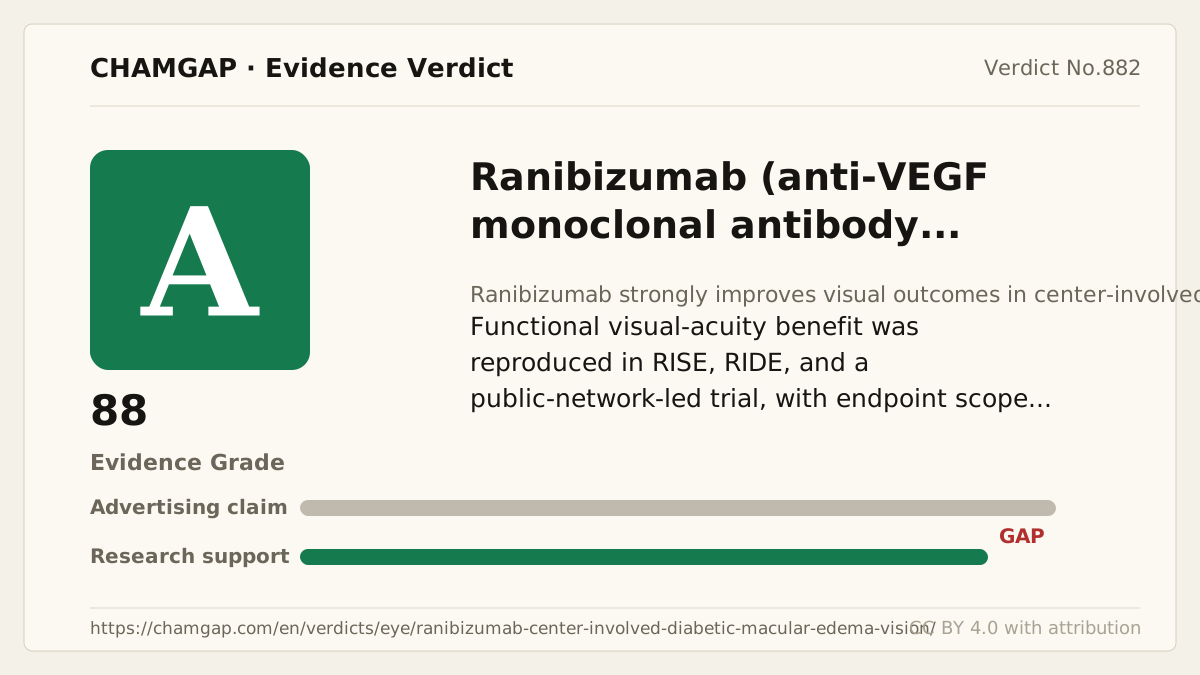
[Chamgap] Ranibizumab x improved vision and reduced vision loss in center-involved diabetic macular edema — Evidence Grade A·88. 3 cited sources checked. Source: https://chamgap.com/en/verdicts/eye/ranibizumab-center-involved-diabetic-macular-edema-vision/ · CC BY 4.0CC BY 4.0 — free to use with attribution; do not distort grades, numbers, or verdict meaning.
What this document does and does not do
Chamgap is an information source. It reports what research has and has not confirmed; it does not tell readers what to take or buy. That decision belongs to readers and, when needed, medical or legal professionals. This verdict reflects literature available up to the search date and may change as new research appears. Nothing here is medical advice.