
Focal or grid retinal laser photocoagulation,
does it really help with Prevention of moderate vision loss in clinically significant diabetic macular edema?
research showsFocal or grid laser photocoagulation is rated A because the large randomized ETDRS trial reduced the three-year risk of moderate vision loss in clinically significant diabetic macular edema by about half, from approximately 24% to 12%. This macular procedure differs from panretinal photocoagulation and primarily prevents loss rather than improves vision. Anti-VEGF therapy is now preferred for center-involving disease, but the procedure-specific hard functional endpoint remains valid.
ads claimClaims that laser fully restores vision or is superior to modern injections in every form of diabetic macular edema overstate the evidence. The established outcome is a lower risk of vision loss in appropriately selected eyes.
Useful facts when choosing a product
- Focal or grid laser selectively treats leaking microaneurysms and edematous retina near the macula, unlike the broad panretinal photocoagulation used for proliferative diabetic retinopathy.
- Intravitreal anti-VEGF therapy is now generally first line for center-involving diabetic macular edema, while laser remains relevant for non-center-involving, combination, or later-line settings.
- Expanding laser scars, central scotoma, altered color or contrast vision, and rare accidental foveal injury can occur; optical coherence tomography and detailed retinal assessment guide treatment and retreatment.
Chamgap Semantic Classification Code
Candidate index · review held
P.focal-or-grid-retinal-laser-photocoagulation.ophthalmic.moderate-vision-loss-in-clinically-significant-diabetic-macular-edema.prevent.noneProcedures, devices and tests > Focal or grid retinal laser photocoagulation > Ophthalmic > moderate vision loss in clinically significant diabetic macular edema > Occurrence-prevention claim > No intervention
An automated migration candidate, not an issued permanent code; exact claim scope remains under review. This machine-generated migration candidate helps retrieval but is not a permanent assignment. The original verdict ID and URL remain authoritative.
What the research actually shows
ETDRS Report 1 randomized 754 eyes with macular edema and mild to moderate diabetic retinopathy to focal argon laser and 1,490 eyes to deferral. In clinically significant macular edema, moderate vision loss over three years fell from about 24% to 12%, and persistent edema was less frequent. Later DRCR.net trials changed modern sequencing by showing better visual improvement with anti-VEGF therapy in center-involving disease.
Why this is classified as A (90)
A large independent landmark trial showed a procedure-specific halving of moderate vision loss over three years, yielding A with 90 points.
Counterpoint. Current treatment selection should be based on center involvement, optical coherence tomography, vision, and anti-VEGF response rather than assuming that historical efficacy always means first-line use.
Rejudgment record. New verdict — Applied the direct procedure-specific hard functional endpoint from the large independent ETDRS randomized deferred-treatment comparison, which reduced three-year moderate vision loss by approximately half
Sub-claim grades by effect
This ingredient is marketed for several effects. A single overall grade blends strong and weak claims together, so each effect is graded separately here. The overall grade reflects the strongest disconfirming or core claim.
| Effect (sub-claim) | Grade | Basis |
|---|---|---|
| Prevention of moderate vision loss | A | Demonstrated in the direct randomized three-year ETDRS visual endpoint. |
| Halving of vision-loss risk | A | Risk fell from approximately 24% to 12% in clinically significant edema. |
| Reduction of persistent macular edema | B | ETDRS also reduced persistent anatomic edema, a supporting endpoint below the visual outcome. |
Cross-check — AI research and Codex final gate
Evidence Table
| Study | Design | Sample | Funding | Endpoint | Result | Weight |
|---|---|---|---|---|---|---|
| Early Treatment Diabetic Retinopathy Study Research Group. ETDRS Report 1. 1985 | Multicenter randomized clinical trial | 754 treated eyes and 1,490 deferred eyes | United States National Eye Institute | Moderate vision loss at three years | Risk fell from about 24% to 12% in clinically significant diabetic macular edema. | Landmark direct hard functional endpoint |
| Diabetic Retinopathy Clinical Research Network (Elman MJ et al.). 2010 | Multicenter randomized comparative-effectiveness trial | 691 patients and 854 eyes | United States NEI and NIDDK | One-year vision and optical coherence tomography | Ranibizumab regimens produced better vision outcomes than laser alone in center-involving disease. | Modern treatment-sequencing context |
| British Multicentre Study Group. Xenon-arc photocoagulation trial. 1983 | British multicenter randomized controlled trial with untreated fellow-eye control | 99 patients with one treated eye and the fellow eye as control | Not ascertained | Visual acuity change and blindness over five to seven years | Mean acuity worsened by less than one line in treated eyes versus more than two lines in controls (P<0.01); blindness occurred in the control eye only in 26 patients versus the treated eye only in 6 (P<0.01). | Independent same-direction replication by different investigators, using xenon-arc technique at smaller scale |
Receipt — 3 References
All 3 cited sources were verified for existence at the original page (as of 2026-08-11).
Final verification and publication gate: Codex · Evidence date: 2026-08-11 · Corrections: none
Cite this verdict
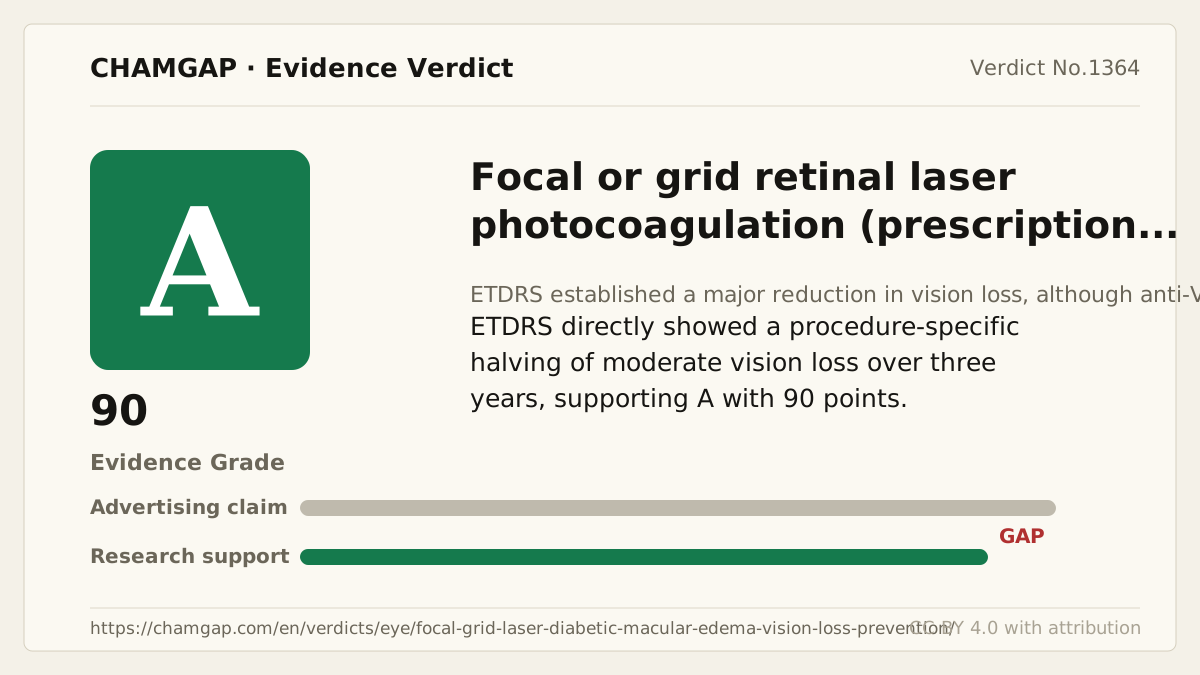
[Chamgap] Focal or grid retinal laser photocoagulation x prevention of moderate vision loss in clinically significant diabetic macular edema — Evidence Grade A·90. 3 cited sources checked. Source: https://chamgap.com/en/verdicts/eye/focal-grid-laser-diabetic-macular-edema-vision-loss-prevention/ · CC BY 4.0CC BY 4.0 — free to use with attribution; do not distort grades, numbers, or verdict meaning.
What this document does and does not do
Chamgap is an information source. It reports what research has and has not confirmed; it does not tell readers what to take or buy. That decision belongs to readers and, when needed, medical or legal professionals. This verdict reflects literature available up to the search date and may change as new research appears. Nothing here is medical advice.