
Repeated low-level red-light therapy,
does it really help with Slowed axial elongation and refractive progression in children with myopia?
research showsRepeated low-level red-light therapy receives C because randomized trials show a large short-term reduction in axial elongation and refractive progression in children with myopia. In a Chinese multicenter trial, 12-month axial elongation was 0.13 mm with RLRL and 0.38 mm with single-vision spectacles, while refractive progression was -0.20 D and -0.79 D, respectively. A separate 336-participant single-center trial reproduced the direction, but the outcomes are surrogates rather than future vision loss, evidence is concentrated in China and particular devices, and participants could not be masked. Rebound after cessation, device-specific optical output, a reported case of retinal injury, and the absence of long-term pediatric retinal safety prevent a B grade.
ads claimMarketing simplifies the evidence into reversing axial length, curing myopia, and guaranteeing safety with six minutes per day. The evidence instead concerns short-term surrogate suppression in Chinese children using particular wavelengths, outputs, and devices; permanent treatment, maintenance after stopping, equivalent performance across devices, and retinal safety are not established.
Useful facts when choosing a product
- RLRL commonly uses a desktop device to expose both eyes to approximately 650-nm red light for 3 minutes twice daily at least 4 hours apart; clinical trials generally used treatment 5 days per week.
- Devices differ in laser versus light-emitting-diode source, irradiance, beam uniformity, retinal dose through the pupil, and safety classification, so results from one product cannot be transferred automatically to another.
- Monitoring should include corrected vision, axial length, cycloplegic refraction, and retinal examination with imaging such as optical coherence tomography. A scotoma, persistent afterimage, or loss of vision warrants immediate cessation and ophthalmic assessment.
- RLRL is distinct from defocus-incorporated multiple-segment spectacle lenses, orthokeratology, and low-dose atropine. Substitution or combination requires a separate comparison of each treatment's evidence and harms.
Chamgap Semantic Classification Code
Candidate index · review held
P.repeated-low-level-red-light-therapy.ophthalmic.slowed-axial-elongation-and-refractive-progression-with-myopia.assess.UNKProcedures, devices and tests > Repeated low-level red-light therapy > Ophthalmic > Slowed axial elongation and refractive progression with myopia > Association or change assessment > Unknown
An automated migration candidate, not an issued permanent code; exact claim scope remains under review. This machine-generated migration candidate helps retrieval but is not a permanent assignment. The original verdict ID and URL remain authoritative.
What the research actually shows
The five-center trial by Jiang and colleagues randomized 264 children aged 8 to 13 years to RLRL plus single-vision spectacles or spectacles alone and analyzed 246. A 650-nm light was given for 3 minutes twice daily, 5 days per week, and significantly reduced both 12-month axial and refractive progression, although participants knew their treatment. The single-center trial by Cao and colleagues randomized 336 children aged 6 to 12 years and reproduced large 12-month changes in axial length and spherical equivalent with 3-minute sessions twice daily. The two-year follow-up by Xiong and colleagues found sustained suppression with continued treatment but rebound after cessation, including second-year axial elongation of 0.42 mm and refractive progression of -0.91 D in the discontinuation group; post-trial selection after randomization ended reduces long-term certainty. Serious retinal injury was uncommon in trials, but Liu and colleagues reported bilateral visual loss and retinal injury in a 12-year-old after 5 months of use, while the 2026 device measurements by Ostrin and Schill found that some laser units reached ANSI exposure limits within 1.4 to 2.8 seconds for a 7-mm pupil.
Why this is classified as C (55)
The 264-participant multicenter trial found 12-month between-group differences of 0.26 mm in axial elongation and 0.59 D in refractive progression, and a 336-participant trial reproduced the direction. Outcomes remain surrogates, however, and evidence is concentrated in Chinese populations and particular unmasked devices. Rebound, a retinal-injury case, device-specific safety-limit differences, and no long-term vision-preservation evidence produce C with 55 points.
Counterpoint. For a child with rapidly progressive myopia despite standard management, a pediatric ophthalmologist may cautiously consider a specific device after reviewing its authorization, output, independent safety testing, and retinal-monitoring plan. Unsupervised long-term use of a self-purchased device exceeds the evidence.
Rejudgment record. New verdict — Accepted the large reduction in axial and refractive progression across multiple randomized trials, but applied the rule ① ceiling of C because outcomes are surrogates, evidence is concentrated in China and particular devices, participant masking is limited, rebound follows cessation, retinal injury has been reported, optical safety differs across devices, and long-term vision-preservation evidence is absent
Sub-claim grades by effect
This ingredient is marketed for several effects. A single overall grade blends strong and weak claims together, so each effect is graded separately here. The overall grade reflects the strongest disconfirming or core claim.
| Effect (sub-claim) | Grade | Basis |
|---|---|---|
| Slowed axial elongation in children with myopia | C | Multiple randomized trials replicated a large reduction, but axial length is a surrogate and long-term preservation of vision has not been established. |
| Slowed refractive progression in children with myopia | C | Twelve-month spherical-equivalent effects are consistent, but evidence is concentrated in China and particular devices with limited participant masking. |
| Maintenance of myopia control after treatment cessation | C | Rebound axial and refractive progression after cessation leaves durability and the optimal stopping strategy unestablished. |
Cross-check — AI research and Codex final gate
Evidence Table
| Study | Design | Sample | Funding | Endpoint | Result | Weight |
|---|---|---|---|---|---|---|
| Jiang Y et al. 2022 multicenter randomized trial | Multicenter randomized parallel-group single-masked controlled trial | 264 children with myopia randomized and 246 analyzed | Chinese public research support; a device-related patent interest was disclosed by an investigator | Twelve-month change in axial length and cycloplegic spherical equivalent refraction | Axial elongation was 0.13 mm with RLRL versus 0.38 mm with single-vision spectacles, and refractive progression was -0.20 D versus -0.79 D. | Pivotal multicenter short-term efficacy evidence |
| Cao K et al. 2024 randomized clinical trial | Single-center single-masked randomized controlled trial | 336 children aged 6 to 12 years | Public Capital Health Research and Development of Special funding; authors reported no conflicts of interest | Six- and twelve-month changes in cycloplegic spherical equivalent and axial length | At 12 months, axial-length change was -0.11 mm with RLRL versus +0.26 mm in controls, and refractive change was +0.24 D versus -0.65 D. | Replication of a large effect at one center |
| Xiong R et al. 2022 two-year post-trial follow-up | Selective two-year post-trial follow-up after a randomized trial | 138 of 199 eligible children attended and 114 were analyzed | Chinese public research support; device-related patents and company equity interests were disclosed | Two-year axial and refractive changes and rebound after treatment cessation | Suppression persisted with continued treatment, while the cessation group showed rebound with second-year axial change of +0.42 mm and refractive change of -0.91 D. | Durability and rebound evidence with possible selection bias |
| Liu H et al. 2023 retinal-injury case report | Case report | One 12-year-old child with myopia | No specific study funding reported in the article | Vision and retinal structure after 5 months of RLRL use | Bilateral visual loss and retinal injury were reported, but one case cannot estimate incidence or risk across all devices. | Serious safety warning signal |
| Ostrin LA and Schill AW. 2026 device safety evaluation | Independent optical-output and ANSI safety evaluation of four commercial red-light devices | Four commercial devices | University-based quality-improvement evaluation; author consulting and research relationships were disclosed | Retinal irradiance by pupil size and time to ANSI exposure safety limits | Some laser devices reached safety limits within 1.4 to 2.8 seconds for a 7-mm pupil, far shorter than the recommended 180-second exposure. | Key device-specific optical-safety evidence |
Receipt — 5 References
All 5 cited sources were verified for existence at the original page (as of 2026-07-24).
Final verification and publication gate: Codex · Evidence date: 2026-07-24 · Corrections: none
Cite this verdict
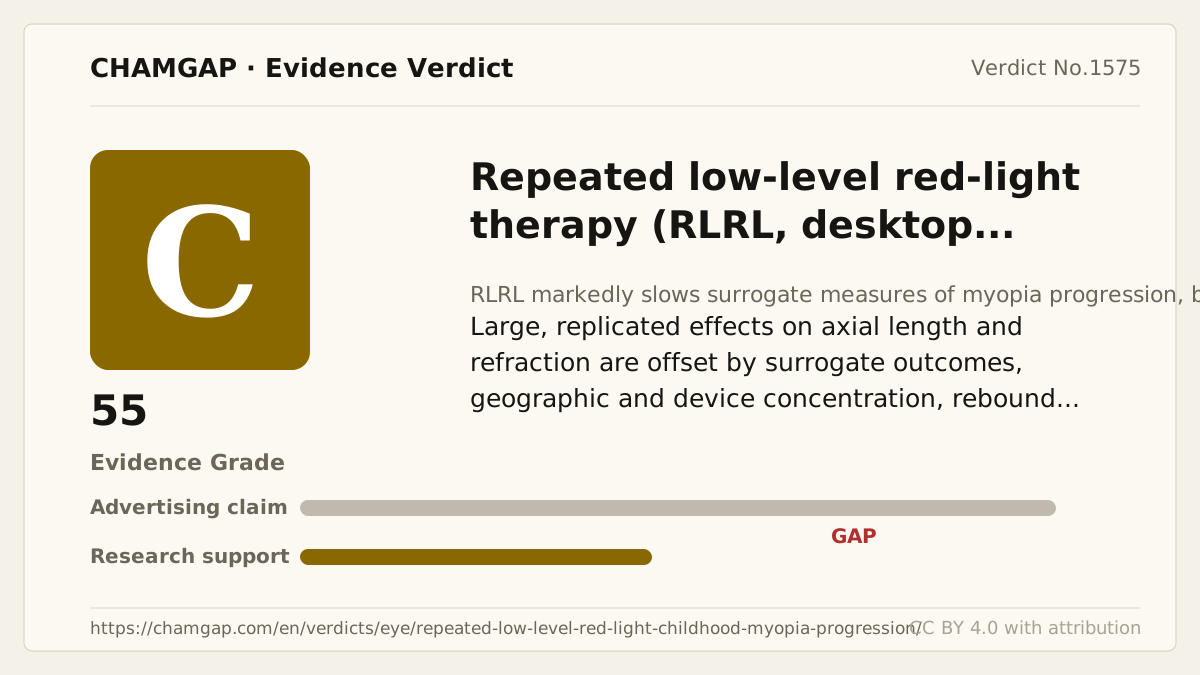
[Chamgap] Repeated low-level red-light therapy x slowed axial elongation and refractive progression in children with myopia — Evidence Grade C·55. 5 cited sources checked. Source: https://chamgap.com/en/verdicts/eye/repeated-low-level-red-light-childhood-myopia-progression/ · CC BY 4.0CC BY 4.0 — free to use with attribution; do not distort grades, numbers, or verdict meaning.
What this document does and does not do
Chamgap is an information source. It reports what research has and has not confirmed; it does not tell readers what to take or buy. That decision belongs to readers and, when needed, medical or legal professionals. This verdict reflects literature available up to the search date and may change as new research appears. Nothing here is medical advice.