
Oral lactoferrin 350 mg/day added from the day after small-incision cataract surgery,
does it really help with Improved tear-breakup time, Schirmer testing, and dry-eye symptoms at 60 days after surgery?
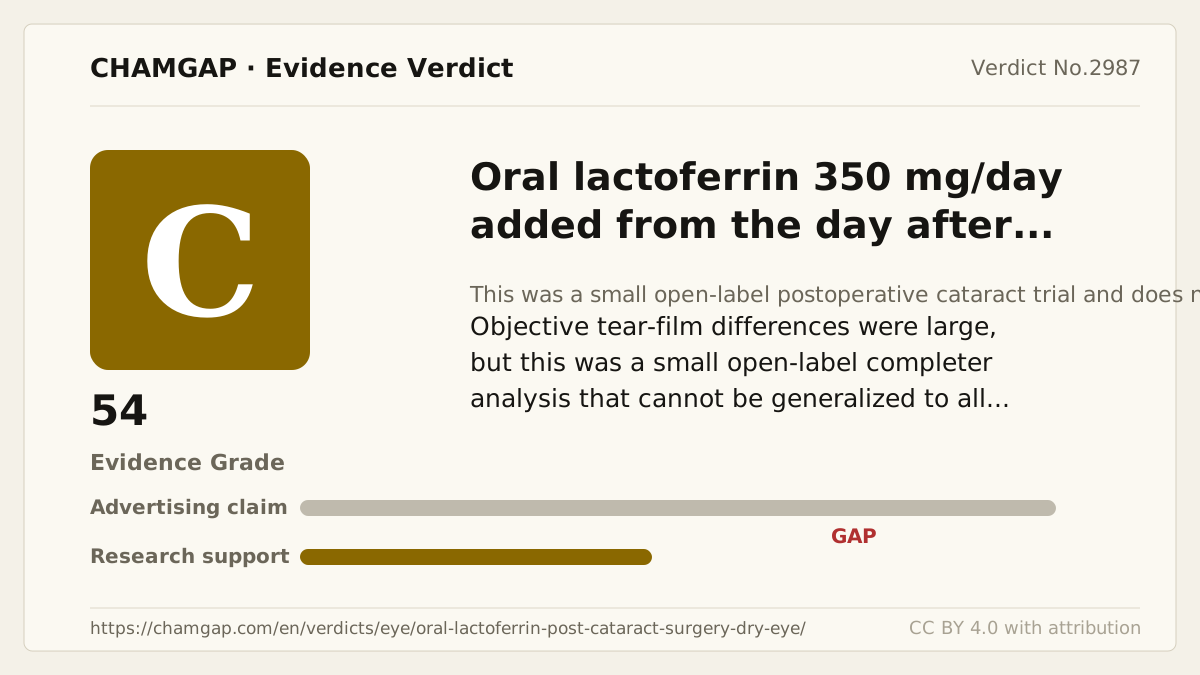
research showsGrade C. In an open-label trial randomizing 64 cataract patients without pre-existing dry eye and analyzing 58 completers, 60-day tear-breakup time was 13.9 seconds with lactoferrin versus 7.86 seconds with control, and Schirmer testing was 30.9 versus 15.86 mm. The differences were large, but there was no placebo or masking, only completers were analyzed, and the population had postoperative rather than general chronic dry eye.
ads claimSaying that lactoferrin treats all dry eye erases the postoperative population and the open-label no-placebo design.
Useful facts when choosing a product
- The tested oral dose was 350 mg/day.
- Treatment began after small-incision cataract surgery and lasted 60 days.
- No multivitamin or omega-3 combination was tested.
Chamgap Semantic Classification Code
Permanent code issued
S.lactoferrin.oral.postoperative-dry-eye.improve.standard-careSupplements and nutraceuticals > Oral lactoferrin 350 mg/day added from the day after small-incision cataract surgery > Oral > Improved tear-breakup time, Schirmer testing, and dry-eye symptoms at 60 days after surgery > Improvement claim > Standard care
Codex retrospectively verified the principal intervention, delivery, population, endpoint, and comparator from the existing reviewed verdict and issued a permanent semantic code. Secondary outcomes on the page are not transferred as separate claims. The code identifies the intervention and claim; it never contains the evidence grade, score, or safety result.
Exact Claim Classification
These independent facets prevent evidence from different forms, routes, populations, effects, and comparators from being mixed.
| Intervention class | S · Supplement or nutraceutical |
|---|---|
| Canonical ingredient or intervention | Oral lactoferrin 350 mg/day added from the day after small-incision cataract surgery |
| Source or part used | Single supplement ingredient specified in the verdict; unreported manufacturing details remain unverified |
| Formulation or processing | Oral lactoferrin 350 mg/day added from the day after small-incision cataract surgery |
| Route | Oral |
| Dose | Oral lactoferrin 350 mg/day added from the day after small-incision cataract surgery |
| Duration | 60 days |
| Population | 64 randomized, 58 completers analyzed, 60 days |
| Effect or condition | Improved tear-breakup time, Schirmer testing, and dry-eye symptoms at 60 days after surgery |
| Primary endpoint | Tear-breakup time, Schirmer test 1, and OSDI |
| Comparator | Standard care |
| Duplicate-detection key | lactoferrin|oral|64 randomized, 58 completers analyzed, 60 days|postoperative-dry-eye|60 days |
What the research actually shows
Sixty-four small-incision cataract patients were simply randomized 32/32 to routine postoperative care with or without lactoferrin 350 mg/day. Six did not complete follow-up, leaving 28 and 30 analyzed. At day 60, tBUT was 7.86 versus 13.9 seconds, Schirmer was 15.86 versus 30.9 mm, and at least mild OSDI symptoms occurred in 42.8% versus 26.6%.
Why this is classified as C (54)
Large objective differences provide a human efficacy signal, but completer analysis, n=64, 60 days, open-label no-placebo design, and a narrow postoperative population give C with 54 points.
Counterpoint. No participant reported diarrhea, loss of appetite, rash, or constipation during the study.
Rejudgment record. Codex PMC full-text, bibliographic, and scoring cross-check — Accepted large tBUT and Schirmer effect sizes and independent randomization while accounting for completer analysis, n=64, 60 days, open-label no-placebo design, and postoperative population restriction
| Endpoint | S | Surrogate marker - laboratory or imaging measures |
| Replication | R1 | Single confirmatory trial |
| Independence | I2 | Decisive evidence is publicly or non-profit funded |
| Effect size | E+ | Meets the clinically important threshold |
Stored derived and displayed grades match; this is not a current recalculation or validity check (C).
Sub-claim grades by effect
This ingredient is marketed for several effects. A single overall grade blends strong and weak claims together, so each effect is graded separately here. The overall grade reflects the strongest disconfirming or core claim.
| Effect (sub-claim) | Grade | Basis |
|---|---|---|
| Improved tear-film tests 60 days after cataract surgery | C | Both tBUT and Schirmer differed substantially. |
| Treatment of chronic dry-eye disease in general | ? | Patients with pre-existing dry eye were excluded. |
Cross-check — AI research and Codex final gate
Evidence Table
| Study | Design | Sample | Funding | Endpoint | Result | Weight |
|---|---|---|---|---|---|---|
| Devendra J and Singh S. 2015 | Single-center nonblinded simple-randomized parallel trial | 64 randomized, 58 completers analyzed, 60 days | No financial or competing interests reported | Tear-breakup time, Schirmer test 1, and OSDI | Day-60 tBUT 13.9 vs 7.86 seconds; Schirmer 30.9 vs 15.86 mm; at least mild OSDI symptoms 26.6% vs 42.8% | Large objective signal in an open-label completer analysis |
Receipt — 1 References
All 1 cited sources were verified for existence at the original page (as of 2026-09-07).
Final verification and publication gate: Codex · Evidence date: 2026-09-07 · Corrections: none
Cite this verdict
[Chamgap] Oral Lactoferrin for Dry Eye at 60 Days After Cataract Surgery — Evidence Grade C·54. 1 cited sources checked. Source: https://chamgap.com/en/verdicts/eye/oral-lactoferrin-post-cataract-surgery-dry-eye/ · CC BY 4.0CC BY 4.0 — free to use with attribution; do not distort grades, numbers, or verdict meaning.
What this document does and does not do
Chamgap is an information source. It reports what research has and has not confirmed; it does not tell readers what to take or buy. That decision belongs to readers and, when needed, medical or legal professionals. This verdict reflects literature available up to the search date and may change as new research appears. Nothing here is medical advice.