
Nicotinamide,
does it really help with High-dose supplementation to slow long-term visual-field loss in open-angle or normal-tension glaucoma?
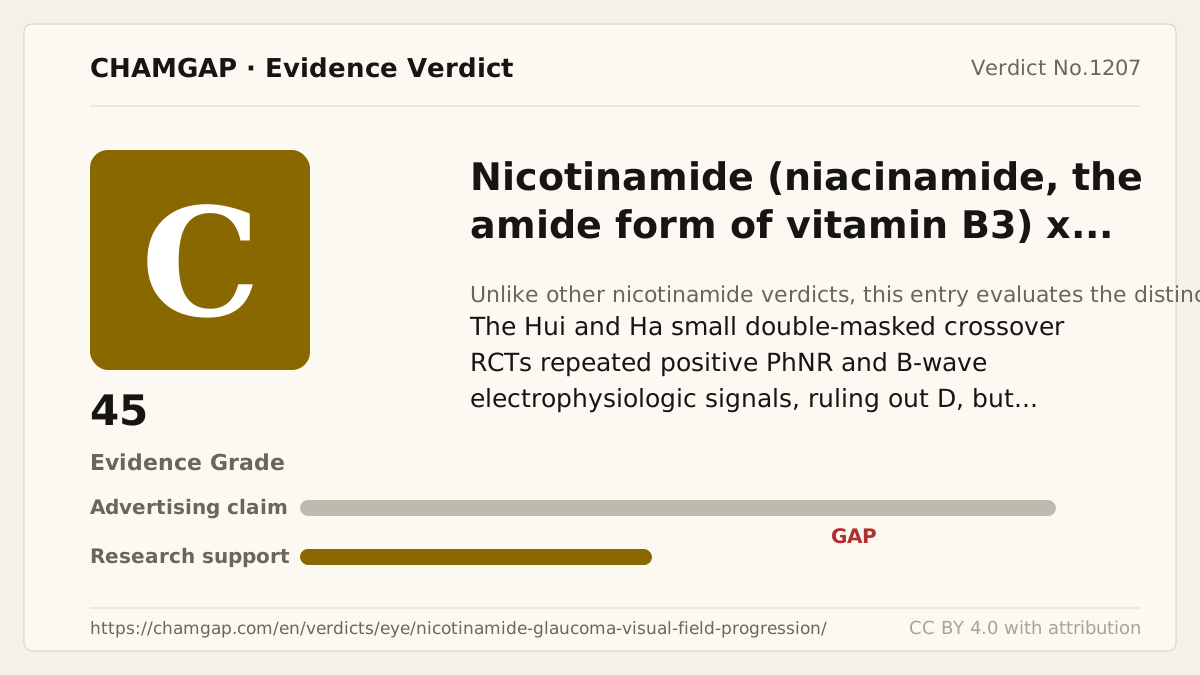
research showsLong-term visual-field preservation has not been demonstrated. Two short crossover trials enrolling 53 to 57 participants found small improvements in retinal electrophysiology, but global standard visual-field indices did not improve significantly and long-term phase 3 results are not yet available.
ads claimClaims that vitamin B3 protects the optic nerve and stops glaucoma progression extrapolate animal and mechanistic evidence plus short-term surrogate signals into unproven long-term visual-field preservation.
Useful facts when choosing a product
- Nicotinamide is the amide form of vitamin B3, but the glaucoma trial doses of 1 to 3 g daily are far above ordinary nutritional supplementation.
- Participants continued established intraocular-pressure-lowering treatment, so nicotinamide did not replace standard glaucoma therapy.
- The published small trials used 12-week crossover designs and were not designed to establish long-term prevention of visual-field loss.
- Nicotinamide is not approved to treat glaucoma, and gram-level dosing warrants clinician review of liver risk.
Chamgap Semantic Classification Code
Candidate index · review held
S.nicotinamide.UNK.high-dose-supplementation-to-slow-long-term-visual-field-loss-in-open-angle-or-normal-tension-glaucoma.assess.placeboSupplements and nutraceuticals > Nicotinamide > Unknown > High-dose supplementation to slow long-term visual-field loss in open-angle or normal-tension glaucoma > Association or change assessment > Placebo
An automated migration candidate, not an issued permanent code; exact claim scope remains under review. This machine-generated migration candidate helps retrieval but is not a permanent assignment. The original verdict ID and URL remain authoritative.
What the research actually shows
A 57-participant crossover RCT in open-angle glaucoma and a 53-participant crossover RCT in normal-tension glaucoma found improvements in selected electroretinographic measures such as the photopic negative response. Both lasted 12 weeks, used no washout period, and found no significant between-group benefit in global visual-field indices such as mean deviation, pattern standard deviation, or visual-field index. The phase 3 NAMinG trial of long-term visual-field mean deviation has not reported results.
Why this is classified as C (45)
Repeated PhNR and B-wave signals in the small double-masked Hui and Ha crossover RCTs support C rather than D. The no-washout crossover designs, short-term surrogate endpoints, null MD, PSD, and VFI measures, and unavailable phase 3 results limit the verdict to C with 45 points.
Counterpoint. The grade could rise if the ongoing large long-term trial reproduces preservation of visual-field mean deviation. If electrophysiologic changes fail to translate into slower visual-field progression, the clinical importance of the current signal would fall.
Rejudgment record. Cross-check applied — The grade is C because small double-masked RCTs produced positive surrogate electroretinographic signals, while standard visual-field outcomes and long-term progression remain unconfirmed.
Sub-claim grades by effect
This ingredient is marketed for several effects. A single overall grade blends strong and weak claims together, so each effect is graded separately here. The overall grade reflects the strongest disconfirming or core claim.
| Effect (sub-claim) | Grade | Basis |
|---|---|---|
| Slowing long-term visual-field loss | C | Short-term electrophysiologic signals are positive, but no reported result directly establishes slower long-term visual-field progression. |
| Short-term improvement in retinal electrophysiologic function | C | Two small crossover RCTs found improvement in selected measures such as the photopic negative response. |
| Improvement in global standard automated-perimetry indices | D | Across the two nicotinamide-only trials, global between-group differences in mean deviation, pattern standard deviation, and visual-field index were not significant. |
Cross-check — AI research and Codex final gate
Evidence Table
| Study | Design | Sample | Funding | Endpoint | Result | Weight |
|---|---|---|---|---|---|---|
| Hui et al., nicotinamide crossover randomized trial in open-angle glaucoma (2020) | Double-masked randomized placebo-controlled crossover trial; 12 weeks per treatment sequence with no washout | 57 randomized; 49 completed | Supported by the Ophthalmic Research Institute of Australia and charitable foundations; no industry funding was reported | Photopic negative-response amplitude and parameters, plus standard automated-perimetry mean deviation | The electroretinographic maximum-amplitude difference was 1.35 µV (95% CI 0.159 to 2.551; p=0.027), while the overall between-group visual-field mean-deviation difference was null at 0.10 dB (95% CI -0.328 to 0.533; p=0.633). | A credible positive small signal on a short-term surrogate, not direct evidence of long-term visual-field preservation. |
| Ha et al., nicotinamide crossover randomized trial in normal-tension glaucoma (2026) | Double-masked randomized placebo-controlled crossover trial; 12 weeks per condition with no washout | 53 enrolled and randomized | Funded by Hanlim Pharm; the article reported no funder role in design, analysis, or writing | Photopic negative response and B-wave amplitudes; visual-field mean deviation, pattern standard deviation, and visual-field index | Changes in photopic negative-response peak-to-trough and B-wave amplitude favored nicotinamide (p=0.045 and p=0.032), but mean deviation, pattern standard deviation, and visual-field index showed no significant between-group differences. | Replicates an electrophysiologic signal in another population, but is short, industry-funded, and null on clinical visual-field indices. |
| NAMinG phase 3 clinical trial (NCT05405868) | Randomized masked placebo-controlled long-term clinical trial | Target enrollment 496; no results reported | Led by University College London and the NIHR | Change in visual-field mean deviation at 27 months | No long-term efficacy results were posted as of 2026-07-23. | Directly addresses long-term visual-field preservation, but pending results cannot support efficacy. |
| American Glaucoma Society and American Academy of Ophthalmology nicotinamide position statement (2025) | Professional-society evidence review and safety position statement | Not applicable | Professional-society statement | State of glaucoma evidence and hepatotoxicity of high-dose nicotinamide | Long-term glaucoma efficacy was not established, and doses of 3 g/day or more were advised against outside clinical trials. | Not efficacy confirmation, but supports the current clinical uncertainty and high-dose safety boundary. |
Receipt — 4 References
All 4 cited sources were verified for existence at the original page (as of 2026-07-23).
Final verification and publication gate: Codex · Evidence date: 2026-07-23 · Corrections: none
Cite this verdict
[Chamgap] Does nicotinamide slow visual-field loss in glaucoma? — Evidence Grade C·45. 4 cited sources checked. Source: https://chamgap.com/en/verdicts/eye/nicotinamide-glaucoma-visual-field-progression/ · CC BY 4.0CC BY 4.0 — free to use with attribution; do not distort grades, numbers, or verdict meaning.
What this document does and does not do
Chamgap is an information source. It reports what research has and has not confirmed; it does not tell readers what to take or buy. That decision belongs to readers and, when needed, medical or legal professionals. This verdict reflects literature available up to the search date and may change as new research appears. Nothing here is medical advice.