
Marine omega-3 EPA and DHA,
does it really help with Improvement of dry-eye symptoms and tear-film status?
research showsMarine omega-3 EPA and DHA are rated D for treating dry eye. The publicly funded DREAM trial randomized 535 participants, and its prespecified primary endpoint was mean OSDI change across months 6 and 12. The multiply imputed intention-to-treat difference was -1.9 points (95% CI -5.0 to 1.1), P=0.21. A separate nonimputed sensitivity analysis of 499 participants found -1.4 points (-4.6 to 1.8), P=0.40. Both confidence intervals exclude the 10-point OSDI minimal clinically important difference.
ads claimAn anti-inflammatory mechanism or increased blood omega-3 level must not be converted into confirmed treatment of dryness, irritation, or tear-film dysfunction.
Useful facts when choosing a product
- DREAM used EPA 2,000 mg plus DHA 1,000 mg, totaling 3 g daily, a higher dose than many retail products.
- Fish-oil products differ in EPA-to-DHA ratio, oxidation, and purity, complicating comparisons.
- Persistent dry eye warrants assessment for meibomian-gland disease, medicines, autoimmune disease, contact-lens effects, and other causes.
Chamgap Semantic Classification Code
Candidate index · review held
S.marine-omega-3-epa-and-dha-from-fish-oil-supplements.UNK.dry-eye-symptoms-and-tear-film-status.improve.placeboSupplements and nutraceuticals > Marine omega-3 EPA and DHA from fish-oil supplements > Unknown > dry-eye symptoms and tear-film status > Improvement claim > Placebo
An automated migration candidate, not an issued permanent code; exact claim scope remains under review. This machine-generated migration candidate helps retrieval but is not a permanent assignment. The original verdict ID and URL remain authoritative.
What the research actually shows
DREAM assigned 535 adults with moderate-to-severe dry eye in a 2:1 ratio to EPA 2,000 mg plus DHA 1,000 mg daily or refined olive-oil placebo. The prespecified primary endpoint was mean OSDI change across months 6 and 12. Multiply imputed intention-to-treat analysis found -1.9 points (95% CI -5.0 to 1.1), P=0.21; the separate 499-person nonimputed sensitivity analysis found -1.4 points (-4.6 to 1.8), P=0.40. Both confidence intervals exclude the 10-point threshold, and all major signs failed.
Why this is classified as D (27)
A large independent publicly funded trial failed on its direct symptom primary endpoint and all major signs, with an effect far below the minimal clinically important difference. Heterogeneous small positive trials remain, so D with 27 points is more appropriate than F.
Counterpoint. A small benefit in a specific subtype or formulation remains possible, but DREAM found none in prespecified subgroups.
Rejudgment record. Cross-check applied — The publicly funded DREAM trial randomized 535 participants, and its prespecified primary endpoint was mean OSDI change across months 6 and 12. Multiply imputed intention-to-treat analysis failed at -1.9 points (95% CI -5.0 to 1.1), P=0.21; a separate 499-person nonimputed sensitivity analysis also failed at -1.4 points (-4.6 to 1.8), P=0.40. Both confidence intervals exclude the 10-point minimal clinically important difference; heterogeneous small positive trials prevent F
Sub-claim grades by effect
This ingredient is marketed for several effects. A single overall grade blends strong and weak claims together, so each effect is graded separately here. The overall grade reflects the strongest disconfirming or core claim.
| Effect (sub-claim) | Grade | Basis |
|---|---|---|
| Improvement of moderate-to-severe dry-eye symptoms | D | The large DREAM trial failed on its OSDI primary endpoint and fell far below the minimal clinically important difference. |
| Improvement of tear break-up time and tear production | D | Both tear break-up time and Schirmer testing were null versus placebo in DREAM. |
| Additional symptom benefit from continued use for two years | D | The OSDI primary endpoint failed in the 43-person rerandomized extension. |
Cross-check — AI research and Codex final gate
Evidence Table
| Study | Design | Sample | Funding | Endpoint | Result | Weight |
|---|---|---|---|---|---|---|
| DREAM Study Research Group 2018 | Twenty-seven-center randomized double-blind placebo-controlled 12-month trial | 535 randomized; 499 in the nonimputed sensitivity analysis (329 versus 170) | United States National Eye Institute cooperative agreements U10EY022879 and U10EY022881 plus NIH supplements; not manufacturer led | Prespecified primary mean change in OSDI averaged across months 6 and 12 | Multiply imputed intention-to-treat -1.9 points (95% CI -5.0 to 1.1), P=0.21; 499-person nonimputed sensitivity result -1.4 (-4.6 to 1.8), P=0.40. Both exclude the 10-point minimal clinically important difference. | Pivotal large independent counterevidence |
| Hussain M et al. 2020 | Rerandomized double-blind withdrawal extension of the DREAM active group | 43 rerandomized and analyzed (22 continued active and 21 switched to placebo) | United States National Eye Institute and NIH Office of Dietary Supplements support; not manufacturer led | Primary change in OSDI from month 12 to month 24 | Primary endpoint failed: between-group difference -0.6 points (95% CI -10.7 to 9.5), P=0.91. | Small extension replication |
Receipt — 2 References
All 2 cited sources were verified for existence at the original page (as of 2026-07-24).
Final verification and publication gate: Codex · Evidence date: 2026-07-24 · Corrections: none
Cite this verdict
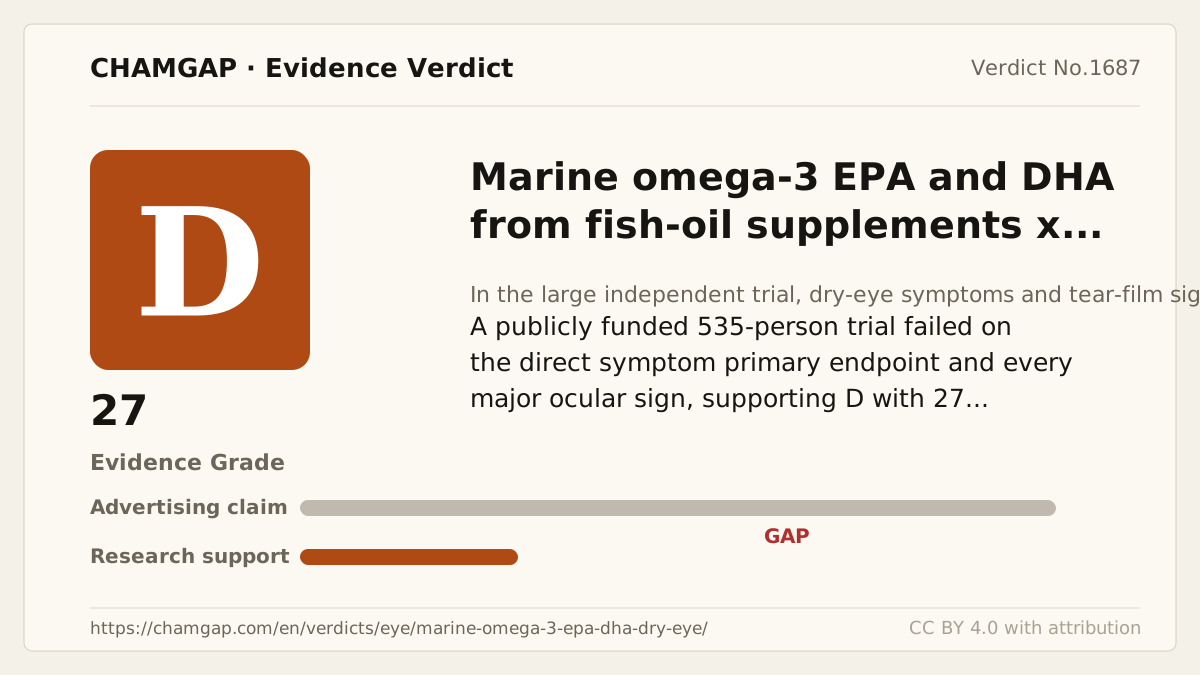
[Chamgap] Marine omega-3 EPA and DHA x improved dry-eye symptoms and tear film — Evidence Grade D·27. 2 cited sources checked. Source: https://chamgap.com/en/verdicts/eye/marine-omega-3-epa-dha-dry-eye/ · CC BY 4.0CC BY 4.0 — free to use with attribution; do not distort grades, numbers, or verdict meaning.
What this document does and does not do
Chamgap is an information source. It reports what research has and has not confirmed; it does not tell readers what to take or buy. That decision belongs to readers and, when needed, medical or legal professionals. This verdict reflects literature available up to the search date and may change as new research appears. Nothing here is medical advice.