
Lutein-zeaxanthin botanical formula,
does it really help with Reduced digital eye fatigue in adults using video displays?
research showsThe grade is C with 46 points. A 360-person randomized trial analyzed only 303 completers, and eye-fatigue scores were lower than placebo at both 45 and 90 days for all three doses. However, no validated minimum important difference exists and the adjusted between-group effect and variance were not reported, so magnitude cannot be judged.
ads claimContaining lutein and zeaxanthin is a composition fact, but this trial evaluated one exact five-component formula. It does not establish that Korean lutein products contain the same blackcurrant, chrysanthemum, and goji doses.
Useful facts when choosing a product
- The intervention combined lutein ester and zeaxanthin with water extracts of blackcurrant, chrysanthemum, and goji berry in seven chewable tablets daily.
- The highest dose supplied 14 mg lutein, 2.8 mg zeaxanthin, 233 mg blackcurrant, 175 mg chrysanthemum, and 175 mg goji berry.
- Verdict 1107 is D with 25 points for the same ingredients in cataract, while verdict 380 is C with 40 points for blackcurrant anthocyanins in VDT eye fatigue.
Chamgap Semantic Classification Code
Candidate index · review held
S.botanical-formula-containing-lutein-ester.UNK.digital-eye-fatigue-using-video-displays.reduce.placeboSupplements and nutraceuticals > botanical formula containing lutein ester > Unknown > digital eye fatigue using video displays > Reduction claim > Placebo
An automated migration candidate, not an issued permanent code; exact claim scope remains under review. This machine-generated migration candidate helps retrieval but is not a permanent assignment. The original verdict ID and URL remain authoritative.
What the research actually shows
A single Chinese eye hospital randomized 360 adults equally to placebo or formula providing 6, 10, or 14 mg of lutein. The paper named eye-fatigue score, visuognosis persistence, macular pigment optical density, and Schirmer testing as primary outcomes and reported ChiCTR1800018987. Fifty-seven participants, 15.8%, were lost, leaving 303 in the per-protocol analysis. Funding came jointly from China's National Key R&D Program, the Chinese Nutrition Society research foundation, and Amway China. Funders and the principal investigator jointly conducted design, implementation, analysis, and interpretation; five authors were employees of Amway's Nutrilite Health Institute.
Why this is classified as C (46)
Patient-experienced eye fatigue improved significantly, but magnitude cannot be judged; one trial with substantial attrition, completer analysis, and joint public, nonprofit, and manufacturer support gives C with 46 points.
Counterpoint. This verdict is limited to the exact formula and digital eye fatigue; cataract, macular-disease prevention, and lutein alone are separate questions.
Rejudgment record. Cross-check applied — Cross-checked the paper and registry identifier for primary outcomes, 360 randomized and 303 completer analyses, 57 losses, funder participation, and author employment
| Endpoint | P | Symptom or function itself is the target - including patient reports and performance tests |
| Replication | R1 | Single confirmatory trial |
| Independence | I1 | Mixed funding sources |
| Effect size | EX | The clinical size of the effect could not be judged |
| Precision | CX | No pooled confidence interval could be confirmed |
Stored derived and displayed grades match; this is not a current recalculation or validity check (C).
Sub-claim grades by effect
This ingredient is marketed for several effects. A single overall grade blends strong and weak claims together, so each effect is graded separately here. The overall grade reflects the strongest disconfirming or core claim.
| Effect (sub-claim) | Grade | Basis |
|---|---|---|
| The formula reduces digital eye-fatigue scores | C | All six comparisons across three doses and two follow-ups were significant. |
| Lutein and zeaxanthin alone produce the same effect | ? | The trial used a formula that also contained blackcurrant, chrysanthemum, and goji berry. |
Cross-check — AI research and Codex final gate
Evidence Table
| Study | Design | Sample | Funding | Endpoint | Result | Weight |
|---|---|---|---|---|---|---|
| Kan J, Wang M, Liu Y, Liu H, Chen L, Zhang X, Huang C, Liu BY, Gu Z, Du J. 2020 | Single-center four-arm randomized double-blind placebo-controlled trial | 360 randomized, 90 per arm; 303 in per-protocol analysis (76/76/75/76) | Mixed Chinese public R&D, Chinese Nutrition Society foundation, and Amway China funding; manufacturer supplied products and jointly participated in the study | Eye-fatigue score and three other primary outcomes at days 45 and 90 | All six eye-fatigue comparisons were significant; adjusted between-group effect and variance not reported | Single positive jointly funded trial with substantial attrition and completer analysis |
Receipt — 1 References
All 1 cited sources were verified for existence at the original page (as of 2026-08-15).
Final verification and publication gate: Codex · Evidence date: 2026-08-15 · Corrections: none
Cite this verdict
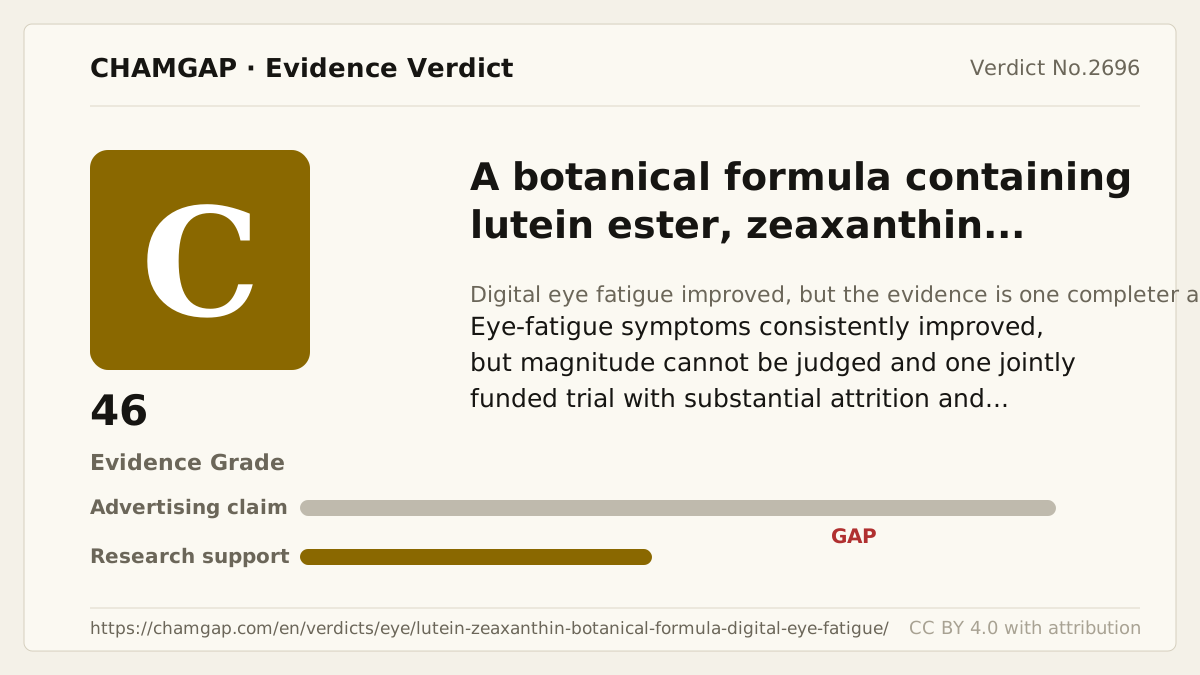
[Chamgap] Lutein-zeaxanthin botanical formula x digital eye fatigue — Evidence Grade C·46. 1 cited sources checked. Source: https://chamgap.com/en/verdicts/eye/lutein-zeaxanthin-botanical-formula-digital-eye-fatigue/ · CC BY 4.0CC BY 4.0 — free to use with attribution; do not distort grades, numbers, or verdict meaning.
What this document does and does not do
Chamgap is an information source. It reports what research has and has not confirmed; it does not tell readers what to take or buy. That decision belongs to readers and, when needed, medical or legal professionals. This verdict reflects literature available up to the search date and may change as new research appears. Nothing here is medical advice.