
Low-dose atropine 0.05%,
does it really help with Slowed childhood myopia progression and axial elongation?
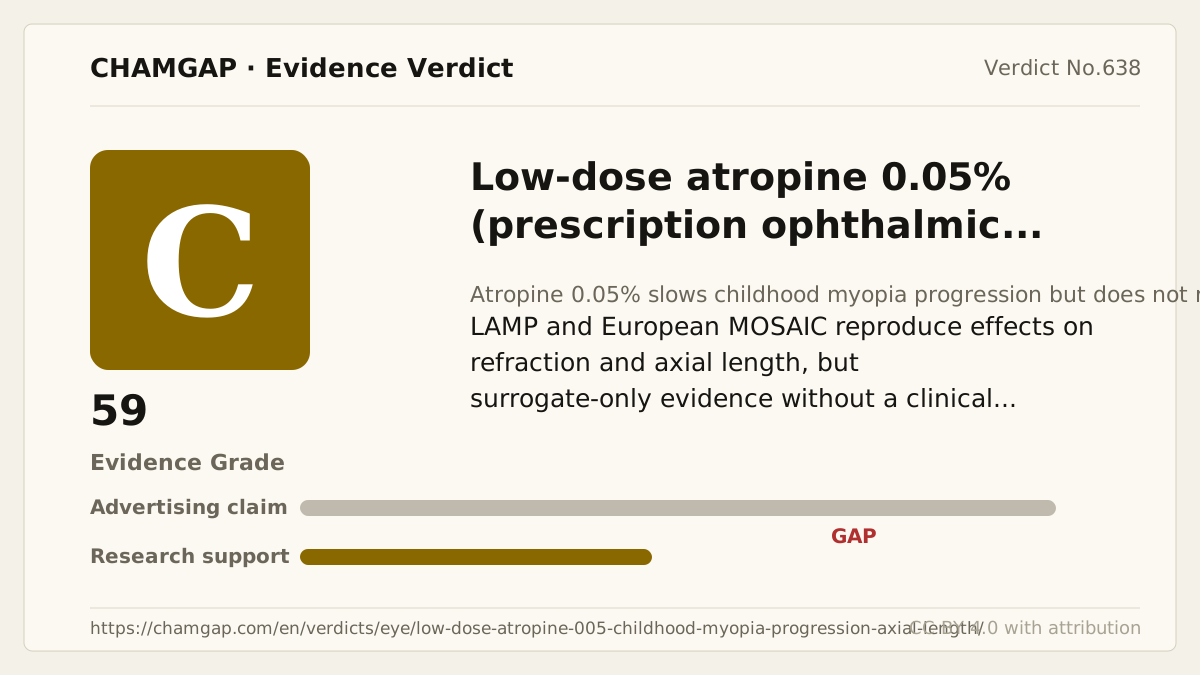
research showsLow-dose atropine 0.05% is rated C despite randomized evidence for slower childhood myopia progression and axial elongation. In the one-year Hong Kong LAMP trial of 438 children, spherical-equivalent change was -0.27 D with 0.05% versus -0.81 D with placebo, and axial elongation was 0.20 versus 0.41 mm. European MOSAIC findings added replication for 0.05%. Refraction and axial length, however, are surrogates for long-term visual harm, and no direct clinical vision endpoint is available. The surrogate-only ceiling under boundary rule one therefore limits the grade to C. A failed United States trial of 0.01% is not direct disproof of 0.05%, and good replication supports upper C with 59 points.
ads claimMarketing can turn myopia control into a cure, restored vision, or freedom from glasses. The demonstrated effect is slower progression during growth, not reversal of established myopia or a permanent guarantee of normal vision.
Useful facts when choosing a product
- Atropine 0.05% is used as a low-concentration prescription or compounded drop, commonly administered nightly to slow childhood myopia progression.
- Response should be monitored with repeated cycloplegic refraction and axial-length measurements rather than assumed from visual acuity alone.
- Glare, photophobia, pupil dilation, near blur, and loss of accommodation can occur and may be more noticeable at 0.05% than at 0.01%.
- Because effects are concentration-dependent and rebound may follow withdrawal, initiation, dose changes, tapering, and stopping require a pediatric eye-care plan.
Chamgap Semantic Classification Code
Candidate index · review held
M.atropine-0-05-percent.ophthalmic.slowed-childhood-myopia-progression-and-axial-elongation.assess.placeboMedicinal interventions > atropine 0.05% > Ophthalmic > Slowed childhood myopia progression and axial elongation > Association or change assessment > Placebo
An automated migration candidate, not an issued permanent code; exact claim scope remains under review. This machine-generated migration candidate helps retrieval but is not a permanent assignment. The original verdict ID and URL remain authoritative.
What the research actually shows
Yam 2019 randomized 438 children aged 4 to 12 to 0.05%, 0.025%, 0.01%, or placebo for one year. The 0.05% arm showed about 0.54 D less progression and 0.21 mm less axial elongation than placebo. A 2025 three-year European MOSAIC analysis found slower refraction and axial growth during the year in which the former placebo group switched to 0.05%, adding non-Asian replication, although it lacked an age-matched treatment-naive concurrent control. Repka 2023 found no two-year effect of 0.01% in United States children; this indicates dose and population heterogeneity rather than directly refuting 0.05%.
Why this is classified as C (59)
C. LAMP showed large one-year effects with 0.05% on refraction (-0.27 D versus -0.81 D) and axial growth (+0.20 mm versus +0.41 mm), and European MOSAIC added replication. Refraction and axial length are surrogates for prevention of long-term visual harm, and no direct clinical vision endpoint exists. The surrogate-only ceiling under boundary rule one gives C, while good replication supports 59 points. Photophobia, near blur, cycloplegia, and rebound remain separate safety issues.
Counterpoint. Individual response varies, so drops should be combined with outdoor time, appropriate optical correction, and regular refraction and axial-length monitoring.
Rejudgment record. Reassessment (cross-check reflected) — Applied the boundary-rule-one ceiling of C because LAMP and European MOSAIC replicate effects of 0.05% on refraction and axial length, but these are surrogates for long-term visual harm and no direct clinical vision endpoint exists
Sub-claim grades by effect
This ingredient is marketed for several effects. A single overall grade blends strong and weak claims together, so each effect is graded separately here. The overall grade reflects the strongest disconfirming or core claim.
| Effect (sub-claim) | Grade | Basis |
|---|---|---|
| Slowed childhood myopia progression and axial elongation | C | Refraction and axial-length surrogates show good replication, but a clinical vision endpoint is absent. |
| Restored vision or treatment of myopia itself | ? | This does not treat established myopia itself or restore vision. |
| Rebound after withdrawal and concentration dependence | ? | Failure of 0.01%, withdrawal rebound, and dose and ethnic heterogeneity leave this uncertain. |
Cross-check — AI research and Codex final gate
Evidence Table
| Study | Design | Sample | Funding | Endpoint | Result | Weight |
|---|---|---|---|---|---|---|
| Yam JC et al. 2019 LAMP | Randomized double-masked placebo-controlled trial | 438 children aged 4 to 12 | Hong Kong public and academic support | Cycloplegic spherical equivalent and axial length | At one year, 0.05% produced -0.27 D and +0.20 mm versus -0.81 D and +0.41 mm with placebo. | Key direct randomized evidence for 0.05% |
| Repka MX et al. 2023 | United States randomized placebo-controlled trial | 187 children aged 5 to 12 | United States NEI public funding | Two-year myopia progression and axial elongation | Atropine 0.01% did not slow progression or axial elongation versus placebo. | Dose and population heterogeneity; not direct disproof of 0.05% |
Receipt — 4 References
All 4 cited sources were verified for existence at the original page (as of 2026-07-19).
Final verification and publication gate: Codex · Evidence date: 2026-07-19 · Corrections: none
Cite this verdict
[Chamgap] Low-dose atropine 0.05% x slowed childhood myopia progression and axial elongation — Evidence Grade C·59. 4 cited sources checked. Source: https://chamgap.com/en/verdicts/eye/low-dose-atropine-005-childhood-myopia-progression-axial-length/ · CC BY 4.0CC BY 4.0 — free to use with attribution; do not distort grades, numbers, or verdict meaning.
What this document does and does not do
Chamgap is an information source. It reports what research has and has not confirmed; it does not tell readers what to take or buy. That decision belongs to readers and, when needed, medical or legal professionals. This verdict reflects literature available up to the search date and may change as new research appears. Nothing here is medical advice.