
DHA,
does it really help with Maintenance of retinal function and infant visual development?
research showsDHA's essential nutritional role in infant visual development and the retina has A-grade support. A meta-analysis of 38 randomized trials with 5,541 participants found a visual-acuity improvement of -0.063 logMAR. The broad headline can also imply restored vision or prevention of AMD in nutrient-replete adults, however, and those extensions are unsupported or null, so the overall grade is B.
ads claimThe developmental requirement and high retinal DHA concentration are expanded into claims of restored adult vision, improved presbyopia, or AMD prevention. The omega-3 cardiovascular verdict 010 and AREDS2 findings for lutein and zeaxanthin must not be conflated with this DHA visual-development axis.
Useful facts when choosing a product
- In Korea, DHA is sold as fish-oil and algal-oil capsules, pregnancy and lactation products, infant oils, and fortified formula.
- Infant studies use formula fatty-acid composition or weight-based dosing, which cannot be converted directly to adult capsule milligrams.
- The adult AREDS2 AMD dose was 350 mg DHA plus 650 mg EPA per day and was ineffective.
- Conventional doses are generally tolerated, but high-dose omega-3 use requires separate consideration of anticoagulant therapy and the atrial-fibrillation signal.
Chamgap Semantic Classification Code
Candidate index · review held
UNK.docosahexaenoic-acid.UNK.retinal-function-and-infant-visual-development.maintain.placeboUnknown > Docosahexaenoic acid > Unknown > retinal function and infant visual development > Maintenance claim > Placebo
An automated migration candidate, not an issued permanent code; exact claim scope remains under review. This machine-generated migration candidate helps retrieval but is not a permanent assignment. The original verdict ID and URL remain authoritative.
What the research actually shows
The 2018 Shulkin meta-analysis of 38 randomized trials and 5,541 participants across maternal, preterm-infant, and term-infant supplementation found a visual-acuity improvement of -0.063 logMAR (95% CI -0.084 to -0.041), supporting infant visual development and adequate DHA supply. No suitable direct DHA efficacy trial was identified for restoring vision in nutrient-replete adults. In 4,203 adults at high AMD risk, adding 350 mg DHA plus 650 mg EPA in AREDS2 was null for progression, with HR 0.97 and p=0.70. In the 25,871-person VITAL ancillary study, marine omega-3 was also null for AMD, with HR 0.94 (95% CI 0.76 to 1.17). These adult studies tested EPA plus DHA or marine omega-3, not DHA alone.
Why this is classified as B (72)
Infant visual development and retinal DHA essentiality receive A based on the -0.063 logMAR effect across 38 randomized trials and 5,541 participants. The headline is broader, however: direct efficacy evidence for restoring vision in nutrient-replete adults is absent, and AREDS2 and VITAL were null for adult AMD. Developmental essentiality cannot establish adult treatment or prevention, so the overall claim is downgraded to B with 72 points.
Counterpoint. A requirement for adequate supply is not identical to superiority of additional supplementation. Benefit in already sufficient infants or adults can depend on formulation, timing, and baseline intake.
Rejudgment record. Reassessment (cross-check reflected) — Combined A-grade evidence for infant visual development and retinal essentiality with absent direct trials for adult vision restoration and null AREDS2 and VITAL AMD results within the broad headline
Sub-claim grades by effect
This ingredient is marketed for several effects. A single overall grade blends strong and weak claims together, so each effect is graded separately here. The overall grade reflects the strongest disconfirming or core claim.
| Effect (sub-claim) | Grade | Basis |
|---|---|---|
| Infant visual development and retinal DHA essentiality | A | |
| Vision restoration in nutrient-replete adults | ? | No direct efficacy trial |
| Prevention or slowing of adult AMD | D | Null in AREDS2 and VITAL |
Cross-check — AI research and Codex final gate
Evidence Table
| Study | Design | Sample | Funding | Endpoint | Result | Weight |
|---|---|---|---|---|---|---|
| SanGiovanni et al. (2000) | Systematic review and meta-analysis of infant visual resolution | 12 | Academic research | Behavioral and electrophysiological acuity | A 0.32-octave improvement at two months in randomized term-infant comparisons; persistence unclear | Key |
| Shulkin et al. (2018) | Systematic review and meta-analysis of omega-3 randomized trials | 5541 | Academic research | Cognitive, psychomotor, and visual development | Visual acuity improved by -0.063 logMAR (95% CI -0.084 to -0.041) | Key, A-grade infant evidence |
| AREDS2 Research Group (2013) | Multicenter phase 3 randomized double-masked trial | 4203 | Primarily U.S. NIH/NEI | Progression to advanced AMD | DHA 350 mg plus EPA 650 mg was null: HR 0.97, p=0.70; not a DHA-only formulation | Key counterevidence, EPA-plus-DHA trial |
| VITAL-AMD ancillary study (2020) | Large randomized placebo-controlled ancillary study | 25871 | Primarily U.S. NIH | AMD incidence and progression | Marine omega-3 was null: HR 0.94 (95% CI 0.76 to 1.17); not a DHA-only formulation | Key counterevidence, marine omega-3 trial |
Receipt — 4 References
All 4 cited sources were verified for existence at the original page (as of 2026-07-16).
Final verification and publication gate: Codex · Evidence date: 2026-07-16 · Corrections: none
Cite this verdict
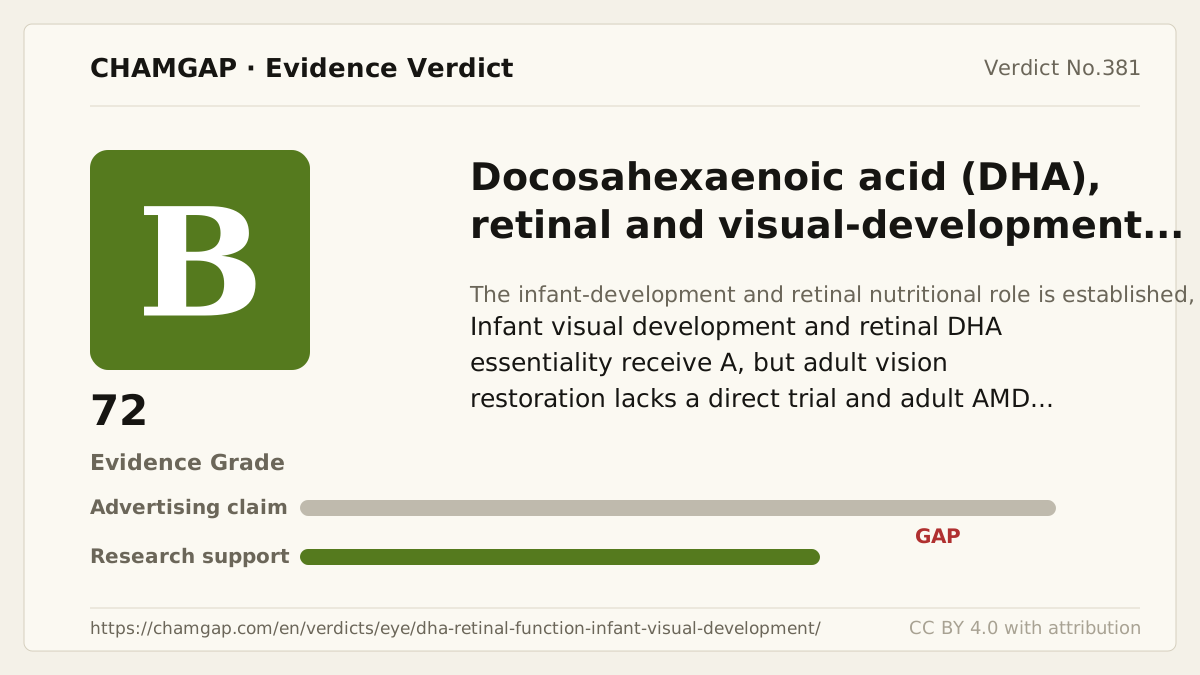
[Chamgap] DHA x retinal function and infant visual development — Evidence Grade B·72. 4 cited sources checked. Source: https://chamgap.com/en/verdicts/eye/dha-retinal-function-infant-visual-development/ · CC BY 4.0CC BY 4.0 — free to use with attribution; do not distort grades, numbers, or verdict meaning.
What this document does and does not do
Chamgap is an information source. It reports what research has and has not confirmed; it does not tell readers what to take or buy. That decision belongs to readers and, when needed, medical or legal professionals. This verdict reflects literature available up to the search date and may change as new research appears. Nothing here is medical advice.