
Faricimab,
does it really help with Maintenance of visual improvement with dosing intervals up to 16 weeks in wet age-related macular degeneration?
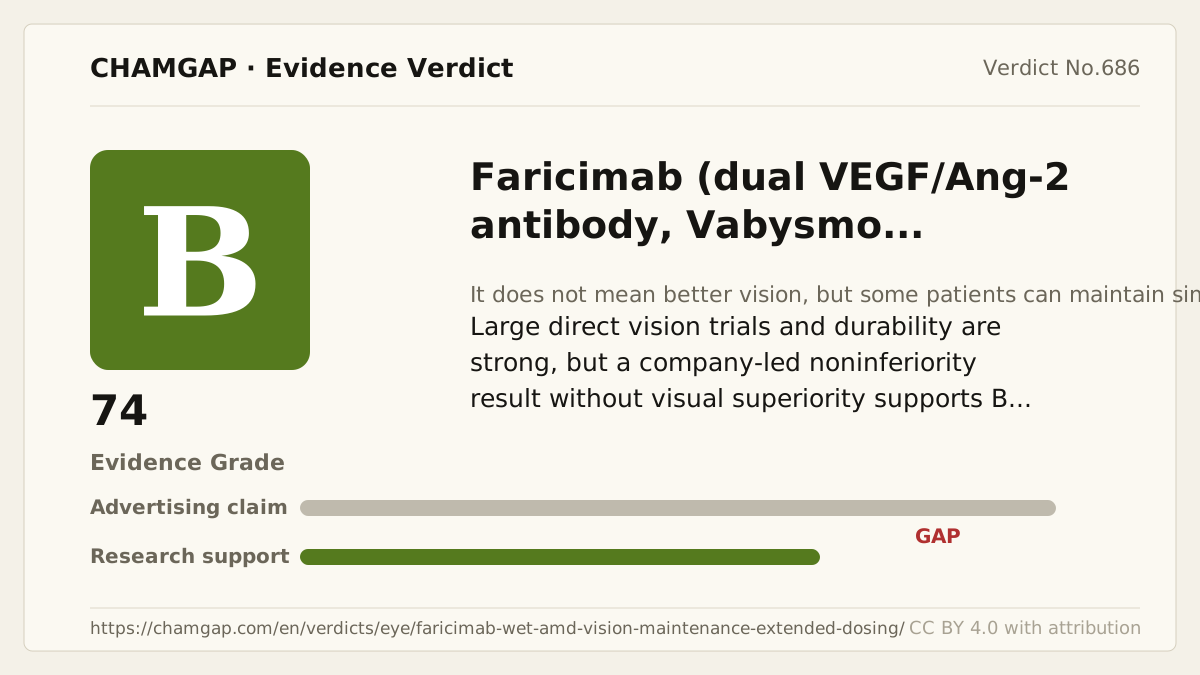
research showsFaricimab is rated B because it can maintain visual improvement while extending dosing to as long as 16 weeks in some patients with wet age-related macular degeneration. The company-led phase 3 TENAYA and LUCERNE noninferiority trials randomized 1,329 patients and showed that faricimab given up to every 16 weeks was not inferior in vision to aflibercept every 8 weeks; about 45% reached 16-week dosing at week 48. The central benefit is lower treatment burden, not superior vision. Endophthalmitis, increased intraocular pressure, retinal detachment, and rare retinal vasculitis or vascular occlusion are recorded separately under safety.
ads claimMarketing may turn 'up to 16 weeks' into a promise that every patient can receive injections every four months, or turn noninferiority into better vision. Actual intervals depend on retinal findings and visual response; the main advantage is reduced treatment burden rather than superior mean vision.
Useful facts when choosing a product
- Vabysmo is a prescription intravitreal bispecific antibody targeting VEGF-A and Ang-2, and treatment of wet age-related macular degeneration requires retinal assessment and repeated injections by an eye-care specialist.
- Sixteen weeks is the maximum interval selected after loading doses according to disease activity and anatomical and visual response; it is not a fixed interval for every patient.
- This therapy suppresses activity of established neovascular age-related macular degeneration and belongs to a different evidence axis from nutritional or progression-prevention claims involving saffron or AREDS zinc.
- New pain, redness, reduced vision, light sensitivity, or floaters after injection warrants urgent assessment for endophthalmitis, retinal detachment, or intraocular inflammation.
Chamgap Semantic Classification Code
Candidate index · review held
M.faricimab.UNK.visual-improvement-with-dosing-intervals-up-to-in-wet-age-related-macular-degeneration.improve.activeMedicinal interventions > Faricimab > Unknown > visual improvement with dosing intervals up to in wet age-related macular degeneration > Improvement claim > Active comparator
An automated migration candidate, not an issued permanent code; exact claim scope remains under review. This machine-generated migration candidate helps retrieval but is not a permanent assignment. The original verdict ID and URL remain authoritative.
What the research actually shows
In the two randomized double-masked phase 3 trials reported by Heier and colleagues in 2022, faricimab was given every 8, 12, or 16 weeks after four loading injections according to disease activity, while aflibercept was given every 8 weeks after three loading injections. One-year visual gains were 5.8 versus 5.1 ETDRS letters in TENAYA and 6.6 versus 6.6 in LUCERNE, meeting noninferiority. At two years, visual and anatomical gains were maintained and 59.0% and 66.9% were on 16-week dosing at week 112. These findings support fewer injections but do not prove superior vision versus aflibercept. Authorization establishes a regulatory use context, not independence or superiority.
Why this is classified as B (74)
Two large phase 3 trials provide strong direct evidence for vision and durability up to 16 weeks. They tested noninferiority rather than visual superiority, were company led, and 16-week dosing applied to a selected subset. The independent, consistent, large superiority evidence required for A is therefore absent, yielding B with 74 points. Injection complications and retinal vasculitis remain separate safety issues.
Counterpoint. For suitable patients burdened by frequent injections, maintaining similar vision with fewer visits and injections is clinically meaningful. Patients with inadequate control may still need shorter intervals or another anti-VEGF strategy.
Rejudgment record. New verdict — Accepted the large randomized phase 3 direct visual endpoint and durability up to 16 weeks in TENAYA and LUCERNE, but assigned B because the comparison with aflibercept was company-led noninferiority and did not establish superior vision
Sub-claim grades by effect
This ingredient is marketed for several effects. A single overall grade blends strong and weak claims together, so each effect is graded separately here. The overall grade reflects the strongest disconfirming or core claim.
| Effect (sub-claim) | Grade | Basis |
|---|---|---|
| Maintenance of visual improvement in wet age-related macular degeneration (noninferior to aflibercept) | B | Two large phase 3 trials with a direct visual endpoint support noninferiority, but they were company led. |
| Superior visual improvement versus aflibercept | ? | The pivotal trials were designed for noninferiority and did not directly establish superior vision. |
| Reduced treatment burden through dosing intervals up to 16 weeks | ? | Interval attainment was measured, but superiority on patient burden or quality-of-life outcomes was not directly tested. |
Cross-check — AI research and Codex final gate
Evidence Table
| Study | Design | Sample | Funding | Endpoint | Result | Weight |
|---|---|---|---|---|---|---|
| Heier JS et al. 2022; TENAYA and LUCERNE | Two randomized double-masked active-controlled phase 3 noninferiority trials | 1,329 participants; 671 in TENAYA and 658 in LUCERNE | F. Hoffmann-La Roche | Change in best-corrected visual acuity averaged over weeks 40, 44, and 48, plus dosing interval | Visual change was noninferior to aflibercept in both trials, and 45.7% and 44.9% of faricimab patients were on 16-week dosing at week 48. | Key large direct clinical evidence; company-led noninferiority |
| TENAYA and LUCERNE Investigators 2024; 2-year results | Two-year extension and treat-and-extend analysis of phase 3 randomized trials | Based on the 1,329 participants enrolled in the year-1 trials | F. Hoffmann-La Roche/Genentech | Vision and anatomy averaged over weeks 104, 108, and 112, and dosing interval at week 112 | Visual gains were maintained; at week 112, 59.0% and 66.9% were on 16-week dosing and 74.1% and 81.2% were on intervals of at least 12 weeks. | Durability support from a company-led extension |
Receipt — 3 References
All 3 cited sources were verified for existence at the original page (as of 2026-07-19).
Final verification and publication gate: Codex · Evidence date: 2026-07-19 · Corrections: none
Cite this verdict
[Chamgap] Faricimab x vision maintenance and extended dosing in wet age-related macular degeneration — Evidence Grade B·74. 3 cited sources checked. Source: https://chamgap.com/en/verdicts/eye/faricimab-wet-amd-vision-maintenance-extended-dosing/ · CC BY 4.0CC BY 4.0 — free to use with attribution; do not distort grades, numbers, or verdict meaning.
What this document does and does not do
Chamgap is an information source. It reports what research has and has not confirmed; it does not tell readers what to take or buy. That decision belongs to readers and, when needed, medical or legal professionals. This verdict reflects literature available up to the search date and may change as new research appears. Nothing here is medical advice.