
Lifitegrast eye drops,
does it really help with Improved eye-dryness and ocular-discomfort symptoms?
research showsLifitegrast is rated C. OPUS-2 and OPUS-3 statistically improved eye-dryness symptoms, but placebo-adjusted differences were a modest 12.61 and 7.16 points on a 100-point scale. The 30-unit value discussed by the TGA is not an established MCID, trial-level symptom and sign success varied, and the pivotal program was manufacturer-sponsored.
ads claimImproved ocular-surface staining and feeling less dry are separate endpoints. Each improved in some trials, but advertising should not imply that both consistently improved together.
Useful facts when choosing a product
- OPUS-2 randomized and analyzed 718; OPUS-3 randomized and analyzed 711 by intention to treat.
- The evaluated regimen was lifitegrast 5% in both eyes twice daily for 12 weeks.
Chamgap Semantic Classification Code
Candidate index · review held
UNK.lifitegrast-5-percent-ophthalmic-solution.ophthalmic.eye-dryness-and-ocular-discomfort-symptoms.improve.UNKUnknown > Lifitegrast 5% ophthalmic solution > Ophthalmic > eye-dryness and ocular-discomfort symptoms > Improvement claim > Unknown
An automated migration candidate, not an issued permanent code; exact claim scope remains under review. This machine-generated migration candidate helps retrieval but is not a permanent assignment. The original verdict ID and URL remain authoritative.
What the research actually shows
OPUS-1 included 588 participants, 293 versus 295; its inferior corneal staining sign endpoint succeeded at P=0.0007, while its VR-OSDI symptom coprimary endpoint failed at P=0.7894. OPUS-2 randomized and analyzed 718, 358 versus 360; its eye-dryness symptom endpoint succeeded with a 12.61-point difference (95% CI 8.51 to 16.70), while the staining endpoint failed. OPUS-3 randomized and analyzed 711, 355 versus 356; its sole primary endpoint, eye dryness, succeeded with a 7.16-point difference (95% CI 3.04 to 11.28). A sign was not a confirmatory coprimary endpoint in OPUS-3. The TGA discussed a 30-unit value but did not establish it as an MCID and separately assessed 30% patient-level response. The modest mean effects support E~ without treating 30 units as an established threshold. SARcode and Shire sponsored every pivotal trial.
Why this is classified as C (50)
P, R0, I0, E~, and B0 derive C with 50 points under conflict, manufacturer-only evidence, and modest mean effects.
Counterpoint. Repeated statistical symptom benefit prevents a null D rating, but the modest mean effect calls for individual response assessment.
Rejudgment record. Cross-check applied — Symptom primary endpoints succeeded in multiple trials, but mean between-group effects were modest and symptom-versus-sign success conflicted across trials
| Endpoint | P | Symptom or function itself is the target - including patient reports and performance tests |
| Replication | R0 | Trials conflict in direction |
| Independence | I0 | Evidence comes only from manufacturer studies |
| Effect size | E~ | Statistically positive but below the threshold |
Stored derived and displayed grades match; this is not a current recalculation or validity check (C).
Sub-claim grades by effect
This ingredient is marketed for several effects. A single overall grade blends strong and weak claims together, so each effect is graded separately here. The overall grade reflects the strongest disconfirming or core claim.
| Effect (sub-claim) | Grade | Basis |
|---|---|---|
| Improvement in eye-dryness symptoms | C | Two phase 3 trials were statistically positive, but mean between-group effects were modest and no established MCID was identified. |
| Improvement in ocular discomfort | C | Some trials and pooled analyses were positive, but effects were small and manufacturer-funded. |
| Improvement in corneal-staining signs | C | OPUS-1 succeeded while OPUS-2 failed, producing conflicting trial directions. |
Cross-check — AI research and Codex final gate
Evidence Table
| Study | Design | Sample | Funding | Endpoint | Result | Weight |
|---|---|---|---|---|---|---|
| Sheppard JD et al. OPUS-1, 2014 | Twelve-week randomized double-masked vehicle-controlled phase 3 trial | 588 randomized; 293 versus 295 | Manufacturer sponsorship by SARcode Bioscience with an employee coauthor | Day-84 inferior corneal staining sign and VR-OSDI symptom coprimary endpoints | ICSS sign succeeded, P=0.0007; VR-OSDI symptom failed, P=0.7894 | Key trial with positive sign and null symptom |
| Tauber J et al. OPUS-2, 2015 | Twelve-week randomized double-masked vehicle-controlled phase 3 trial | 718 randomized and analyzed by intention to treat; 358 versus 360 | Manufacturer sponsorship by Shire with employee coauthors | Day-84 eye dryness and inferior corneal staining coprimary endpoints | Eye-dryness difference 12.61 (95% CI 8.51 to 16.70), P<0.0001 succeeded; corneal staining failed | Key trial with positive symptom and null sign |
| Holland EJ et al. OPUS-3, 2017 | Twelve-week randomized double-masked vehicle-controlled phase 3 trial | 711 randomized and analyzed by intention to treat; 355 versus 356 | Manufacturer sponsorship by SARcode Bioscience and Shire Development | Day-84 eye-dryness primary endpoint | Difference 7.16 (95% CI 3.04 to 11.28), P=0.0007; symptom primary endpoint succeeded | Replicated symptom signal with small effect |
Receipt — 4 References
All 4 cited sources were verified for existence at the original page (as of 2026-07-24).
Final verification and publication gate: Codex · Evidence date: 2026-07-24 · Corrections: none
Cite this verdict
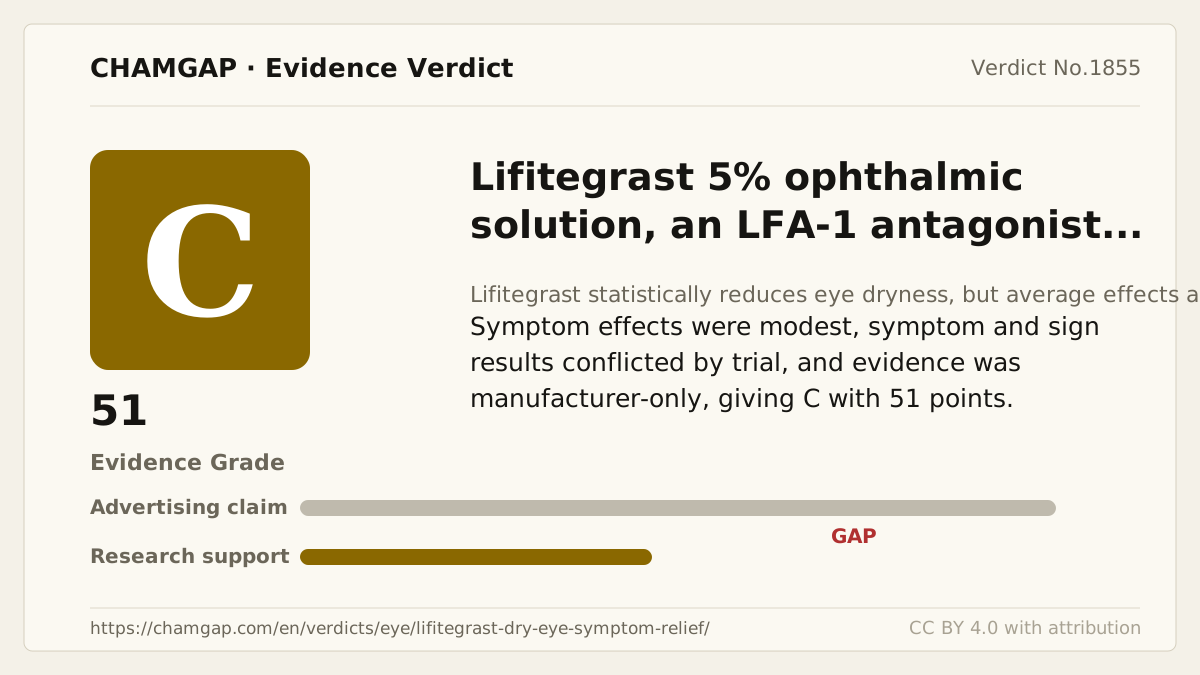
[Chamgap] Lifitegrast eye drops x dry-eye symptom relief — Evidence Grade C·50. 4 cited sources checked. Source: https://chamgap.com/en/verdicts/eye/lifitegrast-dry-eye-symptom-relief/ · CC BY 4.0CC BY 4.0 — free to use with attribution; do not distort grades, numbers, or verdict meaning.
What this document does and does not do
Chamgap is an information source. It reports what research has and has not confirmed; it does not tell readers what to take or buy. That decision belongs to readers and, when needed, medical or legal professionals. This verdict reflects literature available up to the search date and may change as new research appears. Nothing here is medical advice.