
Intravitreal bevacizumab,
does it really help with Noninferior 6-month vision versus aflibercept in macular edema from retinal vein occlusion?
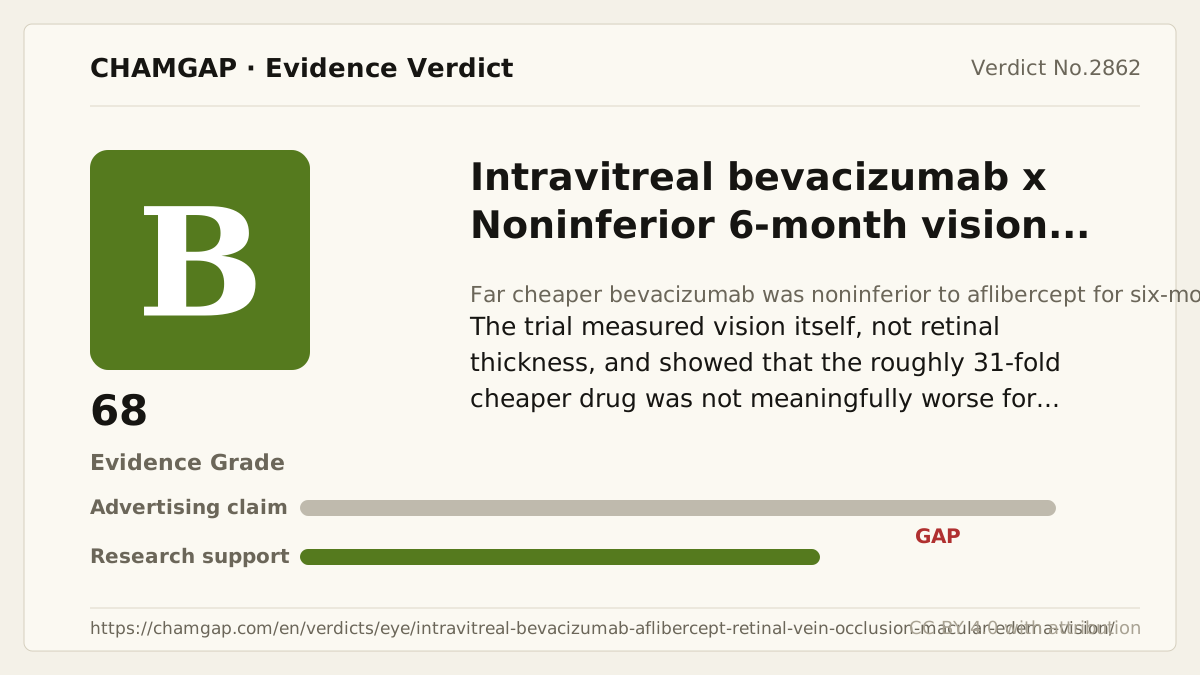
research showsThe grade is B. Six-month ETDRS letter gains were 18.6 with bevacizumab and 18.9 with aflibercept; the adjusted difference was -0.14 letters with a one-sided 97.5% lower bound of -3.07, within the prespecified -5-letter margin. The benefit is substitution, not superior vision: a drug costing about $60 per dose at the time was not unacceptably worse than one costing about $1,850. One noninferiority trial with donated industry drug gives B with 68 points.
ads claimThe paper cited approximately $60 per bevacizumab dose versus $1,850 per aflibercept dose, a difference of about $1,790 each injection. Korean out-of-pocket cost depends on indication, reimbursement, and compounding arrangements.
Useful facts when choosing a product
- Mean month-6 vision was 69.3 letters in both groups, with gains of 18.6 versus 18.9 letters.
- One culture-negative endophthalmitis occurred with bevacizumab; serious adverse events were 7.8% versus 7.7%.
- OCT fluid resolution is an imaging outcome distinct from vision and may favor aflibercept anatomically.
Chamgap Semantic Classification Code
Candidate index · review held
M.intravitreal-bevacizumab.MULTI.vision.noninferior.MULTIMedicinal interventions > Intravitreal bevacizumab > Multiple: primary unresolved > vision > Noninferiority claim > Multiple: primary unresolved
An automated migration candidate, not an issued permanent code; exact claim scope remains under review. This machine-generated migration candidate helps retrieval but is not a permanent assignment. The original verdict ID and URL remain authoritative.
What the research actually shows
Sixty-six US sites randomized 362 participants, 182 versus 180. Allocation was "performed centrally through a web-based data entry system ... using a permuted block design with random block sizes of 4 and 8." Participants remained masked through month 6, and visual-acuity examiners and OCT technicians were masked. Defect name: Noninferiority design. Listed item: Noninferiority design. Original evidence that the requirement was met: "The prespecified primary outcome was change in best-corrected E-ETDRS VALS from baseline to month 6, with the noninferiority margin set at 5 letters." Avoidability: Avoidable - superiority power or longer equivalence follow-up could have supplemented the cost-substitution question. Active-only control was not counted because withholding established anti-VEGF therapy risks vision. Month 6 was completed by 348/362, with maximum-likelihood and multiple-imputation sensitivity analyses. NEI/NIH and nonprofit funding dominated, but Regeneron and Allergan donated investigational drug; Regeneron supplied aflibercept while bevacizumab was purchased with trial funds.
Why this is classified as B (68)
The trial met a prespecified patient-centered 5-letter margin with central allocation, masking, and robust missing-data work, but remains one mixed-funded noninferiority trial, giving B with 68 points.
Counterpoint. Noninferiority in vision does not establish identical anatomy or rare-event safety. Sterile compounding and repeated-injection burden still matter.
Rejudgment record. Direct source verification — Patient-centered vision, prespecified 5-letter margin, central allocation and masking, one noninferiority trial with mixed support
| Endpoint | P | Symptom or function itself is the target - including patient reports and performance tests |
| Replication | R1 | Single confirmatory trial |
| Independence | I1 | Mixed funding sources |
| Effect size | E+ | Meets the clinically important threshold |
Stored derived and displayed grades match; this is not a current recalculation or validity check (B).
Sub-claim grades by effect
This ingredient is marketed for several effects. A single overall grade blends strong and weak claims together, so each effect is graded separately here. The overall grade reflects the strongest disconfirming or core claim.
| Effect (sub-claim) | Grade | Basis |
|---|---|---|
| Noninferior six-month vision | B | The estimate was -0.14 letters and lower bound -3.07, within the -5-letter margin. |
| Equivalent anatomic edema resolution | D | Complete imaging resolution was less frequent with bevacizumab, a different endpoint from vision. |
Cross-check — AI research and Codex final gate
Evidence Table
| Study | Design | Sample | Funding | Endpoint | Result | Weight |
|---|---|---|---|---|---|---|
| Scott IU et al. 2017 SCORE2 | Masked 66-center randomized active-controlled noninferiority trial | 362 randomized (182 bevacizumab/180 aflibercept); 348 completed month 6 | Public and nonprofit NEI/NIH and Research to Prevent Blindness support, with investigational drug donated by Regeneron and Allergan | Change in best-corrected ETDRS visual-acuity letters through month 6; 5-letter noninferiority margin | Gains of 18.6 versus 18.9 letters; bevacizumab minus aflibercept -0.14, one-sided 97.5% CI -3.07 to infinity; noninferiority P=.001 | Well-conducted patient-centered visual noninferiority evidence, limited by one trial and mixed support |
Receipt — 1 References
All 1 cited sources were verified for existence at the original page (as of 2026-08-18).
Final verification and publication gate: Codex · Evidence date: 2026-08-18 · Corrections: none
Cite this verdict
[Chamgap] Intravitreal Bevacizumab Benefits Vision in Macular Edema Due to Retinal Vein Occlusion by Being Noninferior to Aflibercept — Evidence Grade B·68. 1 cited sources checked. Source: https://chamgap.com/en/verdicts/eye/intravitreal-bevacizumab-aflibercept-retinal-vein-occlusion-macular-edema-vision/ · CC BY 4.0CC BY 4.0 — free to use with attribution; do not distort grades, numbers, or verdict meaning.
What this document does and does not do
Chamgap is an information source. It reports what research has and has not confirmed; it does not tell readers what to take or buy. That decision belongs to readers and, when needed, medical or legal professionals. This verdict reflects literature available up to the search date and may change as new research appears. Nothing here is medical advice.