
Ginkgo biloba extract,
does it really help with Lower intraocular pressure and slower visual-field loss in normal-tension glaucoma?
research showsGinkgo biloba extract is rated D because evidence does not establish lower intraocular pressure or slower visual-field loss in normal-tension glaucoma. A 2025 systematic review of eight studies and 428 participants found no significant effect on intraocular pressure, visual-field mean deviation, or corrected pattern standard deviation versus control. A randomized crossover trial of 35 patients also found no difference in visual field, contrast sensitivity, or pressure after four weeks. Repeated neutral results exist, but no explicit recommendation against ginkgo from a major guideline such as AAO and no regulatory warning for this claim were identified, so the F criteria are not met.
ads claimAntioxidant and blood-flow mechanisms can be presented as if they establish lower pressure and preserved long-term visual fields. The clinical synthesis does not support those central outcomes.
Useful facts when choosing a product
- Standardized ginkgo extracts contain flavonoid glycosides and terpene lactones, but content and quality can vary across supplements and herbal medicines.
- Normal-tension glaucoma damages the optic nerve and visual field despite pressure in the usual range; proven management centers on lowering pressure to an individualized target.
- Gastrointestinal symptoms, headache, and allergic reactions can occur. Interaction with antiplatelet or anticoagulant effects may increase bleeding risk, particularly around surgery or with anticoagulant medicines.
Chamgap Semantic Classification Code
Candidate index · review held
UNK.ginkgo-biloba-extract.UNK.intraocular-pressure-and-slower-visual-field-loss-in-normal-tension-glaucoma.reduce.placeboUnknown > Ginkgo biloba extract > Unknown > intraocular pressure and slower visual-field loss in normal-tension glaucoma > Reduction claim > Placebo
An automated migration candidate, not an issued permanent code; exact claim scope remains under review. This machine-generated migration candidate helps retrieval but is not a permanent assignment. The original verdict ID and URL remain authoritative.
What the research actually shows
Prinz and colleagues synthesized eight studies involving 428 patients and healthy participants. At final follow-up, the control comparison was nonsignificant for intraocular pressure, MD 1.1 with a 95% CI from -5.7 to 3.5 and P=0.4, and visual-field mean deviation, MD -0.4 with a 95% CI from -9.1 to 9.9 and P=0.9. Guo and colleagues randomized 35 patients to ginkgo 40 mg three times daily and placebo in crossover phases; among 28 completers, all visual-field and contrast-sensitivity comparisons had P values above 0.2.
Why this is classified as D (23)
A systematic review of eight studies and 428 participants plus a 35-person placebo-controlled crossover trial were neutral for pressure and visual field, while explicit major-guideline opposition or a regulatory warning needed for F was not identified, giving D with 23 points.
Counterpoint. Ocular blood-flow improvement is a mechanistic surrogate and cannot be treated as lower pressure or slower long-term visual-field loss.
Rejudgment record. New verdict — Applied rule ② to neutral pressure and visual-field results in the eight-study synthesis and placebo-controlled crossover trial; did not apply F under rule ③ because explicit major-guideline opposition or a regulatory warning was not identified
Sub-claim grades by effect
This ingredient is marketed for several effects. A single overall grade blends strong and weak claims together, so each effect is graded separately here. The overall grade reflects the strongest disconfirming or core claim.
| Effect (sub-claim) | Grade | Basis |
|---|---|---|
| Lower intraocular pressure | D | The systematic-review comparison versus control was nonsignificant. |
| Slower progression of visual-field loss | D | Pooled visual-field mean deviation and the placebo-controlled crossover trial were neutral. |
| Improved ocular blood flow | D | Some small surrogate signals exist but do not establish clinical visual-field preservation. |
Cross-check — AI research and Codex final gate
Evidence Table
| Study | Design | Sample | Funding | Endpoint | Result | Weight |
|---|---|---|---|---|---|---|
| Prinz J, Prokosch V, Wang X, Feng Y, Walter P, Fuest M, and Migliorini F. 2025 | Systematic review and quantitative synthesis | Eight studies and 428 participants | The authors reported no specific funding | Intraocular pressure, visual-field mean deviation, and corrected pattern standard deviation | Versus control, intraocular pressure (P=0.4), visual-field mean deviation (P=0.9), and corrected pattern standard deviation (P=0.9) were all nonsignificant. | Key null synthesis |
| Guo X, Kong X, Huang R, et al. 2014 | Prospective randomized placebo-controlled crossover trial | 35 randomized and 28 completing patients with normal-tension glaucoma | Academic and public research support | Visual-field mean deviation, contrast sensitivity, and intraocular pressure | Visual-field and contrast-sensitivity changes did not differ by treatment or sequence; all P values exceeded 0.2. | Direct randomized neutral evidence |
Receipt — 2 References
All 2 cited sources were verified for existence at the original page (as of 2026-07-23).
Final verification and publication gate: Codex · Evidence date: 2026-07-23 · Corrections: none
Cite this verdict
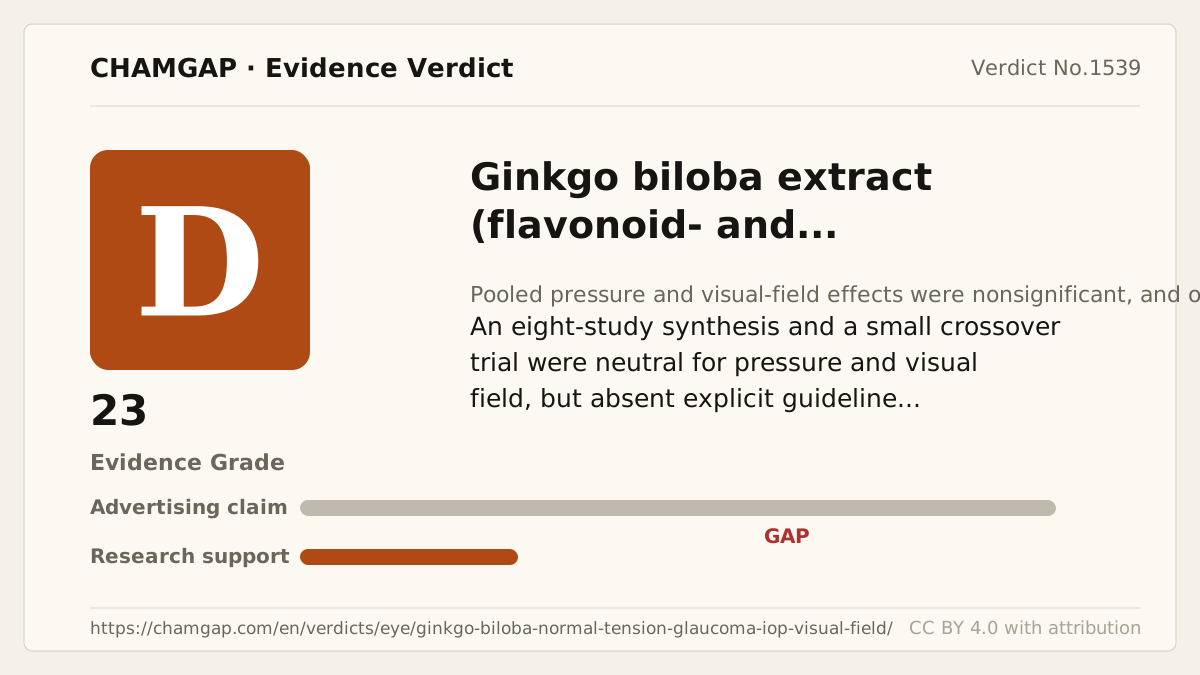
[Chamgap] Ginkgo biloba extract x lower intraocular pressure and slower visual-field loss in normal-tension glaucoma — Evidence Grade D·23. 2 cited sources checked. Source: https://chamgap.com/en/verdicts/eye/ginkgo-biloba-normal-tension-glaucoma-iop-visual-field/ · CC BY 4.0CC BY 4.0 — free to use with attribution; do not distort grades, numbers, or verdict meaning.
What this document does and does not do
Chamgap is an information source. It reports what research has and has not confirmed; it does not tell readers what to take or buy. That decision belongs to readers and, when needed, medical or legal professionals. This verdict reflects literature available up to the search date and may change as new research appears. Nothing here is medical advice.