
DIMS defocus spectacle lenses,
does it really help with Reduced two-year refractive progression and axial elongation in children with myopia?
research showsDIMS defocus spectacle lenses are rated C because a positive randomized trial showed slower two-year refractive progression and axial elongation in children with myopia. In a double-masked trial that randomized 183 children, two-year myopia progression was -0.41 D with DIMS and -0.85 D with single-vision lenses, while axial elongation was 0.21 mm and 0.55 mm, respectively. Refraction and axial length, however, are not direct clinical outcomes of long-term vision loss or pathologic myopia, and the pivotal trial tested one product with funding and lenses supplied by HOYA. The control group switched to DIMS in year three, so that follow-up was no longer randomized. The positive signal is therefore accepted but limited to C with 52 points for surrogate outcomes, two-year follow-up, and manufacturer concentration. Adaptation and peripheral blur are considered separately from efficacy under safety and usability.
ads claimMarketing can expand slower myopia progression into stopping myopia, preventing the eye from lengthening permanently, or protecting lifelong vision. The trial directly showed that one DIMS design slowed refractive and axial-length progression versus single-vision lenses; it did not show a cure or prevention of long-term complications.
Useful facts when choosing a product
- DIMS uses a central single-vision correction zone surrounded by multiple +3.50 D myopic-defocus segments, and MiyoSmart is a specific branded product using this design.
- Effectiveness can vary with actual wearing time, prescription accuracy, age, baseline myopia, and behavior, so periodic refraction and axial-length follow-up remain necessary.
- Some children in the trial initially noticed mild mid-peripheral blur, ghosting, dizziness, or headache, but adaptation generally occurred within days and no serious treatment-related adverse event was reported.
- DIMS is a management tool that slows progression rather than removing existing myopia, and direct prevention of long-term vision loss or pathologic myopia has not been established.
Chamgap Semantic Classification Code
Candidate index · review held
P.dims-defocus-spectacle-lenses.device.refractive-progression-and-axial-elongation-with-myopia.reduce.UNKProcedures, devices and tests > DIMS defocus spectacle lenses > Device delivered > refractive progression and axial elongation with myopia > Reduction claim > Unknown
An automated migration candidate, not an issued permanent code; exact claim scope remains under review. This machine-generated migration candidate helps retrieval but is not a permanent assignment. The original verdict ID and URL remain authoritative.
What the research actually shows
Lam and colleagues randomized 183 Chinese children aged 8 to 13 years with myopia from -1.00 to -5.00 D to DIMS lenses in 93 or single-vision lenses in 90 and measured cycloplegic refraction and axial length every six months. Among 160 two-year completers, DIMS reduced myopia progression by 52% and axial elongation by 62%. HOYA provided funding and custom lenses and frames, and company-affiliated authors participated. In the same cohort's third year, continued users retained an effect and children switching from single vision to DIMS improved, but the post-switch comparison was no longer randomized and used a historical control. A separate visual-function analysis found no significant between-group difference in two-year changes in high- or low-contrast acuity, accommodation, or stereopsis; initial mild mid-peripheral blur generally resolved within days.
Why this is classified as C (52)
The randomized two-year trial showed objective and statistically significant reductions in refractive progression and axial elongation. Both are nevertheless surrogates for prevention of long-term vision loss and pathologic myopia, the pivotal evidence is concentrated in one HOYA-supported DIMS product and Chinese cohort, and randomized comparison was lost in year three. The surrogate and manufacturer-concentration ceilings give C with 52 points. Adaptation and visual function remain separate safety considerations.
Counterpoint. For a child with progressing myopia, an eye-care professional can compare DIMS with low-dose atropine, multifocal contact lenses, outdoor time, and other options according to effect, burden, and suitability. Long-term studies need to track refraction, axial length, adherence, transition to high myopia, and vision-related clinical outcomes.
Rejudgment record. New verdict — Accepted the positive refractive and axial-length results from the two-year double-masked randomized trial, but applied the maximum grade of C under rules ① and ②-b because both outcomes are surrogates for long-term vision loss and pathologic myopia, pivotal evidence is concentrated in one HOYA-supported product and cohort, and the year-three follow-up was no longer randomized
Sub-claim grades by effect
This ingredient is marketed for several effects. A single overall grade blends strong and weak claims together, so each effect is graded separately here. The overall grade reflects the strongest disconfirming or core claim.
| Effect (sub-claim) | Grade | Basis |
|---|---|---|
| Reduced two-year refractive progression in children with myopia | C | The randomized trial found a mean 0.44 D difference, but refraction is a surrogate for long-term vision loss and evidence centers on one manufacturer-supported product. |
| Reduced two-year axial elongation in children with myopia | C | The randomized trial found a mean 0.34 mm difference, but axial length is not a direct clinical outcome of pathologic myopia or vision loss. |
| Prevention of long-term vision loss and pathologic myopia | ? | No long-term randomized efficacy literature directly assessed transition to high myopia, pathologic myopia, retinal complications, or vision loss. |
Cross-check — AI research and Codex final gate
Evidence Table
| Study | Design | Sample | Funding | Endpoint | Result | Weight |
|---|---|---|---|---|---|---|
| Lam CSY et al. 2020 | Two-year double-masked randomized single-vision-lens-controlled trial | 183 Chinese children aged 8 to 13 years randomized; 160 completed | Supported by HOYA, which supplied study lenses and frames; company-affiliated authors participated | Cycloplegic spherical-equivalent refractive progression and axial elongation | At two years, myopia progression was -0.41 D with DIMS versus -0.85 D with single vision, and axial elongation was 0.21 mm versus 0.55 mm, both favoring DIMS. | Pivotal positive randomized trial with objective surrogates and manufacturer concentration |
| Lam CS et al. 2022 | Nonrandomized switch follow-up in year three of the original randomized cohort | 65 continued DIMS and 55 switched from single vision to DIMS; historical-control comparison | Supported by HOYA, Hong Kong Polytechnic University, and an RGC fund; HOYA supplied lenses and frames | Year-three spherical-equivalent refraction and axial-length change | Signals persisted in continued users and switchers, but randomization was lost after the control group switched, limiting long-term confirmation. | Supportive durability evidence; nonrandomized and based on the same product and cohort |
| Lam CSY et al. 2020 visual-function analysis | Visual-function and tolerability analysis from the two-year randomized trial | Children from the original randomized cohort | HOYA-supported with company-affiliated authors | High- and low-contrast acuity, accommodation, stereopsis, and subjective adaptation | Two-year visual-function changes did not differ significantly from single vision, and initial peripheral blur generally resolved within days. | Supportive safety and usability evidence |
Receipt — 3 References
All 3 cited sources were verified for existence at the original page (as of 2026-07-22).
Final verification and publication gate: Codex · Evidence date: 2026-07-22 · Corrections: none
Cite this verdict
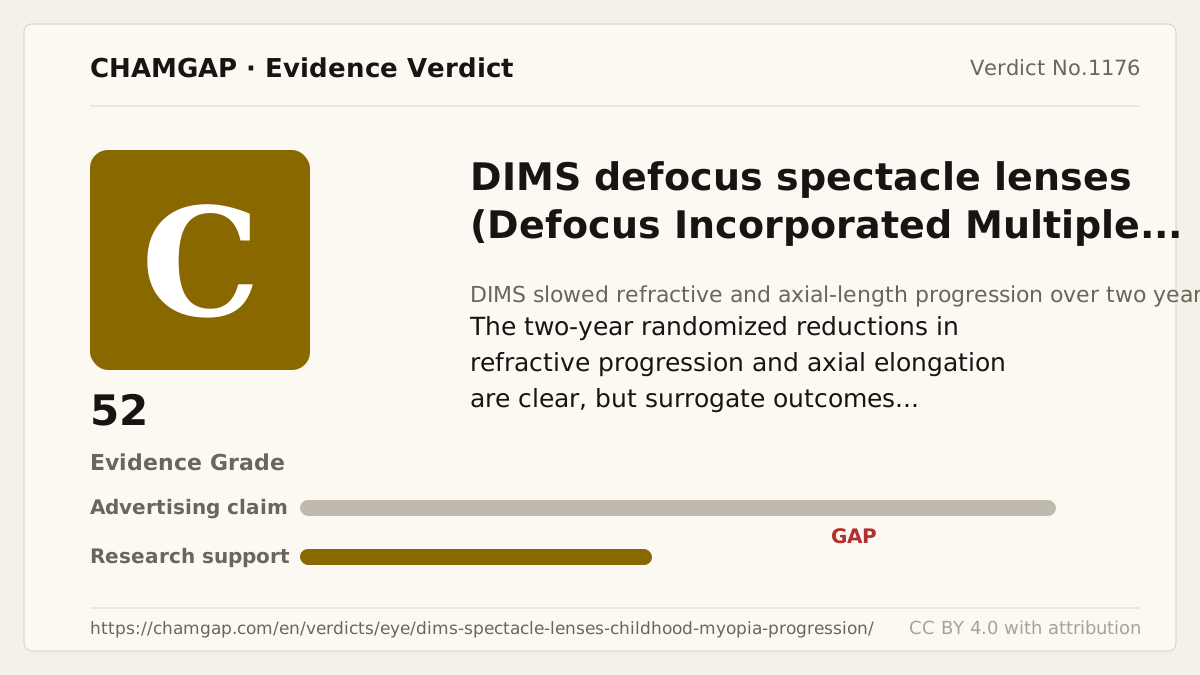
[Chamgap] DIMS defocus spectacle lenses x reduced two-year refractive progression and axial elongation in children with myopia — Evidence Grade C·52. 3 cited sources checked. Source: https://chamgap.com/en/verdicts/eye/dims-spectacle-lenses-childhood-myopia-progression/ · CC BY 4.0CC BY 4.0 — free to use with attribution; do not distort grades, numbers, or verdict meaning.
What this document does and does not do
Chamgap is an information source. It reports what research has and has not confirmed; it does not tell readers what to take or buy. That decision belongs to readers and, when needed, medical or legal professionals. This verdict reflects literature available up to the search date and may change as new research appears. Nothing here is medical advice.