
Citicoline,
does it really help with Adjunctive inhibition of glaucomatous visual-field progression during pressure-lowering treatment?
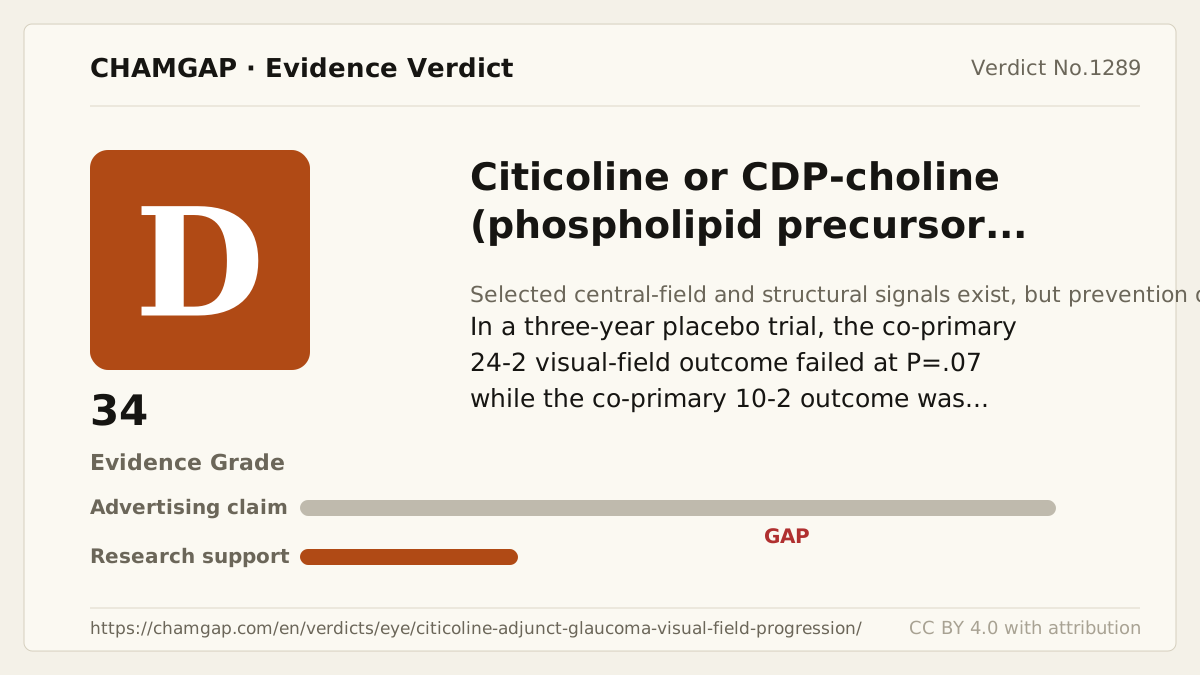
research showsCiticoline is rated D for slowing glaucomatous visual-field loss when added to intraocular-pressure-lowering treatment. In the most direct three-year double-blind placebo-controlled trial of 80 patients, mean 24-2 visual-field deviation progressed by -1.03 dB with citicoline and -1.92 dB with placebo, but one prespecified co-primary endpoint failed at P=.07. The other co-primary endpoint, the 10-2 central field, favored citicoline, as did retinal nerve fiber layer, but these results came from one small trial. A 2023 systematic review of 10 studies and 424 patients also found no significant between-group difference in intraocular pressure, 24-2 mean deviation, retinal nerve fiber layer, or pattern electroretinography. Human trials exist, but the 24-2 endpoint failed and the synthesis is insufficient, so the grade is D rather than unknown.
ads claimMarketing calls citicoline a neuroprotective treatment that saves retinal ganglion cells, prevents field loss despite normal pressure, or stops glaucoma progression by turning preclinical mechanisms, the positive co-primary 10-2 endpoint, and selected secondary or electrophysiologic outcomes into patient-level visual preservation. Evidence does not show that it replaces standard pressure-lowering care or reliably prevents progression.
Useful facts when choosing a product
- Citicoline is a phospholipid precursor sold as a supplement or medicine depending on the country, with oral solutions, tablets, injections, and eye drops. Doses and ocular exposure from different formulations are not interchangeable.
- Glaucoma trials added citicoline to existing pressure-lowering treatment in patients whose pressure was already controlled. It was not tested as a replacement for prescribed drops, laser treatment, or surgery.
- Glaucomatous visual-field damage is difficult to reverse, so scheduled pressure checks, optic-nerve imaging, and visual-field tests remain essential. Starting a supplement is not a reason to reduce or stop prescribed eye drops.
- Oral citicoline is generally tolerated but gastrointestinal discomfort, headache, insomnia, or restlessness can occur. Eye-drop products may cause stinging, redness, or preservative irritation, and product instructions and concomitant medicines should be reviewed.
Chamgap Semantic Classification Code
Candidate index · review held
UNK.citicoline-or-cdp-choline.UNK.adjunctive-inhibition-of-glaucomatous-visual-field-progression-during-pressure-lowering-treatment.reduce.placeboUnknown > Citicoline or CDP-choline > Unknown > Adjunctive inhibition of glaucomatous visual-field progression during pressure-lowering treatment > Reduction claim > Placebo
An automated migration candidate, not an issued permanent code; exact claim scope remains under review. This machine-generated migration candidate helps retrieval but is not a permanent assignment. The original verdict ID and URL remain authoritative.
What the research actually shows
Rossetti 2020 enrolled 80 patients with mild to moderate open-angle glaucoma that had progressed by at least 0.5 dB per year during the prior two years despite intraocular pressure at or below 18 mmHg. Seventy-eight were analyzed after assignment to citicoline eye drops or placebo. Of the prespecified co-primary endpoints, the three-year 24-2 visual-field comparison was null at P=.07, while the 10-2 central field was positive at P=.02; retinal nerve fiber layer was also favorable at P=.02. Prinz 2023 reviewed 10 clinical studies with 424 patients through July 2023. Mean follow-up was 12.1 months, routes included oral, intramuscular, and topical treatment, and risk of bias was low to moderate. Pooled results found no significant improvement in intraocular pressure at P=.3, 24-2 mean deviation at P=.7, retinal nerve fiber layer at P=.8, or pattern electroretinography amplitude at P=.2. The positive co-primary 10-2 result is recognized, while electrophysiologic and structural signals remain hypothesis-generating rather than confirmatory visual-field preservation.
Why this is classified as D (34)
In the most direct three-year double-blind trial, the co-primary 24-2 visual-field progression was -1.03 versus -1.92 dB but failed at P=.07, while the other co-primary endpoint, 10-2, and retinal nerve fiber layer were positive. Yet a systematic review of 10 studies and 424 patients found no significant difference for 24-2 field, retinal nerve fiber layer, or pattern electroretinography. The positive 10-2 result is reflected in the score, but the failed 24-2 endpoint, small sample, and formulation heterogeneity give D with 34 points.
Counterpoint. When visual fields progress despite controlled pressure, adherence, pressure fluctuation, nocturnal hypotension, test reliability, and treatment intensity require ophthalmologic reassessment. Anyone choosing citicoline should keep proven pressure-lowering care and understand that adjunctive benefit is uncertain.
Rejudgment record. Cross-check applied — Kept D because, although the prespecified co-primary 10-2 endpoint was positive, the other co-primary endpoint, standard 24-2 visual-field progression, missed significance at P=.07, and a systematic review of 10 studies and 424 patients found no significant benefit for 24-2 field, retinal nerve fiber layer, or pattern electroretinography; the 10-2 result raises the score to 34
Sub-claim grades by effect
This ingredient is marketed for several effects. A single overall grade blends strong and weak claims together, so each effect is graded separately here. The overall grade reflects the strongest disconfirming or core claim.
| Effect (sub-claim) | Grade | Basis |
|---|---|---|
| Slowing progression of standard 24-2 visual-field loss | D | The three-year placebo trial found -1.03 versus -1.92 dB, but the comparison was nonsignificant at P=.07. |
| Preservation of the 10-2 central field and retinal nerve fiber layer | C | The prespecified co-primary 10-2 endpoint was positive and retinal nerve fiber layer was also favorable at P=.02 in one 80-patient trial, but the small sample limits confidence. |
| Protection of retinal ganglion-cell and electrophysiologic function | D | Small positive studies exist, but the systematic-review between-group pattern electroretinography result was nonsignificant at P=.2. |
Cross-check — AI research and Codex final gate
Evidence Table
| Study | Design | Sample | Funding | Endpoint | Result | Weight |
|---|---|---|---|---|---|---|
| Rossetti L et al. 2020 | Three-year multicenter randomized double-blind placebo-controlled trial | 80 patients with progressing open-angle glaucoma randomized and 78 analyzed | Separate study funding was not clearly reported; the OMK1 citicoline formulation was used | Rates of 24-2 and 10-2 visual-field mean-deviation progression and retinal nerve fiber layer change | The 24-2 change was -1.03 versus -1.92 dB and nonsignificant at P=.07, while 10-2 and retinal nerve fiber layer outcomes favored citicoline at P=.02. | Key long-term direct trial with a failed co-primary 24-2 outcome and positive co-primary 10-2 outcome |
| Prinz J et al. 2023 | Systematic review of clinical studies of citicoline in glaucoma | 10 studies with 424 patients | No specific funding | Intraocular pressure, 24-2 mean deviation, retinal nerve fiber layer, and pattern electroretinography P50-N95 amplitude | No assessed outcome differed significantly between citicoline and control, and evidence was insufficient to support slower glaucoma progression. | Key insufficient and null synthesis |
Receipt — 2 References
All 2 cited sources were verified for existence at the original page (as of 2026-07-24).
Final verification and publication gate: Codex · Evidence date: 2026-07-24 · Corrections: none
Cite this verdict
[Chamgap] Citicoline x adjunctive prevention of visual-field progression in glaucoma — Evidence Grade D·34. 2 cited sources checked. Source: https://chamgap.com/en/verdicts/eye/citicoline-adjunct-glaucoma-visual-field-progression/ · CC BY 4.0CC BY 4.0 — free to use with attribution; do not distort grades, numbers, or verdict meaning.
What this document does and does not do
Chamgap is an information source. It reports what research has and has not confirmed; it does not tell readers what to take or buy. That decision belongs to readers and, when needed, medical or legal professionals. This verdict reflects literature available up to the search date and may change as new research appears. Nothing here is medical advice.