
Ubrogepant,
does it really help with Freedom from pain and the most bothersome associated symptom two hours after treatment of an acute migraine?
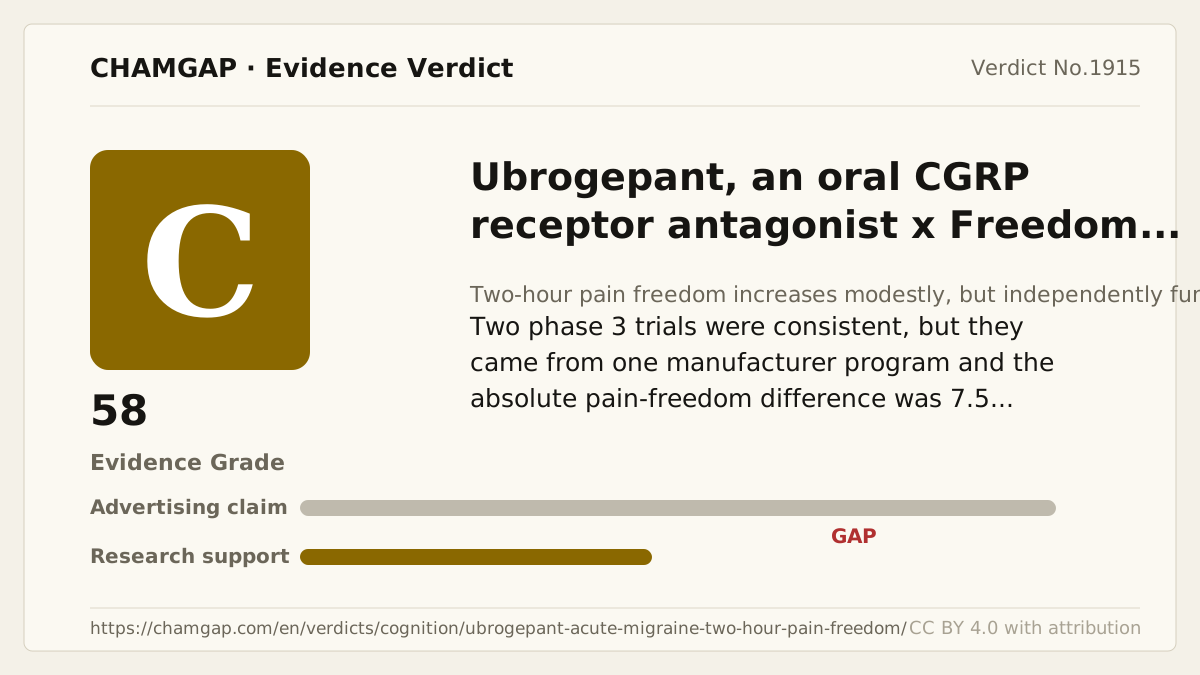
research showsThe grade is C. The common 50-mg dose met both co-primary endpoints—pain freedom and absence of the most bothersome symptom—in ACHIEVE I and II. In ACHIEVE II, two-hour pain freedom was 101/464 (21.8%) versus 65/456 (14.3%), difference 7.5 points (95% CI 2.6 to 12.5). Both trials were funded within the same Allergan program, giving C with 50 points.
ads claimFast pain freedom describes an outcome in a minority at the two-hour time point. It does not establish migraine prevention or superiority over another active acute treatment.
Useful facts when choosing a product
- ACHIEVE II's 1,686 randomized participants and 1,355 modified intention-to-treat participants are different denominators.
- The common 50-mg dose met both co-primary endpoints in both trials, but ACHIEVE II's 25-mg dose failed the most-bothersome-symptom endpoint.
- Both confirmed phase 3 trials were in the Allergan development program; no independently funded confirmatory trial was identified.
Chamgap Semantic Classification Code
Candidate index · review held
UNK.ubrogepant.oral.freedom-from-pain-and-the-most-bothersome-associated-symptom-after-treatment-of-an-acute-migraine.treat.placeboUnknown > Ubrogepant > Oral > Freedom from pain and the most bothersome associated symptom after treatment of an acute migraine > Treatment or remission claim > Placebo
An automated migration candidate, not an issued permanent code; exact claim scope remains under review. This machine-generated migration candidate helps retrieval but is not a permanent assignment. The original verdict ID and URL remain authoritative.
What the research actually shows
ACHIEVE I randomized 1,672 participants: 559 placebo, 556 to 50 mg, and 557 to 100 mg; the modified intention-to-treat population was 1,327. ACHIEVE II randomized 1,686: 563 placebo, 561 to 25 mg, and 562 to 50 mg; modified intention to treat was 1,355. With 50 mg in ACHIEVE II, pain freedom was 21.8% versus 14.3%, and most-bothersome-symptom freedom was 180/463 (38.9%) versus 125/456 (27.4%), difference 11.5 points (95% CI 5.4 to 17.5). Both trials were funded within the same Allergan program.
Why this is classified as C (50)
Both manufacturer phase 3 trials and their pooled analysis were consistently positive on co-primary endpoints, but lack of independent replication and single-attack short-duration design give C with 50 points.
Counterpoint. Its place as a nonvasoconstrictive option for patients unable to use or respond to triptans is separate from this placebo comparison.
Rejudgment record. Cross-check applied — Accepted successful co-primary endpoints and concordant pooled results across two Allergan phase 3 trials while accounting for one manufacturer program and single-attack short-duration design
| Endpoint | P | Symptom or function itself is the target - including patient reports and performance tests |
| Replication | R1 | Single confirmatory trial |
| Independence | I0 | Evidence comes only from manufacturer studies |
| Effect size | E+ | Meets the clinically important threshold |
Stored derived and displayed grades match; this is not a current recalculation or validity check (C).
Sub-claim grades by effect
This ingredient is marketed for several effects. A single overall grade blends strong and weak claims together, so each effect is graded separately here. The overall grade reflects the strongest disconfirming or core claim.
| Effect (sub-claim) | Grade | Basis |
|---|---|---|
| Pain freedom two hours after dosing | C | An absolute difference of about seven to eight points recurred in two manufacturer trials. |
| Absence of the most bothersome associated symptom | C | This ACHIEVE II co-primary endpoint succeeded significantly. |
Cross-check — AI research and Codex final gate
Evidence Table
| Study | Design | Sample | Funding | Endpoint | Result | Weight |
|---|---|---|---|---|---|---|
| Lipton et al. 2019 ACHIEVE II | Phase 3 randomized double-blind placebo-controlled single-attack trial | 1,686 randomized, placebo 563, 25 mg 561, 50 mg 562; 1,355 in modified intention to treat | Allergan sponsored and participated in design and analysis | Co-primary: two-hour pain freedom and absence of the most bothersome associated symptom | With 50 mg, pain freedom was 101/464 (21.8%) versus 65/456 (14.3%), difference 7.5 points (95% CI 2.6 to 12.5); symptom freedom was 180/463 (38.9%) versus 125/456 (27.4%), difference 11.5 points (95% CI 5.4 to 17.5). The 25-mg symptom endpoint failed at adjusted P=0.07. | Pivotal manufacturer phase 3 trial |
| Dodick et al. 2019 ACHIEVE I | Phase 3 randomized double-blind placebo-controlled single-attack trial | 1,672 randomized, placebo 559, 50 mg 556, 100 mg 557; 1,327 in modified intention to treat | Same Allergan development program | Co-primary two-hour pain freedom and associated-symptom absence | With 50 mg, pain freedom was 81/422 (19.2%) versus 54/456 (11.8%), difference 7.4 points, P=0.002; symptom freedom was 162/420 (38.6%) versus 126/454 (27.8%), difference 10.8 points, P=0.002; 95% CIs for the four ACHIEVE-I comparisons were not confirmed. | Concordant but not independent replication |
Receipt — 2 References
All 2 cited sources were verified for existence at the original page (as of 2026-08-01).
Final verification and publication gate: Codex · Evidence date: 2026-08-01 · Corrections: none
Cite this verdict
[Chamgap] Ubrogepant x two-hour pain freedom in acute migraine — Evidence Grade C·50. 2 cited sources checked. Source: https://chamgap.com/en/verdicts/cognition/ubrogepant-acute-migraine-two-hour-pain-freedom/ · CC BY 4.0CC BY 4.0 — free to use with attribution; do not distort grades, numbers, or verdict meaning.
What this document does and does not do
Chamgap is an information source. It reports what research has and has not confirmed; it does not tell readers what to take or buy. That decision belongs to readers and, when needed, medical or legal professionals. This verdict reflects literature available up to the search date and may change as new research appears. Nothing here is medical advice.