
Carotid endarterectomy,
does it really help with Prevention of ipsilateral stroke and stroke death after recent TIA or nondisabling stroke with 70% to 99% carotid stenosis?
research showsCarotid endarterectomy is rated A because randomized trials show a large reduction in ipsilateral and severe or fatal stroke after recent TIA or nondisabling stroke with 70% to 99% ipsilateral carotid stenosis. In 659 NASCET participants, two-year ipsilateral stroke risk fell from 26% with medical therapy to 9% with surgery. The benefit is procedure-specific, but net benefit depends on patient selection and operator and institutional outcomes.
ads claimCarotid stenosis alone is not an indication for the same benefit. This verdict best fits recent symptoms, NASCET-method 70% to 99% stenosis, nondisabling presentation, acceptable operative risk, and reasonable life expectancy.
Useful facts when choosing a product
- Carotid endarterectomy is a non-drug vascular operation that removes the atherosclerotic plaque, requiring preoperative imaging and etiologic and anatomic assessment.
- Benefit is generally greatest when delay after symptoms is short, but a large infarct, hemorrhagic risk, or major comorbidity can change timing and eligibility.
- Perioperative stroke or death, myocardial infarction, bleeding, and cranial nerve injury can occur, making an experienced operator and a center with verified low complication rates essential.
Chamgap Semantic Classification Code
Candidate index · review held
P.carotid-endarterectomy.procedural.ipsilateral-stroke-and-stroke-death-after-recent-tia-or-nondisabling-stroke-with-70-percent-to-99-percent-carotid-stenosis.prevent.UNKProcedures, devices and tests > Carotid endarterectomy > Procedural > ipsilateral stroke and stroke death after recent TIA or nondisabling stroke with 70% to 99% carotid stenosis > Occurrence-prevention claim > Unknown
An automated migration candidate, not an issued permanent code; exact claim scope remains under review. This machine-generated migration candidate helps retrieval but is not a permanent assignment. The original verdict ID and URL remain authoritative.
What the research actually shows
NASCET assigned 659 patients with TIA or nondisabling stroke within 120 days and 70% to 99% stenosis of the symptomatic internal carotid artery to medical therapy alone or endarterectomy. Two-year ipsilateral stroke fell from 26% to 9%, an absolute reduction of 17 percentage points. The independent ECST also found net reduction in disabling or fatal stroke in severe stenosis. A 2020 Cochrane individual-patient-data synthesis concluded that benefit is greatest for recently symptomatic severe stenosis.
Why this is classified as A (90)
NASCET's 26% versus 9% ipsilateral-stroke endpoint is supported by an independent European trial and pooled individual data, providing strong procedure-specific net benefit. With appropriate patient selection and operator expertise, this gives A with 90 points. Perioperative harm is included in net interpretation and separately stated under safety.
Counterpoint. Stenosis measurement and recent symptom status are decisive. The same A verdict does not automatically extend to asymptomatic disease or 50% to 69% stenosis, where net benefit is narrower.
Rejudgment record. Cross-check applied — Assigned A because NASCET showed a large procedure-specific hard-endpoint reduction in two-year ipsilateral stroke from 26% to 9% in recently symptomatic 70% to 99% stenosis, consistent with independent ECST and individual-patient-data synthesis, conditional on experienced operators and appropriate selection
Sub-claim grades by effect
This ingredient is marketed for several effects. A single overall grade blends strong and weak claims together, so each effect is graded separately here. The overall grade reflects the strongest disconfirming or core claim.
| Effect (sub-claim) | Grade | Basis |
|---|---|---|
| Prevention of ipsilateral stroke | A | NASCET reduced two-year risk from 26% to 9%. |
| Prevention of stroke death | A | NASCET reduced the major-or-fatal ipsilateral stroke composite from 13.1% to 2.5%; fatal events alone were not isolated in that estimate. |
| Prevention of major or disabling stroke | A | NASCET and the independent ECST consistently showed net reduction including perioperative risk. |
Cross-check — AI research and Codex final gate
Evidence Table
| Study | Design | Sample | Funding | Endpoint | Result | Weight |
|---|---|---|---|---|---|---|
| Barnett HJM et al.; NASCET Collaborators. 1991 | Multicenter randomized trial of surgery versus medical therapy | 659 patients with recently symptomatic 70% to 99% stenosis | Public support from the United States NINDS and Medical Research Council of Canada | Two-year ipsilateral stroke and major or fatal stroke | Two-year ipsilateral stroke was 26% versus 9%; major or fatal ipsilateral stroke was 13.1% versus 2.5%. | Decisive procedure-specific hard-endpoint evidence |
| Rerkasem A et al. Cochrane. 2020 | Systematic review and individual-patient-data synthesis of randomized trials | 6,092 participants in three major trials | Academic support through the Cochrane Stroke Group | Any stroke or operative death and ipsilateral ischemic stroke | Confirmed that net benefit from endarterectomy was greatest in recently symptomatic 70% to 99% stenosis. | Independent pooled confirmation |
| European Carotid Surgery Trialists' Collaborative Group (ECST). 1998 | Final report of a multicenter randomized trial of surgery versus conservative management | 3,024 patients with recently symptomatic carotid stenosis | Public support from the UK Medical Research Council, a funding source independent of NASCET's United States NINDS, as named in the trial title | Three-year major stroke or death including perioperative risk | Above about 80% stenosis, three-year major stroke or death was 26.5% versus 14.9%, an absolute reduction of 11.6 percentage points; across all stenosis grades combined there was no surgical benefit at 37.0% versus 36.5%, unfavorable in milder stenosis. | Independent hard-endpoint replication by different investigators with separate public funding |
| Mayberg MR et al.; VA Cooperative Studies Program 309. 1991 | Multicenter randomized trial of surgery versus medical therapy, stopped early after other trial results were published | 189 men with symptomatic stenosis greater than 50% | Public support from the United States Veterans Affairs Cooperative Studies Program, a third public agency separate from NINDS and the UK MRC | Ipsilateral stroke or crescendo transient ischemic attacks | At a mean follow-up of 11.9 months, events occurred in 7.7% versus 19.4%, an absolute reduction of 11.7 percentage points (P=.011); above 70% stenosis the absolute reduction was larger at 17.7 percentage points (P=.004). | Small independent replication with a third public funding source |
Receipt — 4 References
All 4 cited sources were verified for existence at the original page (as of 2026-08-11).
Final verification and publication gate: Codex · Evidence date: 2026-08-11 · Corrections: none
Cite this verdict
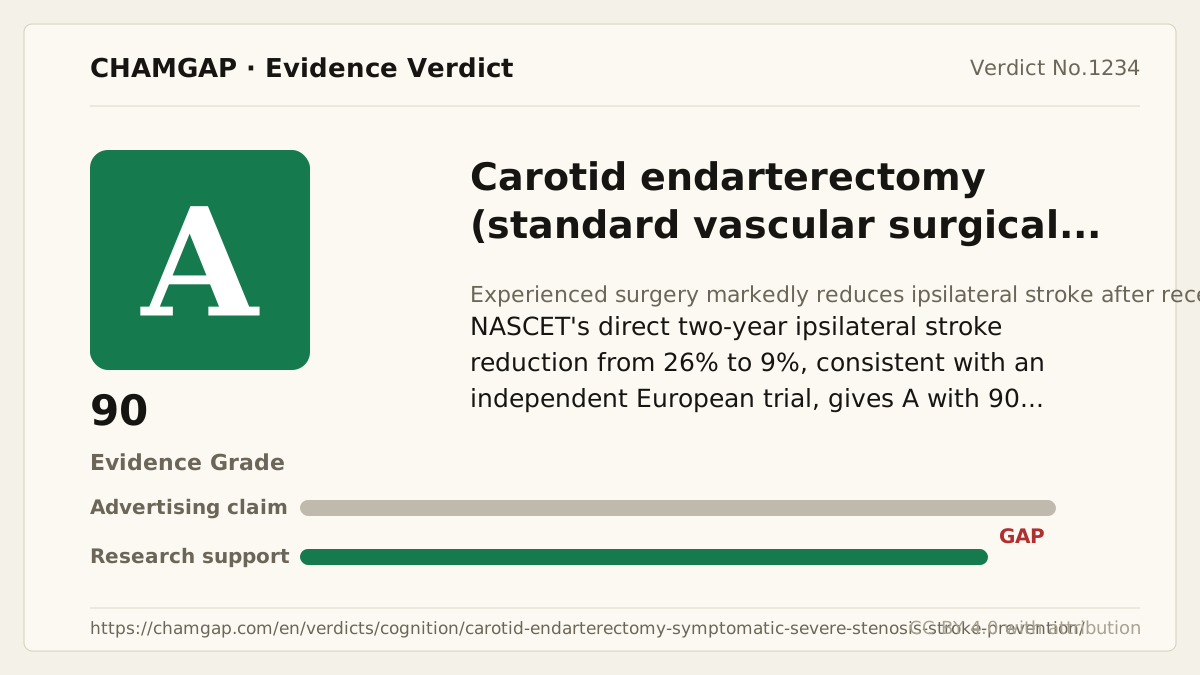
[Chamgap] Carotid endarterectomy x stroke prevention in recently symptomatic severe carotid stenosis — Evidence Grade A·90. 4 cited sources checked. Source: https://chamgap.com/en/verdicts/cognition/carotid-endarterectomy-symptomatic-severe-stenosis-stroke-prevention/ · CC BY 4.0CC BY 4.0 — free to use with attribution; do not distort grades, numbers, or verdict meaning.
What this document does and does not do
Chamgap is an information source. It reports what research has and has not confirmed; it does not tell readers what to take or buy. That decision belongs to readers and, when needed, medical or legal professionals. This verdict reflects literature available up to the search date and may change as new research appears. Nothing here is medical advice.