
Aspirin,
does it really help with Reduced early death and recurrent stroke when started within 48 hours of acute ischemic stroke after intracranial hemorrhage has been excluded?
research showsAspirin 160 to 300 mg started within 48 hours of acute ischemic stroke after intracranial hemorrhage has been excluded is rated A. Two independent megatrials, CAST with 21,106 participants and IST with 19,435, pointed in the same direction. Their prospectively planned combined analysis found seven fewer recurrent ischemic strokes and nine fewer further strokes or deaths per 1,000 patients. A 2022 Cochrane review also found nine fewer deaths during follow-up and 13 fewer cases of death or dependency per 1,000, and AHA/ASA guidance recommends aspirin within 24 to 48 hours. This is not a self-treatment for stroke symptoms: brain imaging, bleeding contraindications, swallowing safety, and thrombolysis timing require clinical management. The verdict concerns acute treatment, not chronic secondary prevention or dementia prevention.
ads claimConsumer messaging can collapse the evidence into taking aspirin immediately whenever stroke is suspected. The proven intervention is clinician-managed acute treatment after hemorrhage has been excluded and thrombolysis status, swallowing safety, and bleeding contraindications have been assessed. Evidence for chronic recurrence prevention or dementia prevention must not be substituted for this acute-care verdict.
Useful facts when choosing a product
- The regimen directly supported by the trials starts aspirin 160 to 300 mg within 48 hours of acute ischemic stroke. CAST used 160 mg daily and IST used 300 mg daily.
- A patient should not self-administer aspirin merely because stroke symptoms are suspected. Noncontrast brain CT or MRI must exclude intracranial hemorrhage, and clinicians must assess contraindications and the route of administration.
- After intravenous thrombolysis, antiplatelet treatment is generally withheld for 24 hours and started only after follow-up brain imaging excludes hemorrhage. The stroke team also determines how thrombectomy and other antithrombotic drugs affect timing.
- Gastrointestinal bleeding, intracranial bleeding, hypersensitivity, and worsening of aspirin-sensitive asthma can occur. Active bleeding, severe thrombocytopenia, and recent major surgery require individualized risk assessment.
Chamgap Semantic Classification Code
Candidate index · review held
UNK.aspirin.oral.early-death-and-recurrent-stroke-when-started-within-of-acute-ischemic-stroke-after-intracranial-hemorrhage-has-been-excluded.reduce.MULTIUnknown > aspirin > Oral > early death and recurrent stroke when started within of acute ischemic stroke after intracranial hemorrhage has been excluded > Reduction claim > Multiple: primary unresolved
An automated migration candidate, not an issued permanent code; exact claim scope remains under review. This machine-generated migration candidate helps retrieval but is not a permanent assignment. The original verdict ID and URL remain authoritative.
What the research actually shows
CAST assigned 21,106 patients with suspected acute ischemic stroke to aspirin 160 mg daily or placebo for up to four weeks and reported about 5.4 fewer in-hospital deaths and 4.7 fewer recurrent ischemic strokes per 1,000. IST assigned 19,435 patients to aspirin 300 mg daily or no aspirin for 14 days; recurrent ischemic stroke decreased while hemorrhagic stroke increased slightly, leaving a net benefit for death or nonfatal stroke. The patient-level combined analysis found seven fewer recurrent ischemic strokes and nine fewer further strokes or deaths per 1,000, with about two additional hemorrhagic strokes. The 2022 Cochrane review, dominated by CAST and IST, estimated 13 fewer cases of death or dependency and nine fewer deaths during follow-up per 1,000 when aspirin 160 to 300 mg was started within 48 hours.
Why this is classified as A (93)
Two independent megatrials, CAST and IST, a patient-level analysis of about 40,000 participants, the Cochrane synthesis, and AHA/ASA standard-of-care guidance converge on a net hard-outcome benefit for recurrent ischemic stroke and death or dependency. The absolute benefit is modest at about 9 per 1,000 and hemorrhagic stroke increases by about 2 per 1,000, so with that bleeding trade-off the grade sits below the top of the A band, at A with 93 points.
Counterpoint. The efficacy is firmly established, but the absolute benefit is not unlimited. The conclusion does not justify self-treatment before imaging, antiplatelet use immediately after thrombolysis, or treatment in a patient with active bleeding.
Rejudgment record. Cross-check applied — Applied the A standard because the independent CAST and IST megatrials, a patient-level combined analysis of about 40,000 patients, and the Cochrane synthesis agree on aspirin-specific hard-outcome benefit for recurrent ischemic stroke and death or dependency
Sub-claim grades by effect
This ingredient is marketed for several effects. A single overall grade blends strong and weak claims together, so each effect is graded separately here. The overall grade reflects the strongest disconfirming or core claim.
| Effect (sub-claim) | Grade | Basis |
|---|---|---|
| Reduction in recurrent ischemic stroke when started within 48 hours | A | The combined CAST and IST analysis found an absolute reduction of seven per 1,000. |
| Reduction in early death | B | CAST and the combined analysis were positive, but death alone was less certain in IST than the composite outcome, supporting a conservative one-grade downgrade. |
| Reduction in death or dependency during follow-up | A | The Cochrane synthesis found 13 fewer cases per 1,000, with the two megatrials providing most of the evidence. |
Cross-check — AI research and Codex final gate
Evidence Table
| Study | Design | Sample | Funding | Endpoint | Result | Weight |
|---|---|---|---|---|---|---|
| CAST (Chinese Acute Stroke Trial) Collaborative Group. 1997 | Multicenter randomized double-blind placebo-controlled megatrial | 21,106 patients with suspected acute ischemic stroke | Predominantly Chinese public research support; not a commercial marketing trial | Death, recurrent ischemic or hemorrhagic stroke, and death or nonfatal stroke within four weeks | Aspirin 160 mg daily reduced death by about 5.4 per 1,000 and recurrent ischemic stroke by about 4.7 per 1,000, with a small increase in hemorrhagic stroke. | Independent hard-outcome megatrial |
| International Stroke Trial Collaborative Group. 1997 | Multicenter randomized open-label 2-by-2 factorial megatrial | 19,435 patients with acute ischemic stroke | Public and charitable support including the UK Medical Research Council and Stroke Association | Death and recurrent stroke at 14 days and death or dependency at six months | Aspirin 300 mg daily reduced recurrent ischemic stroke and slightly increased hemorrhagic stroke, with a net benefit for death or nonfatal stroke. | Second independent hard-outcome megatrial |
| Chen ZM et al.; CAST and IST Collaborative Groups. 2000 | Prospectively planned patient-level combined analysis of CAST and IST | About 40,000 randomized patients | Academic combined analysis of two independent trials | In-hospital recurrent ischemic stroke, hemorrhagic stroke, and further stroke or death | Seven fewer recurrent ischemic strokes and nine fewer further strokes or deaths per 1,000, with about two additional hemorrhagic strokes per 1,000. | Decisive patient-level combined evidence |
| Minhas JS et al. 2022 | Cochrane systematic review and meta-analysis of randomized trials | 11 trials and 42,226 participants; 96% of data from CAST and IST | Public support from the UK NIHR | Death or dependency, death during follow-up, recurrent ischemic stroke, and symptomatic intracranial hemorrhage | Aspirin produced 13 fewer cases of death or dependency, nine fewer deaths during follow-up, and seven fewer recurrent ischemic strokes per 1,000. | Current key synthesis |
Receipt — 5 References
All 5 cited sources were verified for existence at the original page (as of 2026-07-24).
Final verification and publication gate: Codex · Evidence date: 2026-07-24 · Corrections: none
Cite this verdict
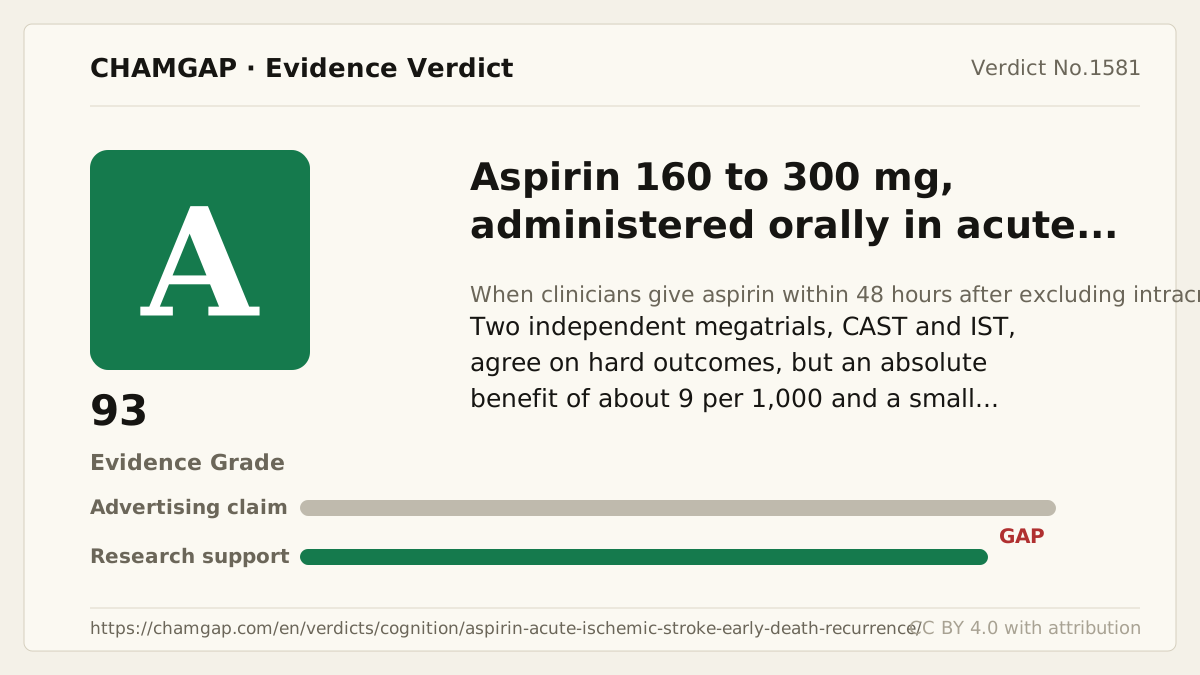
[Chamgap] Aspirin x reduced early death and recurrent stroke in acute ischemic stroke — Evidence Grade A·93. 5 cited sources checked. Source: https://chamgap.com/en/verdicts/cognition/aspirin-acute-ischemic-stroke-early-death-recurrence/ · CC BY 4.0CC BY 4.0 — free to use with attribution; do not distort grades, numbers, or verdict meaning.
What this document does and does not do
Chamgap is an information source. It reports what research has and has not confirmed; it does not tell readers what to take or buy. That decision belongs to readers and, when needed, medical or legal professionals. This verdict reflects literature available up to the search date and may change as new research appears. Nothing here is medical advice.