
Mechanical thrombectomy,
does it really help with Reduced disability and dependence and increased functional independence at 90 days after acute ischemic stroke caused by anterior-circulation large-vessel occlusion?
research showsMechanical thrombectomy is rated A because evidence that it reduces 90-day disability and increases functional independence after acute anterior-circulation large-vessel-occlusion stroke is exceptionally strong. HERMES pooled individual data from 1,287 participants in five randomized trials and found a favorable shift across the 90-day modified Rankin Scale, with an adjusted common odds ratio of 2.49. Functional independence, defined as a score of 0 to 2, occurred in 46.0% versus 26.5%, and the number needed to treat for one patient to have disability reduced by at least one Rankin level was 2.6. Several separate large trials, including MR CLEAN, converged on the same direct clinical outcome, so this is not a verdict based only on the surrogate of reperfusion. Symptomatic intracranial hemorrhage, vessel perforation or dissection, distal embolization, and access-site complications remain separate safety issues.
ads claimA high reperfusion rate does not guarantee complete recovery; even with thrombectomy, functional independence was 46.0%, so disability or death remained in more than half of treated participants. Benefit diminishes with time, and transfer to a capable center and imaging selection must not be delayed.
Useful facts when choosing a product
- Mechanical thrombectomy is an emergency endovascular procedure in which a catheter is advanced to the occluded artery and the clot is removed with a stent retriever or aspiration.
- The evidence mainly applies to patients with proximal anterior-circulation large-vessel occlusion confirmed by vascular imaging who meet clinical, imaging, and time-window criteria for prompt treatment.
- In patients eligible for intravenous thrombolysis, thrombectomy evaluation should not unnecessarily delay thrombolysis, and the two treatments can be used together rather than as alternatives.
- Symptomatic intracranial hemorrhage, vessel perforation or dissection, embolization to a new territory, access-site bleeding, and contrast-related problems require immediate management by a stroke and neurointerventional team.
Chamgap Semantic Classification Code
Candidate index · review held
P.mechanical-thrombectomy.procedural.disability-and-dependence-and-increased-functional-independence-at-after-acute-ischemic-stroke-caused-by-anterior-circulation-large-vessel-occlusion.reduce.UNKProcedures, devices and tests > Mechanical thrombectomy > Procedural > disability and dependence and increased functional independence at after acute ischemic stroke caused by anterior-circulation large-vessel occlusion > Reduction claim > Unknown
An automated migration candidate, not an issued permanent code; exact claim scope remains under review. This machine-generated migration candidate helps retrieval but is not a permanent assignment. The original verdict ID and URL remain authoritative.
What the research actually shows
Goyal and colleagues in HERMES pooled individual data from five positive randomized trials using an adjusted mixed-effects ordinal logistic model. Among 634 participants assigned to thrombectomy and 653 controls, the 90-day modified Rankin distribution improved substantially, with the direction of benefit retained across major subgroups defined by age, sex, stroke severity, occlusion site, and intravenous alteplase use. Symptomatic intracranial hemorrhage in HERMES was 4.4% versus 4.3%, although that does not mean the procedure has no individual hazards. The preceding MR CLEAN trial enrolled 500 participants at 16 Dutch centers and demonstrated improved Rankin shift and functional independence with treatment available within six hours. Convergence across devices, countries, and selection strategies on the same clinical outcome is central to the A grade.
Why this is classified as A (97)
In HERMES, five randomized trials involving 1,287 participants yielded a common odds ratio of 2.49 for 90-day Rankin shift, functional independence in 46.0% versus 26.5%, and a number needed to treat of 2.6 for at least one Rankin-level reduction in disability. MR CLEAN and the other component trials replicated the direct clinical benefit. Convergence of multiple large trials on disability, dependence, and independence rather than a surrogate supports A with 97 points. Bleeding and procedural complications remain separate safety considerations.
Counterpoint. This verdict concerns patients with confirmed anterior-circulation large-vessel occlusion who are eligible for emergency intervention. The absolute benefit varies with infarct extent, collateral circulation, onset time, baseline function, and treatment delay.
Rejudgment record. New verdict — Applied grade A for the direct 90-day modified-Rankin disability shift, common odds ratio 2.49, functional independence of 46.0% versus 26.5%, and number needed to treat of 2.6 in the 1,287-participant individual-patient HERMES analysis of five randomized trials; incorporated replication in MR CLEAN and the other trials and the hard-endpoint exception to the manufacturer ceiling for a major prescription procedure
Sub-claim grades by effect
This ingredient is marketed for several effects. A single overall grade blends strong and weak claims together, so each effect is graded separately here. The overall grade reflects the strongest disconfirming or core claim.
| Effect (sub-claim) | Grade | Basis |
|---|---|---|
| Reduced disability and dependence at 90 days after acute anterior-circulation large-vessel-occlusion ischemic stroke | A | The direct disability endpoint improved substantially in individual data from five HERMES trials, with an adjusted common odds ratio of 2.49 for modified-Rankin shift. |
| Increased functional independence at 90 days, defined as modified Rankin Scale 0 to 2 | A | Rates were 46.0% versus 26.5% in HERMES, with a consistent direction across component trials. |
| Improved functional outcome in promptly selected patients with proximal anterior-circulation large-vessel occlusion | A | The effect directly applies to patients meeting vascular-imaging, clinical, and time-window criteria and should not be extended to every ischemic stroke or unlimited delay. |
Cross-check — AI research and Codex final gate
Evidence Table
| Study | Design | Sample | Funding | Endpoint | Result | Weight |
|---|---|---|---|---|---|---|
| Goyal M et al.; HERMES collaborators. 2016 | Individual-patient-data meta-analysis of five randomized trials | 1,287 participants; 634 assigned to thrombectomy and 653 to control | Mixed public, nonprofit, and some device-industry support across component trials | Disability shift across the full 90-day modified Rankin Scale, functional independence, and safety | The adjusted common odds ratio was 2.49 (95% CI 1.76 to 3.53); functional independence was 46.0% versus 26.5%, and the number needed to treat for one Rankin-level disability reduction was 2.6. | Pivotal synthesis of multiple trials with a direct disability endpoint |
| Berkhemer OA et al.; MR CLEAN Investigators. 2015 | Randomized open-label controlled trial with blinded outcome assessment at 16 centers | 500 participants with proximal anterior-circulation occlusion; 233 assigned to endovascular treatment and 267 to usual care | Dutch Heart Foundation and unrestricted grants from several device companies; investigator independence reported | Ninety-day modified Rankin Scale distribution and functional independence | The adjusted common odds ratio was 1.67 (95% CI 1.21 to 2.30), and functional independence improved to 32.6% versus 19.1%. | Foundational independent large randomized trial with a direct clinical endpoint |
| Bracard S et al.; THRACE investigators. 2016 | Randomized controlled trial at 26 French centers comparing intravenous alteplase alone with alteplase plus mechanical thrombectomy | 414 randomly assigned; 208 to intravenous thrombolysis alone and 204 to added thrombectomy | French Ministry for Health, 2009 STIC programme (grant 2009 A00753-54); exclusively public funding | Functional independence at 3 months, defined as modified Rankin Scale 0 to 2, with mortality and symptomatic intracranial hemorrhage as safety outcomes | Functional independence improved to 53% versus 42% (odds ratio 1.55, 95% CI 1.05 to 2.30; P=0.028), with no difference in 3-month mortality or 24-hour symptomatic intracranial hemorrhage; thrombectomy-related vasospasm occurred in 23% and embolization to a new territory in 6%. | Independent replication trial outside HERMES by a separate group with exclusively public funding |
| Campbell BC et al.; EXTEND-IA Investigators. 2015 | Randomized controlled trial with perfusion-imaging selection comparing alteplase alone with added stent-retriever thrombectomy, stopped early for efficacy | 70 participants; 35 in each group | Australian National Health and Medical Research Council and others, as stated in the article | Coprimary outcomes were reperfusion at 24 hours and early neurologic improvement at 3 days; 90-day modified Rankin functional outcome was secondary | Median reperfusion at 24 hours was 100% versus 37% (P<0.001) and early neurologic improvement 80% versus 37% (P=0.002), with 90-day functional independence of 71% versus 40% (P=0.01); death and symptomatic intracerebral hemorrhage did not differ significantly. | Publicly led component trial of HERMES by a separate group, individually replicating the direction of benefit |
Receipt — 4 References
All 4 cited sources were verified for existence at the original page (as of 2026-08-11).
Final verification and publication gate: Codex · Evidence date: 2026-08-11 · Corrections: none
Cite this verdict
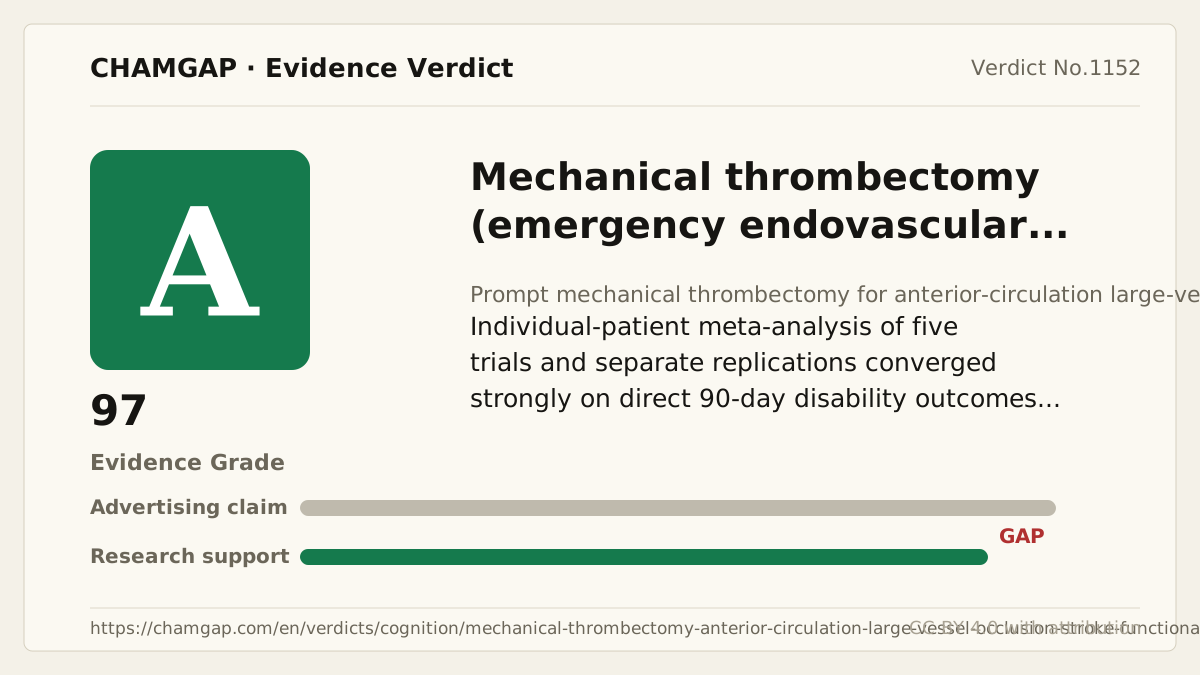
[Chamgap] Mechanical thrombectomy x reduced 90-day disability and increased independence after anterior-circulation large-vessel-occlusion stroke — Evidence Grade A·97. 4 cited sources checked. Source: https://chamgap.com/en/verdicts/cognition/mechanical-thrombectomy-anterior-circulation-large-vessel-occlusion-stroke-functional-outcome/ · CC BY 4.0CC BY 4.0 — free to use with attribution; do not distort grades, numbers, or verdict meaning.
What this document does and does not do
Chamgap is an information source. It reports what research has and has not confirmed; it does not tell readers what to take or buy. That decision belongs to readers and, when needed, medical or legal professionals. This verdict reflects literature available up to the search date and may change as new research appears. Nothing here is medical advice.