
Propranolol,
does it really help with Reduction in attack frequency for adult episodic migraine prevention?
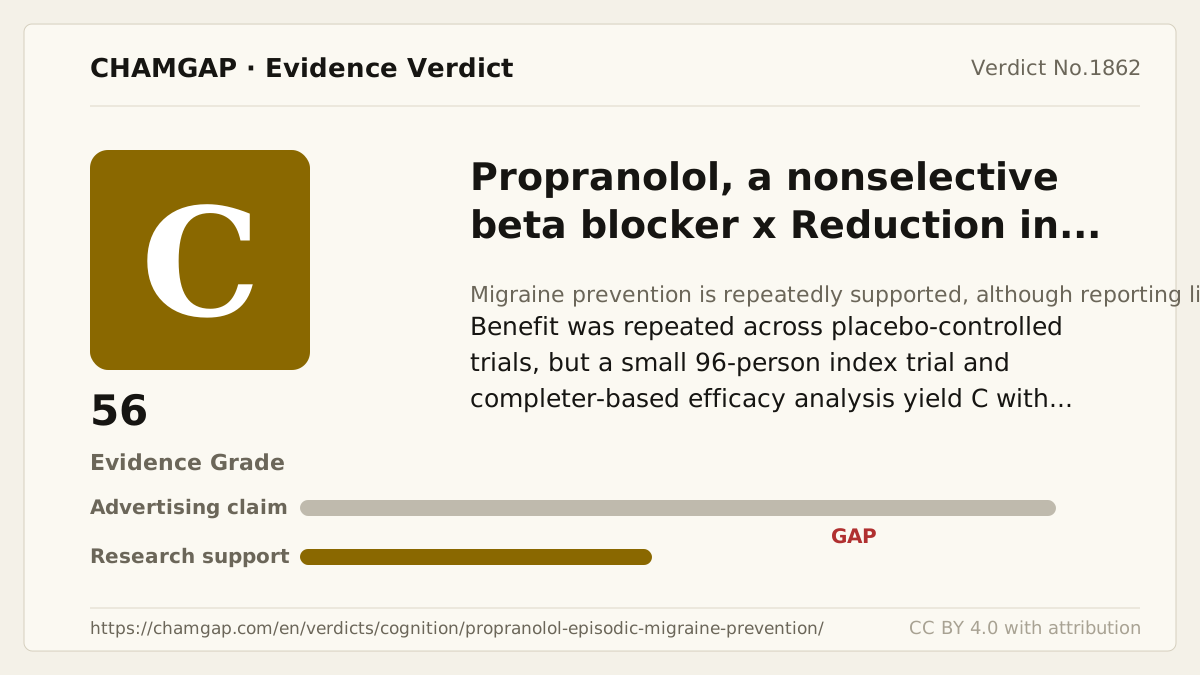
research showsPropranolol is rated C. Older placebo-controlled trials repeatedly improved migraine frequency and response, but the index trial randomized only 96 people and based efficacy mainly on 80 completers.
ads claimPrevention can be marketed as elimination of attacks, but average response varies and should be assessed over weeks at a tolerated dose.
Useful facts when choosing a product
- The index crossover trial used propranolol 80 mg twice daily.
- The distinct counts are 96 randomized, 80 in the efficacy analysis, and 83 in adverse-event data.
Chamgap Semantic Classification Code
Candidate index · review held
UNK.propranolol.UNK.attack-frequency-episodic-migraine-prevention.prevent.MULTIUnknown > Propranolol > Unknown > attack frequency episodic migraine prevention > Occurrence-prevention claim > Multiple: primary unresolved
An automated migration candidate, not an issued permanent code; exact claim scope remains under review. This machine-generated migration candidate helps retrieval but is not a permanent assignment. The original verdict ID and URL remain authoritative.
What the research actually shows
Tfelt-Hansen 1984 enrolled 96 people in a three-period crossover trial. Eighty-three received all three treatments and contributed adverse-event data, while the Cochrane efficacy extraction used 80. Propranolol produced 3.69 attacks per 28 days and a headache index of 6.66 versus 4.83 and 9.03 with placebo. The 2004 Cochrane review included 58 trials and 5,072 participants, including 26 placebo-controlled trials. Across nine trials with response data, the risk ratio for at least 50% response was 1.94 (95% CI 1.61 to 2.35). International Headache Society prevention-trial guidance identifies at least 50% reduction as a clinically relevant response threshold; it is used only to source the threshold, not to recommend treatment. Funding was unreported for many of the 26 placebo-controlled trials, and independent review does not change source-trial funding.
Why this is classified as C (54)
Replicated patient-important response is tempered by a 96-person index trial, an efficacy analysis centered on 80 completers, and incomplete source-trial funding reports, yielding C with 54 points.
Counterpoint. Asthma, bradycardia, low blood pressure, comedications, and gradual dose adjustment matter in selection.
Rejudgment record. Cross-check applied — Accepted replicated placebo-controlled prevention effects while accounting for a 96-person trial and efficacy analysis centered on 80 completers
| Endpoint | P | Symptom or function itself is the target - including patient reports and performance tests |
| Replication | R2 | Independently replicated across trials |
| Independence | I1 | Mixed funding sources |
| Effect size | E+ | Meets the clinically important threshold |
Stored derived and displayed grades match; this is not a current recalculation or validity check (C).
Sub-claim grades by effect
This ingredient is marketed for several effects. A single overall grade blends strong and weak claims together, so each effect is graded separately here. The overall grade reflects the strongest disconfirming or core claim.
| Effect (sub-claim) | Grade | Basis |
|---|---|---|
| Reduction in monthly migraine attack frequency | B | Multiple placebo-controlled trials consistently found a reduction. |
| At least 50% reduction in attack frequency | B | The pooled risk ratio across nine trials was 1.94. |
| Reduction in headache index | B | The index trial found 6.66 versus 9.03, P<0.01. |
Cross-check — AI research and Codex final gate
Evidence Table
| Study | Design | Sample | Funding | Endpoint | Result | Weight |
|---|---|---|---|---|---|---|
| Tfelt-Hansen P et al. 1984 | Four-center randomized double-blind three-period crossover placebo- and active-controlled trial | 96 randomized; 80 in the efficacy analysis; 83 in adverse-event data | Funding source not identified in the accessible abstract or bibliographic record | Migraine attack frequency per 28 days and headache index | 3.69 versus 4.83 attacks, P<0.05, and headache index 6.66 versus 9.03, P<0.01; primary clinical comparison succeeded | Direct placebo-controlled efficacy evidence |
| Linde K and Rossnagel K. 2004 | Cochrane systematic review and meta-analysis of randomized trials | 58 trials and 5,072 participants; 26 placebo-controlled trials | No separate industry funding reported for the review; funding was inadequately reported in many included trials | Attack frequency and at least 50% response | Risk ratio 1.94 (95% CI 1.61 to 2.35) across nine trials with response data; multiple trials positive | Replication across multiple research groups |
Receipt — 3 References
All 3 cited sources were verified for existence at the original page (as of 2026-07-24).
Final verification and publication gate: Codex · Evidence date: 2026-07-24 · Corrections: none
Cite this verdict
[Chamgap] Propranolol x migraine attack prevention — Evidence Grade C·54. 3 cited sources checked. Source: https://chamgap.com/en/verdicts/cognition/propranolol-episodic-migraine-prevention/ · CC BY 4.0CC BY 4.0 — free to use with attribution; do not distort grades, numbers, or verdict meaning.
What this document does and does not do
Chamgap is an information source. It reports what research has and has not confirmed; it does not tell readers what to take or buy. That decision belongs to readers and, when needed, medical or legal professionals. This verdict reflects literature available up to the search date and may change as new research appears. Nothing here is medical advice.