
Perindopril-based regimen,
does it really help with Prevention of recurrent stroke after stroke or transient ischemic attack?
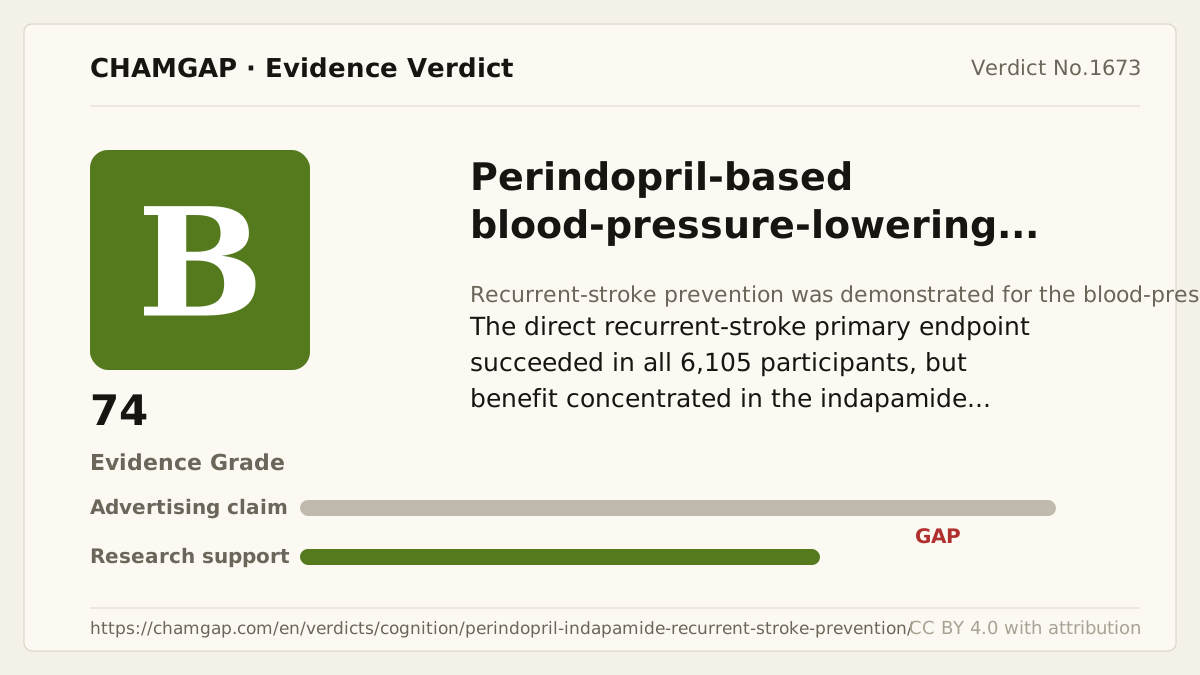
research showsA perindopril-based blood-pressure-lowering regimen is rated B for reducing recurrent stroke after stroke or transient ischemic attack. PROGRESS randomized 6,105 participants and analyzed all of them by intention to treat. The prespecified primary endpoint of fatal or nonfatal stroke occurred in 307 of 3,051 versus 420 of 3,054, a 28% relative risk reduction (95% CI 17 to 38), P<.0001, so it succeeded. The benefit was 43% with added indapamide, however, while perindopril alone had a nonsignificant 5% reduction (95% CI -19 to 23), preventing attribution to perindopril alone.
ads claimIt is wrong to claim that perindopril alone reduced recurrent stroke by 28% or 43%. The evidence applies to a perindopril-based strategy that added indapamide in suitable patients.
Useful facts when choosing a product
- PROGRESS used perindopril 4 mg once daily as the base regimen and added indapamide 2 to 2.5 mg in suitable patients.
- The overall 28% reduction belongs to the flexible regimen, while the perindopril-only stratum had no significant stroke reduction.
- Blood pressure, renal function, potassium, and sodium require monitoring, with attention to hypotension, ACE-inhibitor cough or angioedema, and diuretic electrolyte abnormalities.
Chamgap Semantic Classification Code
Candidate index · review held
UNK.perindopril-based-blood-pressure-lowering-regimen.UNK.recurrent-stroke-after-stroke-or-transient-ischemic-attack.prevent.placeboUnknown > Perindopril-based blood-pressure-lowering regimen > Unknown > recurrent stroke after stroke or transient ischemic attack > Occurrence-prevention claim > Placebo
An automated migration candidate, not an issued permanent code; exact claim scope remains under review. This machine-generated migration candidate helps retrieval but is not a permanent assignment. The original verdict ID and URL remain authoritative.
What the research actually shows
PROGRESS randomly assigned 6,105 people with prior stroke or transient ischemic attack to a perindopril-based active regimen, 3,051 participants, or matching placebo, 3,054 participants, under double masking. Both the randomized count and actual intention-to-treat primary-analysis count were 6,105. Total stroke was reduced from 420 to 307 events, a 28% reduction with P<.0001, so the primary endpoint succeeded. Within active treatment, 1,770 were planned for perindopril plus indapamide and 1,281 for perindopril alone; risk reductions were 43% and a nonsignificant 5%, respectively. Servier supplied grants and drugs, Australian and New Zealand public bodies also supported the work, and academic committees reportedly controlled design, analysis, and reporting.
Why this is classified as B (74)
The direct recurrent-stroke primary endpoint succeeded with P<.0001 in all 6,105 randomized participants and later synthesis agrees that blood-pressure lowering prevents recurrence. Concentration of benefit in the indapamide combination and a null monotherapy stratum limit attribution, yielding B with 74 points.
Counterpoint. Prescribing should incorporate current blood pressure, renal function, electrolytes, and other secondary-prevention medicines. The trial does not require the same fixed combination for every patient.
Rejudgment record. Cross-check applied — Credited successful recurrent-stroke primary outcome in all 6,105 PROGRESS participants while treating null perindopril monotherapy and concentration of benefit with indapamide as an attribution limitation
Sub-claim grades by effect
This ingredient is marketed for several effects. A single overall grade blends strong and weak claims together, so each effect is graded separately here. The overall grade reflects the strongest disconfirming or core claim.
| Effect (sub-claim) | Grade | Basis |
|---|---|---|
| Prevention of total recurrent stroke with a perindopril-based regimen | B | The direct primary endpoint succeeded in all 6,105 participants, with a 28% reduction and P<.0001. |
| Prevention of recurrent stroke with perindopril plus indapamide | B | The prespecified combination stratum had a 43% reduction, but combination versus monotherapy was not itself randomized. |
| Prevention of recurrent stroke with perindopril alone | D | The monotherapy stratum was null, with a 5% reduction and 95% CI from -19 to 23. |
Cross-check — AI research and Codex final gate
Evidence Table
| Study | Design | Sample | Funding | Endpoint | Result | Weight |
|---|---|---|---|---|---|---|
| PROGRESS Collaborative Group. 2001 | Multinational randomized double-blind placebo-controlled trial | 6,105 randomized and included in the actual intention-to-treat primary analysis; 3,051 active and 3,054 placebo | Servier provided grants and study drugs, with additional public support including the Health Research Council of New Zealand and National Health and Medical Research Council of Australia | Total fatal or nonfatal stroke | 307 of 3,051 versus 420 of 3,054; relative risk reduction 28% (95% CI 17 to 38), P<.0001, so the primary endpoint succeeded. | Key large direct recurrent-stroke evidence |
| Kitagawa K et al. 2019 | Blood-pressure-target randomized trial and meta-analysis of four randomized trials | Four randomized trials and 4,895 participants in the meta-analysis | Public support from the Japanese Ministry of Health, Labour and Welfare and Japan Agency for Medical Research and Development; some investigators disclosed pharmaceutical relationships | Recurrent stroke | Intensive blood-pressure control reduced recurrent stroke, RR 0.78 (95% CI 0.64 to 0.96), P=.02, supporting strategy-level replication. | Independent strategy-level replication |
Receipt — 2 References
All 2 cited sources were verified for existence at the original page (as of 2026-07-24).
Final verification and publication gate: Codex · Evidence date: 2026-07-24 · Corrections: none
Cite this verdict
[Chamgap] Perindopril-based regimen x prevention of recurrent stroke — Evidence Grade B·74. 2 cited sources checked. Source: https://chamgap.com/en/verdicts/cognition/perindopril-indapamide-recurrent-stroke-prevention/ · CC BY 4.0CC BY 4.0 — free to use with attribution; do not distort grades, numbers, or verdict meaning.
What this document does and does not do
Chamgap is an information source. It reports what research has and has not confirmed; it does not tell readers what to take or buy. That decision belongs to readers and, when needed, medical or legal professionals. This verdict reflects literature available up to the search date and may change as new research appears. Nothing here is medical advice.