
Oxcarbazepine,
does it really help with Maintenance of 24- and 48-week seizure freedom with monotherapy in newly diagnosed focal epilepsy?
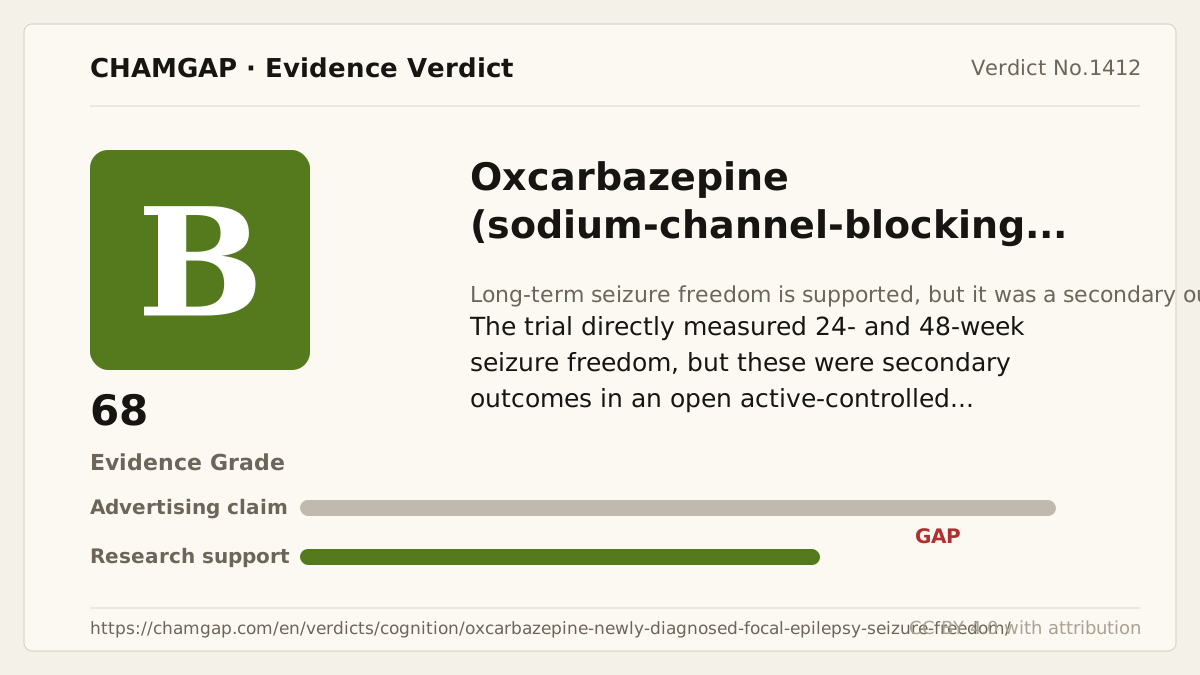
research showsOxcarbazepine monotherapy is rated B for newly diagnosed focal epilepsy. In an open-label randomized phase 4 trial at 23 Korean centers, 24- and 48-week seizure-freedom rates were 58.5% and 40.9% with oxcarbazepine, compared with 53.8% and 34.7% with levetiracetam. Neither seizure-freedom comparison was significant, and the primary purpose was to establish noninferiority of levetiracetam. Direct observation of long-term seizure freedom supports efficacy, but the active-controlled open-label design and secondary outcomes do not establish an absolute effect versus placebo and prevent an A grade.
ads claimBrand descriptions can imply guaranteed long-term complete seizure control after a new focal-epilepsy diagnosis. In the trial, about 41% remained seizure-free for the entire 48-week treatment period, and outcomes depend on titration, adherence, diagnosis, and individual risk.
Useful facts when choosing a product
- Oxcarbazepine is an oral prescription antiseizure medicine that modulates voltage-gated sodium channels and is used alone or with other medicines for focal seizures.
- Trileptal is an oxcarbazepine brand; oxcarbazepine is not the same ingredient as carbamazepine, lamotrigine, or lacosamide.
- Hyponatremia, dizziness, somnolence, diplopia, ataxia, and rash can occur, while severe hypersensitivity or serious skin reactions require urgent evaluation.
- Enzyme induction and other interactions can reduce hormonal-contraceptive effectiveness, and abrupt withdrawal can worsen seizures, so tapering must follow the prescription.
Chamgap Semantic Classification Code
Candidate index · review held
M.oxcarbazepine.oral.24-and-seizure-freedom-with-monotherapy-in-newly-diagnosed-focal-epilepsy.maintain.activeMedicinal interventions > Oxcarbazepine > Oral > 24- and seizure freedom with monotherapy in newly diagnosed focal epilepsy > Maintenance claim > Active comparator
An automated migration candidate, not an issued permanent code; exact claim scope remains under review. This machine-generated migration candidate helps retrieval but is not a permanent assignment. The original verdict ID and URL remain authoritative.
What the research actually shows
Kim and colleagues randomized 353 adults with newly or recently diagnosed focal epilepsy to oxcarbazepine or levetiracetam monotherapy and followed them for 50 weeks. In the oxcarbazepine arm, 58.5% achieved 24 consecutive seizure-free weeks and 40.9% remained seizure-free throughout the 48-week treatment period. Exploratory differences from levetiracetam were not significant, and the noninferiority conclusion concerned the primary treatment-failure outcome for levetiracetam. A 2022 meta-analysis of two randomized trials likewise found no significant difference in 24-week seizure freedom, with substantial heterogeneity and limited long-term data.
Why this is classified as B (68)
A multicenter randomized trial directly documented sustained 24- and 48-week seizure freedom, but it was an open active-controlled noninferiority study, seizure freedom was secondary, and no absolute placebo-controlled effect was measured. Superiority to levetiracetam was not shown, giving B with 68 points.
Counterpoint. Drug selection must also account for seizure type, pregnancy potential, sodium concentration, rash history, and interactions. The efficacy grade does not substitute for safety assessment or individualized treatment.
Rejudgment record. New verdict — Accepted 24- and 48-week seizure freedom as direct efficacy in a randomized phase 4 trial at 23 Korean centers, while applying a ceiling for the open active-controlled noninferiority design, absence of an absolute placebo comparison, and secondary-outcome status
Sub-claim grades by effect
This ingredient is marketed for several effects. A single overall grade blends strong and weak claims together, so each effect is graded separately here. The overall grade reflects the strongest disconfirming or core claim.
| Effect (sub-claim) | Grade | Basis |
|---|---|---|
| Maintenance of seizure freedom for 24 consecutive weeks | B | This was achieved by 58.5% of the oxcarbazepine arm but was a secondary outcome in an active-controlled trial. |
| Maintenance of seizure freedom throughout 48 weeks | B | This was achieved by 40.9% of the oxcarbazepine arm, but no absolute effect versus placebo was measured. |
| Superior seizure freedom versus levetiracetam | C | Neither the 24- nor 48-week between-group difference was significant, so superiority was not established. |
Cross-check — AI research and Codex final gate
Evidence Table
| Study | Design | Sample | Funding | Endpoint | Result | Weight |
|---|---|---|---|---|---|---|
| Kim JH et al. 2017 | Open-label randomized phase 4 noninferiority active-controlled trial at 23 centers | 353 randomized (347 safety set, 344 full-analysis set) | Sponsored by Korea UCB | Primary treatment-failure outcome; secondary 24- and 48-week seizure-freedom outcomes | Oxcarbazepine produced 24- and 48-week seizure-freedom rates of 58.5% and 40.9%, with no significant difference from levetiracetam. | Pivotal direct long-term active-controlled randomized trial |
| Kharel S, Ojha R, Khanal S. 2022 | Systematic review and meta-analysis of randomized trials | Two randomized trials and 574 participants | Reported no external funding | Seizure freedom at 24 weeks and withdrawal due to adverse events | The difference in 24-week seizure freedom between levetiracetam and oxcarbazepine was not significant, with I-squared of 70%. | Supportive comparative synthesis limited by few trials and sparse long-term data |
Receipt — 2 References
All 2 cited sources were verified for existence at the original page (as of 2026-07-23).
Final verification and publication gate: Codex · Evidence date: 2026-07-23 · Corrections: none
Cite this verdict
[Chamgap] Oxcarbazepine x long-term seizure freedom in newly diagnosed focal epilepsy — Evidence Grade B·68. 2 cited sources checked. Source: https://chamgap.com/en/verdicts/cognition/oxcarbazepine-newly-diagnosed-focal-epilepsy-seizure-freedom/ · CC BY 4.0CC BY 4.0 — free to use with attribution; do not distort grades, numbers, or verdict meaning.
What this document does and does not do
Chamgap is an information source. It reports what research has and has not confirmed; it does not tell readers what to take or buy. That decision belongs to readers and, when needed, medical or legal professionals. This verdict reflects literature available up to the search date and may change as new research appears. Nothing here is medical advice.