
Does Oral Single-Ingredient Vitamin B6 Improve Cognition in Adults with MCI?
research showsOne trial with a pyridoxine-only arm in postmenopausal women described as having MCI reports a MoCA improvement signal. The accessible abstract and public figures do not establish the route, detailed diagnosis, adjusted between-group point difference, confidence interval or clinically meaningful magnitude, so cognitive benefit of oral single-ingredient B6 in general adults with MCI remains unconfirmed. This is not a finding of zero effect, equivalence or no human research; B-vitamin combinations, MRI and homocysteine results are not isolated B6 cognitive effects.
ads claimNo marketed product was tested for this page. Turning brain atrophy, homocysteine, B-vitamin combinations or healthy-population memory results into isolated B6 treatment of MCI or dementia prevention exceeds the evidence.
Four separate assessment dimensions
| Effect direction and size | A MoCA signal from the pyridoxine-only arm is retained. Within-group p=0.0323 and A-C between-group p=0.0265 are distinct; clinical point magnitude/CI remain unverified, hence EX. [S01,S04] |
|---|---|
| Evidence certainty | A limited, low-certainty assessment based on one small study and incomplete methods, funding and registry access; not proof of no effect or clinical equivalence. |
| Applicability | The reported MCI population of postmenopausal women is not extended to all adults, men, dementia or confirmed B6 deficiency. Unverified route, diagnosis and nutritional details limit directness. |
| Safety | Caution: supplemental B6 can be associated with peripheral neuropathy, including reports below 50 mg/day and with multiple B6-containing products; TGA has not established a minimum risk dose or duration. Arm-specific adverse-event counts for the closest MCI trial reporting 25 mg over six months were not verified. Research exposures are not personal dosing or treatment-change instructions. [S01,S03,S10] |
The supplied rules and calculator give B/P/R1/I1/EX/B1/CX -> C, with the fixed zero-strength anchor of 46. R1 is a limited mapping for one relevant trial, not certification of prospective confirmatory status. The score is not treatment success probability, official GRADE or manuscript quality. No override or interpolation was used.
Useful facts when choosing a product
- B6 encompasses distinct vitamers. Pyridoxine, its hydrochloride salt, pyridoxal, pyridoxamine and PLP/P5P are not assumed to have interchangeable clinical effects. [S09]
- The 25 mg in Dhivya is the reported pyridoxine amount; the salt or free-base active-equivalent basis is unverified and not converted. OD in Figure 1 is frequency, not verification of an oral route. [S01,S03]
Chamgap Semantic Classification Code
Permanent code issued
S.vitamin-b6-single.oral.mild-cognitive-impairment-cognition.cognitive-improvement.inactive-or-study-specific-active-controlSupplements and nutraceuticals > Single-ingredient vitamin B6 > Oral question; key-trial route unverified > Cognition in mild cognitive impairment > Improvement in cognitive function > No drug or study-specific active control
Technical binding of unchanged ChatGPT C/46, Caution and declared population/route/comparator boundaries. The code identifies the intervention and claim; it never contains the evidence grade, score, or safety result.
Exact Claim Classification
These independent facets prevent evidence from different forms, routes, populations, effects, and comparators from being mixed.
| Intervention class | S · Supplement or nutraceutical |
|---|---|
| Canonical ingredient or intervention | vitamin-b6 |
| Source or part used | Isolated nutrient; botanical source/part not applicable |
| Formulation or processing | Target: single-ingredient oral B6; salt, dosage form and active-equivalent basis unverified for the pyridoxine trial |
| Route | Oral is the question; explicit oral administration is not verified in the accessible Dhivya material |
| Dose | Study-specific; Dhivya pyridoxine 25 mg OD, salt/active-equivalent basis unverified |
| Duration | Dhivya six months; not pooled with three-month healthy or 24-month combination studies |
| Population | Target: adults with MCI; closest trial: postmenopausal women described as MCI |
| Effect or condition | Improvement in cognitive function |
| Primary endpoint | Page endpoint: validated cognition scales; MoCA measured, registered-primary status unverified |
| Comparator | Dhivya: no drug or a separate 100 mg ascorbic acid arm; not placebo |
| Duplicate-detection key | S|vitamin-b6-single|oral|adult-mci|cognitive-function|inactive-or-study-specific-active-control |
What the research actually shows
# Oral Single-Ingredient Vitamin B6 and Cognition in Adults with MCI
TASK-1025 / R01-065 · Second task in this chat (2/5) · Evidence cutoff 2026-09-17
## 1. Thirty-second answer and final decision
**One trial with a pyridoxine-only arm in postmenopausal women described as having MCI reports a MoCA improvement signal. The accessible abstract and public figures do not establish the route, detailed diagnosis, adjusted between-group point difference, confidence interval or clinically meaningful magnitude, so cognitive benefit of oral single-ingredient B6 in general adults with MCI remains unconfirmed. This is not a finding of zero effect, equivalence or no human research; B-vitamin combinations, MRI and homocysteine results are not isolated B6 cognitive effects.** [S01](https://link.springer.com/article/10.1007/s00210-025-04205-9) [S02](https://pubmed.ncbi.nlm.nih.gov/40299018/) [S04](https://media.springernature.com/m312/springer-static/image/art%3A10.1007%2Fs00210-025-04205-9/MediaObjects/210_2025_4205_Fig2_HTML.png)
Efficacy **C, score 46**; safety **Caution**; manuscript quality **A**. Manuscript quality is separate from efficacy and reflects the same author's checks of traceability, numbers, scope, bilingual content and format. It is not independent external review, journal certification or a guarantee of no errors. Content is completed as `completed_with_uncertainty` / `completed_with_declared_scope`; publication mapping is `needs_id_assignment`. No new site ID, slug, URL or first-publication date has been assigned.
## 2. Fixed question versus actual study facts
| Boundary | Scope of this page | |---|---| | Entity and kind | S: single-ingredient vitamin B6; botanical species/part not applicable. Nutrient family is distinct from each trial's actual pyridoxine/salt | | Route and population | Oral B6 in adults with MCI. Explicit route and diagnostic detail in the closest 2025 trial remain separately unverified | | Claim and endpoint | Cognitive function. MoCA was initially only a candidate measure; it was actually measured in Dhivya 2025 | | Comparator | Study-specific. A-C in 2025 is no drug; A-B is ascorbic acid. Neither is relabeled placebo or pooled as the same contrast | | Independent claim | Separate from healthy-population memory, subjective decline, dementia/Alzheimer treatment, deficiency correction, dementia conversion, combinations and imaging/biochemical endpoints | | Classification | cognition. The existing codebook candidate token `vitamin-b6` is reused; no new permanent semantic code issued |
Pyridoxine, pyridoxine hydrochloride, pyridoxal, pyridoxamine and PLP/P5P are distinct chemical forms. Physiological relationships or the term active form do not establish interchangeable clinical effects. Trial exposure is not total dietary-plus-supplement intake. [S09](https://ods.od.nih.gov/factsheets/VitaminB6-HealthProfessional/)
## 3. Duplicate review, reuse and actual access
All 3140 index entries were parsed and boundary-searched, yielding 21 related records. The complete originals for 127/486/580/1059/3095/3096/3097/3098 were read. Candidate 486 concerns combined B vitamins and cognitive decline/dementia prevention; the others concern PMS, pregnancy nausea, ZMA, depression, neuropathic pain or safety. No exact completed single-B6 MCI claim was identified, so `operation=new`. The VITACOG/Kwok source map from 486 and official B6 safety source/extraction map from 3098 were reused. Other candidates are boundary records, not supporting efficacy trials. Exact original hashes and matching boundaries are in `duplicate_audit.json`.
The preceding TASK-1024 is preserved as **actually completed and published under site ID 3140**. Its original manifest's unassigned status is historical and is distinguished from the later deployment receipt and completion ledger. The NR/HbA1c manuscript and grade were neither reused as B6 efficacy evidence nor re-investigated. Every supplied previous-completion document is preserved byte-for-byte.
This review used 47 web search expressions on 2026-09-17 and direct primary-source access. No exhaustive Embase/CENTRAL subscription search, full PubMed export, author correspondence or unpublished individual-data validation was performed. Exact queries, registry/correction searches and access failures are recorded in `search_log.json`. For Dhivya, the **primary abstract, public original figures and declarations** were read, not the complete subscription paper. Relevant full-HTML sections of VITACOG 2010 and primary abstracts of 2012/Kwok/Deijen were used. Numerical claims in review snippets were not promoted to primary verification.
## 4. Expert evidence table
| Study and actual comparison | Participants, duration and endpoint | Finding and weight | |---|---|---| | Dhivya 2025: pyridoxine 25 mg OD / ascorbic acid 100 mg OD / no drug | Postmenopausal women described as MCI, 60 allocated each; analyzed 56/57/54; six months, MoCA | Within-arm A p=0.0323, B p=0.0074. Figure A-C p=0.0265, A-B p=0.3574. Signal retained; exact difference/CI and route/diagnostic detail unverified. Closest single-agent evidence [S01](https://link.springer.com/article/10.1007/s00210-025-04205-9) [S03](https://media.springernature.com/m312/springer-static/image/art%3A10.1007%2Fs00210-025-04205-9/MediaObjects/210_2025_4205_Fig1_HTML.png) [S04](https://media.springernature.com/m312/springer-static/image/art%3A10.1007%2Fs00210-025-04205-9/MediaObjects/210_2025_4205_Fig2_HTML.png) | | VITACOG Smith 2010 + de Jager 2012: B6 HCl 20 mg, folic acid 0.8 mg, B12 0.5 mg/day versus placebo | MCI aged at least 70; 271 randomized/266 started; cognition 133/133, MRI 85/83; 24 months | MRI primary; secondary cognitive and some Hcy-subgroup findings positive. One shared cohort, with no separable B6 contribution [S05](https://journals.plos.org/plosone/article?id=10.1371/journal.pone.0012244) [S06](https://pubmed.ncbi.nlm.nih.gov/21780182/) | | Kwok 2020: methylcobalamin 500 ug plus folic acid 400 ug/day versus two placebo tablets | MCI age at least 65, Hcy>=10 umol/L, 279 participants; 24 months, primary CDR-SOB | Mean changes 0.36 versus 0.22; no significant group difference reported. **No B6**, so not counted as B6 null evidence [S07](https://pubmed.ncbi.nlm.nih.gov/31787369/) | | Deijen 1992: pyridoxine HCl 20 mg/day versus matched placebo controls | Healthy men aged 70-79, 38/38; three months, computerized memory/performance | Primary abstract reports positive memory findings, but not MCI, and numerical difference/CI unverified. Not transported to MCI treatment [S08](https://link.springer.com/article/10.1007/BF02247729) |
Papers, abstracts and figures from the same trial are not independent studies. In particular, the two VITACOG papers share one cohort. Research doses in this table are not personal dosing or treatment-change instructions.
## 5. Numerical values and comparison levels
| Location | Reported/verified value | Interpretation | |---|---|---| | Dhivya abstract | A baseline comparison p=0.0323; B p=0.0074 | Within-arm change tests, not an adjusted A-C treatment difference | | Dhivya Figure 2 | A-C p=0.0265; A-B p=0.3574 | A between-group test exists. Test type, adjustment and difference/CI unverified; p=0.3574 is not equivalence | | Dhivya Figure 1 | Allocated 60/60/60; lost 4/3/6; analyzed 56/57/54 | 180=167+13. Recalculated attrition 13/180=7.22%, not an adverse-event rate | | A-C denominator | Planned 60+60=120; flow-analyzed 56+54=110 | Per-test model denominator and ITT handling remain unverified. Total 180 is not the analyzed B6-control contrast | | VITACOG MRI | 0.76%/year (95% CI 0.63-0.90) versus 1.08%/year (0.94-1.22), age-adjusted p=0.001 | Annual imaging atrophy, not a cognition score or percentage cognitive improvement | | VITACOG cognition | CLOX p=0.015; Hcy>11.3 umol/L subgroup MMSE p<0.001, HVLT delayed recall p=0.001, fluency p=0.037 | Secondary/subgroup combination results, not an overall isolated-B6 MCI effect |
Values above map to [S01](https://link.springer.com/article/10.1007/s00210-025-04205-9) [S03](https://media.springernature.com/m312/springer-static/image/art%3A10.1007%2Fs00210-025-04205-9/MediaObjects/210_2025_4205_Fig1_HTML.png) [S04](https://media.springernature.com/m312/springer-static/image/art%3A10.1007%2Fs00210-025-04205-9/MediaObjects/210_2025_4205_Fig2_HTML.png) [S05](https://journals.plos.org/plosone/article?id=10.1371/journal.pone.0012244) [S06](https://pubmed.ncbi.nlm.nih.gov/21780182/). Arithmetic is reproducible in `calculations.json`. MoCA point difference, CI, SMD and MCID are null rather than fabricated.
Standard Full MoCA ranges from 0-30, with higher performance scores better, but the trial's exact version, language and education correction were not verified. Ranges from other MoCA versions were not imposed. The Figure 2 change-sign formula cannot be established simply from the abstract's improvement wording, so negative boxes were not digitized into an invented positive point effect. Instrument direction and subtraction order are recorded separately. MMSE, ADAS-Cog, MoCA, CLOX, HVLT, fluency and CDR are different scales/domains. ADAS-Cog was not listed as measured in the direct trial. [S01](https://link.springer.com/article/10.1007/s00210-025-04205-9) [S04](https://media.springernature.com/m312/springer-static/image/art%3A10.1007%2Fs00210-025-04205-9/MediaObjects/210_2025_4205_Fig2_HTML.png) [S13](https://mocacognition.com/paper/)
### Verification level of scale-specific ranges and direction
The standard 0-30 MoCA background is separate from the trial version and subtraction formula. VITACOG's MMSE /30 is verified in the 2010 eligibility criteria, not as a baseline mean. Exact CLOX, HVLT and category-fluency versions, possible ranges and change formulas were not established from the 2012 abstract; author-reported findings were not converted into points on another instrument. Kwok's CDR-SOB values of 0.36/0.22 are reported mean changes, without an inferred version-specific range, subtraction order or between-group CI. Deijen's computerized tasks likewise lack verified version-specific units/ranges and CIs in the accessed abstract. Confirmed and unverified elements appear in the study `scale_matrix`. [S05](https://journals.plos.org/plosone/article?id=10.1371/journal.pone.0012244) [S06](https://pubmed.ncbi.nlm.nih.gov/21780182/) [S07](https://pubmed.ncbi.nlm.nih.gov/31787369/) [S08](https://link.springer.com/article/10.1007/BF02247729)
## 6. Study-specific diagnosis, nutrition and common care
**Dhivya 2025.** The authors' description of postmenopausal women with MCI is confirmed. Formal diagnostic criteria, amnestic/non-amnestic or etiologic subtype, stage, preserved daily functioning, dementia exclusion, baseline MoCA/dispersion and exact age/education values could not be verified because full methods were inaccessible. The same applies to PLP assay/cutoff, deficiency and nutritional status, total dietary/supplement intake, hormones/cognitive or antiepileptic medicines and changes, cognitive training, lifestyle interventions and background care. These are **unverified within the accessed material**, not assertions that the entire paper omitted them. OD indicates once-daily frequency, not oral route. Ascorbic acid is a separate arm, not combined B6+C. [S01](https://link.springer.com/article/10.1007/s00210-025-04205-9) [S03](https://media.springernature.com/m312/springer-static/image/art%3A10.1007%2Fs00210-025-04205-9/MediaObjects/210_2025_4205_Fig1_HTML.png)
**VITACOG.** The full report describes Petersen MCI, age at least 70, MMSE>24/30 and TICS-M 17-29/39 with a borderline-test rule. These are **eligibility thresholds, not group baseline means**. Dementia/antidementia drugs, selected anticancer/antiepileptic drugs and higher-dose B-vitamin supplements were excluded, while lower-dose supplements could continue. Individual total intake and baseline PLP/PLP-defined deficiency were not identified in the extracted text; the baseline table image fetch failed. Elevated Hcy is not confirmed B6 deficiency. Prespecification and multiplicity control for the 2012 cognitive subgroups cannot be established from its abstract alone. [S05](https://journals.plos.org/plosone/article?id=10.1371/journal.pone.0012244) [S06](https://pubmed.ncbi.nlm.nih.gov/21780182/)
**Kwok 2020.** MCI outpatient status, age at least 65 and Hcy>=10 umol/L are confirmed; detailed diagnostic criteria, PLP, total intake, common interventions and arm-specific attrition are not available in the accessed abstract. It reports better baseline executive function in the active arm and an aspirin subgroup analysis, but numerical balance tables and full medication changes were not verified. Because treatment contains no B6, neither its nonsignificant outcome nor aspirin signal is assigned to B6 efficacy or interaction. [S07](https://pubmed.ncbi.nlm.nih.gov/31787369/)
**Deijen 1992.** Healthy older men were studied, not an MCI treatment or deficiency-correction population. PLP measurement and matching are confirmed; actual baseline values, deficiency thresholds, total intake, medicines, common care, attrition details, numerical effects and CI were not verified from the abstract, with full-paper access unavailable. [S08](https://link.springer.com/article/10.1007/BF02247729)
Molecular-form searches for pyridoxal, pyridoxamine and PLP/P5P did not identify another eligible trial usable for quantitative estimation within this review's scope. This is not generalized to absence of all human research or equivalence between forms. Bryan 2002 was a bibliographically connected lead, not a source of verified original numerical estimates. Dietary/PLP associations, amyloid-beta42, Hcy, MRI and dementia conversion remain separate from cognitive scale outcomes.
**Assay interference and special populations.** No study-specific PLP or other assay-interference estimate was verified in the accessed materials. Detailed methods/supplements were inaccessible for Dhivya/Kwok/Deijen; no such evaluation was identified in the selected VITACOG sections. These different access states do not establish absence of interference. Renal-function-specific cognitive effects/risks and hepatic, pregnancy or pediatric safety estimates were not established in this extraction; conclusions are not extended beyond actual populations. Study-specific statuses and reasons are retained.
## 7. Design, funding, counterevidence and clinical meaning
Dhivya's RCT designation and participant flow are confirmed. Allocation concealment, assessor masking, cross-use, imputation/ITT, repeat-test management, multiplicity and registered-primary status cannot be established. A no-drug control is not called placebo, while inaccessible methods are not all presumed defective. Small size and restricted generalizability matter, but the public between-group comparison is not suppressed. [S01](https://link.springer.com/article/10.1007/s00210-025-04205-9) [S03](https://media.springernature.com/m312/springer-static/image/art%3A10.1007%2Fs00210-025-04205-9/MediaObjects/210_2025_4205_Fig1_HTML.png) [S04](https://media.springernature.com/m312/springer-static/image/art%3A10.1007%2Fs00210-025-04205-9/MediaObjects/210_2025_4205_Fig2_HTML.png)
Funding is study-specific. Dhivya acknowledges SRM College of Pharmacy/SRMIST facilities/support and declares no competing interests, but financial/product sources were not identifiable. VITACOG lists public/charitable and Meda/Recip support, donated tablets, patents and past honoraria. That disclosure is linked to the same cohort's 2012 cognitive report, not copied to other trials. Kwok and Deijen funding sources could not be established from the accessed abstracts/previews; affiliation or no-COI wording was not treated as independent funding. [S01](https://link.springer.com/article/10.1007/s00210-025-04205-9) [S05](https://journals.plos.org/plosone/article?id=10.1371/journal.pone.0012244) [S07](https://pubmed.ncbi.nlm.nih.gov/31787369/) [S08](https://link.springer.com/article/10.1007/BF02247729)
Limits on the positive signal are retained. A-B p=0.3574 does not establish pyridoxine superiority to ascorbic acid. VITACOG's positive cognitive findings are combination secondary/subgroup results. Kwok's 24-month nonsignificant results concern a treatment without B6 and are not repeated B6 refutations. Different studies, scales and time points are not averaged together. [S04](https://media.springernature.com/m312/springer-static/image/art%3A10.1007%2Fs00210-025-04205-9/MediaObjects/210_2025_4205_Fig2_HTML.png) [S06](https://pubmed.ncbi.nlm.nih.gov/21780182/) [S07](https://pubmed.ncbi.nlm.nih.gov/31787369/)
Clinical meaning was checked in two stages. No validated meaningful threshold matched to the same population, instrument, six-month interval and between-group contrast was established. The supplied conventional-SMD fallback was then considered, but exact mean changes, SD, test statistics and test method are not available for a defensible calculation. A p-value was not inverted under an invented t-test assumption, and a threshold from another disease was not borrowed. Thus EX is used, not E~ (below a known threshold) or E0. No verified CI is available for C1/C0 classification.
## 8. Safety, assessed separately from efficacy
**Safety label: Caution.** The MCI trial's adverse events, sensory symptoms and withdrawals with arm-specific denominators were not verified. Reported exposure of 25 mg over six months is not a long-term or individual safe dose. Thirteen losses were not relabeled thirteen adverse events or zero adverse events. [S01](https://link.springer.com/article/10.1007/s00210-025-04205-9) [S03](https://media.springernature.com/m312/springer-static/image/art%3A10.1007%2Fs00210-025-04205-9/MediaObjects/210_2025_4205_Fig1_HTML.png)
TGA describes supplement-associated peripheral neuropathy reports below 50 mg/day and with multiple products, without an established minimum risk dose or duration. Tingling, burning and numbness are within its warning scope; spontaneous reports lack denominators for personal risk estimation. The Australian >10 mg/day product-warning requirement is not presented as Korean law or an efficacy threshold. [S10](https://www.tga.gov.au/news/safety-updates/peripheral-neuropathy-supplementary-vitamin-b6-pyridoxine)
Upper intake frameworks differ: the US FNB adult total-intake UL is 100 mg/day, whereas EFSA 2023 sets 12 mg/day for adults, including all B6 vitamers and diet plus supplements. Neither is an MCI dosing target, efficacy threshold or guarantee of no harm below it. Individual nutrition/deficiency, kidney function and medicines cannot be inferred from the trial label. ODS information on antiepileptics, cycloserine and theophylline is general interaction/nutrient-status context, not verification of actual co-use or a specific low-dose interaction effect in this MCI trial. [S09](https://ods.od.nih.gov/factsheets/VitaminB6-HealthProfessional/) [S12](https://www.efsa.europa.eu/en/efsajournal/pub/8006)
The TGA announced Pharmacist Only scheduling for oral B6 preparations **>50-<=200 mg per recommended daily dose**, commencing **2027-06-01**. It is not described as already in force on 2026-09-17. No individual supplement initiation, cessation or treatment change is instructed. [S11](https://www.tga.gov.au/news/safety-updates/medicines-containing-vitamin-b6-pyridoxine-pyridoxal-or-pyridoxamine)
## 9. Final grade under the supplied rules
| Axis | Value | Task-specific reason | |---|---|---| | Claim | B | Clinical cognitive-function claim | | Endpoint | P | Function itself is the target; MRI/biochemical S endpoints not substituted | | Replication | R1 | One related single-agent trial, a limited mapping with route/diagnosis and confirmatory-status uncertainty disclosed | | Independence | I1 | Funding unverified; supplied case 29; no inferred I2 | | Effect | EX | Clinically interpretable between-group magnitude unverified, not zero or below-MCID | | Bias | B1 | One confirmed supplied-list flaw: total n<200; inaccessible methods not invented as additional flaws | | Precision | CX | Relevant between-group CI unverified |
Total n=180 meets the supplied small-study criterion. Six months is not less than 12 weeks, and total loss 7.22% is below 15%. Funding and CI concerns are not counted again as bias flaws. `no_human_study=false` and `human_study_exists=true`. Primary-failure and split-coprimary flags remain null because their status is unverified.
The supplied calculator's `validate_axes`, `derive_grade` and `check_verdict` are executed. B/P/R1/I1/EX/B1/CX gives proposed **C**, final **C**. Zero strength checks give the supplied **fixed anchor 46**. No invented score, new rule or override. Inputs, code SHA and clauses are in `grade_audit.json`. The Chamgap score is not a treatment-success probability, official GRADE or manuscript quality.
## 10. Declared limits and revision conditions
The closest trial is restricted to postmenopausal women and full methods and registry history were inaccessible. Gaps include formal MCI diagnosis/etiology, baseline MoCA, PLP/deficiency, total intake, co-medications/common care, explicit oral route, salt/active-dose basis, analysis, multiplicity, between-group magnitude/CI and adverse events. Searches used web and public primary sources, not an exhaustive subscription-database review.
These limitations define the completed current conclusion rather than an unfinished clinical TODO. Revision is triggered when accessible full/registry data establish route, diagnosis, magnitude/CI, analysis or safety; an independent single-B6 MCI trial, correction/retraction, error or relevant safety update appears. An eventual publication retains its assigned ID/URL on revision. Pre-submission audit is separate from the initial postpublication `corrections=[]`. No previously completed record was re-investigated, regraded or rewritten; no server access, deployment or next-task execution occurred.
Only technical ID/path/collision/format and build/deployment linkage remains for Codex. This submission does not delegate clinical revalidation, a new effect/grade decision or manuscript rewriting. The current conclusion, safety, classification and bilingual text are finalized here.
## Source navigation
Direct URLs, verified DOI/PMID/registry identifiers, access levels and locations are in `sources.json`; study-specific values and missing-access reasons are in `study_extraction.json`; number mapping and execution checks are in `verification_report.md` and `validation_report.json`. Web-content hashes were not invented where authenticated response bytes were not downloaded.
Why this is classified as C (46)
The supplied rules and calculator give B/P/R1/I1/EX/B1/CX -> C, with the fixed zero-strength anchor of 46. R1 is a limited mapping for one relevant trial, not certification of prospective confirmatory status. The score is not treatment success probability, official GRADE or manuscript quality. No override or interpolation was used.
Counterpoint. The improvement signal is acknowledged. A single narrow-population study with inaccessible quantitative details does not establish magnitude, generalizability or safety.
Rejudgment record. Derived and final grades agree; no override — Supplied rubric/calculator and fixed score anchor; grade_audit.json
| Endpoint | P | Symptom or function itself is the target - including patient reports and performance tests Case application: P: cognitive performance itself is the target, not merely an imaging or biochemical predictor. Observer administration does not make it S. |
| Replication | R1 | Single confirmatory trial Case application: R1: one closest pyridoxine MCI trial located; route and diagnostic details remain unverified. This rubric mapping does not certify prospective confirmatory status. Combination and healthy-population studies are not replications or repeated refutations. |
| Independence | I1 | Mixed funding sources |
| Effect size | EX | The clinical size of the effect could not be judged |
| Precision | CX | No pooled confidence interval could be confirmed Case application: CX: no verified relevant between-group CI; neither benefit exclusion nor a demonstrated benefit-compatible interval is claimed. |
Stored derived and displayed grades match; this is not a current recalculation or validity check (C).
Review performed and remaining limitations
The closest trial is restricted to postmenopausal women and full methods and registry history were inaccessible. Gaps include formal MCI diagnosis/etiology, baseline MoCA, PLP/deficiency, total intake, co-medications/common care, explicit oral route, salt/active-dose basis, analysis, multiplicity, between-group magnitude/CI and adverse events. Searches used web and public primary sources, not an exhaustive subscription-database review. Study-specific reasons for unverified assay interference and renal-function analyses are recorded in the extraction.
Preliminary RoB 2-informed review — not a complete formal assessment
| Randomization | RCT designation confirmed; sequence generation and allocation concealment details inaccessible. [S01] |
|---|---|
| Deviations from assigned interventions | No-drug comparator confirmed. Participant/assessor masking, common care, medicine changes and adherence management not verified. [S01,S03] |
| Missing outcome data | Flow chart: 180 allocated, 167 analyzed, 13 lost. P-value-specific denominator and ITT/imputation model unverified; losses are not all labeled adverse events. [S03] |
| Outcome measurement | MoCA measurement confirmed; version, language, education correction, alternative forms, assessor masking and practice-effect control unverified. [S01,S13] |
| Selection of the reported result | Registry identifier confirmed as an author report, not independently read registry history. Primary status and multiplicity plan are unknown; selective reporting is neither ruled out nor asserted. [S01,S14] |
Reasons for the certainty judgment — not formal GRADE
| Risk of bias | One confirmed small-study flaw maps to B1. Other design safeguards cannot be established from inaccessible methods. |
|---|---|
| Inconsistency | One relevant single-agent trial cannot establish reproducibility or quantify inconsistency. Different ingredients/populations are not contradictory replications. |
| Indirectness | Postmenopausal women described as MCI are a restricted population, with route, diagnostic detail and nutritional status unverified. Combination studies provide boundary context only. |
| Imprecision | Adjusted between-group point difference and CI unverified; p-values alone do not establish clinical magnitude or exclude benefit. |
| Publication bias | Searches covered registration results, termination and correction leads, but not all subscription databases or unpublished material. Absence of bias is not certified. |
Search scope and limitations. 2026-09-17: 47 web search expressions and direct primary-source access. Exact queries/access failures in search_log.json; no exhaustive subscription-database search or author contact.
Evidence Table
| Study | Design | Sample | Funding | Endpoint | Result | Weight |
|---|---|---|---|---|---|---|
| Dhivya et al. 2025: pyridoxine trial in postmenopausal women described as MCI | Reported three-arm randomized trial: pyridoxine 25 mg OD, ascorbic acid 100 mg OD, or no drug for six months. Explicit oral route, salt, masking and common care are unverified. | 60 allocated per arm (180 total); Figure 1 analyzed 56/57/54, with losses 4/3/6. Exact per-test denominator and ITT model unverified. | SRM College of Pharmacy/SRMIST facilities and support acknowledged; authors declare no competing interests. The accessible preview does not identify financial or product-funding sources, so funding remains unverified. | Total MoCA was measured. Registered-primary status, version, baseline score and dispersion are unverified. Hcy, amyloid-beta42 and MENQOL are separate outcomes. | Abstract baseline comparison: A p=0.0323 (B p=0.0074). Figure 2 between-arm A-C p=0.0265 and A-B p=0.3574. Numeric point difference, adjustment/CI and delta sign definition unverified; neither zero effect nor equivalence inferred. | Closest single-B6/MCI evidence. Retain the signal, but restricted population and unverified route, diagnosis, methods and magnitude preclude a general oral-MCI clinical-effect conclusion. |
| Smith 2010/de Jager 2012 VITACOG: one shared cohort | Double-blind placebo-controlled MCI trial, age at least 70. Oral pyridoxine HCl 20 mg, folic acid 0.8 mg and cyanocobalamin 0.5 mg daily for 24 months. | 271 randomized; 266 started (133/133). Paired MRI n=168 (85/83); cognitive and MRI denominators are distinct. | Smith 2010 lists Charles Wolfson/MRC/Alzheimer's Research Trust and other public/charitable support plus Meda/Recip funding/tablets; patents and past honoraria disclosed. This is same-trial VITACOG funding, not assigned to other studies. | Primary annual MRI brain atrophy; secondary CLOX/MMSE/HVLT delayed recall/category fluency and clinical scales, with Hcy subgroups distinguished. | MRI 0.76%/year (95% CI 0.63-0.90) versus 1.08% (0.94-1.22), age-adjusted p=0.001. CLOX p=0.015; Hcy>11.3 umol/L subgroup MMSE p<0.001, HVLT p=0.001, fluency p=0.037. None is an isolated B6 estimate. | Combination and surrogate/secondary/subgroup context. Positive findings are retained but not counted as B6-only replication or percentage cognitive improvement. |
| Kwok et al. 2020: B12 plus folate in MCI, without B6 | 279 MCI outpatients aged at least 65 with Hcy>=10 umol/L; methylcobalamin 500 ug plus folic acid 400 ug daily versus two placebo tablets for 24 months. | 279 total; arm-specific allocation, analysis and dropout counts unverified in the accessible abstract. | Authors declare no competing interests. PubMed support-type metadata and abstract do not identify a specific financial or product funder; funding remains unverified. | Primary CDR-SOB, where higher is worse; secondary memory/executive outcomes. Better baseline executive function in the active group was reported. | Mean 24-month CDR-SOB changes were 0.36 versus 0.22, with no significant primary/secondary group differences reported; the relevant CI was not verified. This is not B6-only null or equivalence evidence. | Attribution boundary from the existing B-vitamin source map: no B6 in the intervention, so excluded from B6 effect estimation and replication. |
| Deijen et al. 1992: healthy older men, not MCI | Pyridoxine HCl 20 mg daily for three months versus placebo controls matched on age, PLP and intelligence. Primary abstract only; randomization methods and route detail unverified. | 38 supplemented and 38 placebo men aged 70-79; allocation versus completion/analysis and attrition detail unverified. | Funding, product supply and competing-interest fields were not available in the publisher abstract preview. Institutional affiliation is not treated as independent funding. | Computerized memory/performance and mood tests, with PLP as a nutrient biomarker; not labeled as measured MoCA/MMSE/ADAS-Cog. | The author abstract reports positive memory findings, particularly long-term memory; numeric magnitude, CI and baseline PLP were not verified. | Healthy-population findings are not direct MCI treatment or deficiency-correction evidence. They are adjacent human B6 cognitive research. |
Receipt — 15 References
Evidence access cutoff: 2026-09-17. Each citation states its actual access level (full-text transcription, abstract, index, or other) and remaining limitations. Bibliographic checking does not certify the study results or treatment efficacy.


Technical integration by: Codex · Evidence date: 2026-09-17 · Corrections: none
Cite this verdict
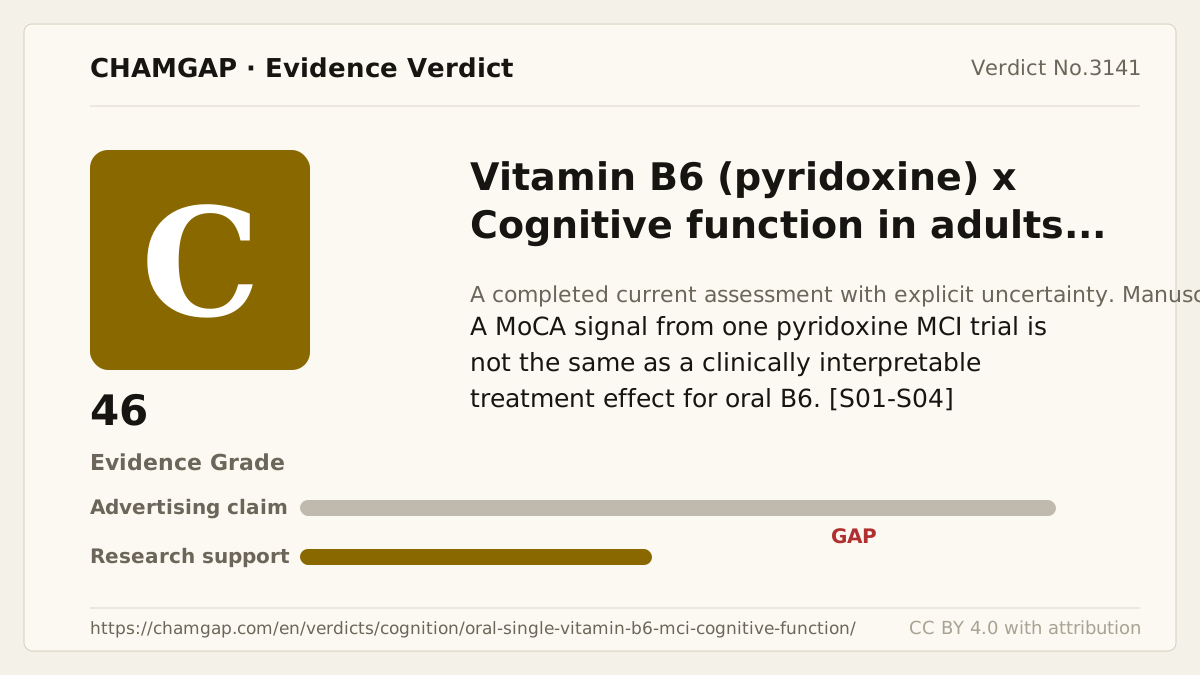
[Chamgap] Does Oral Single-Ingredient Vitamin B6 Improve Cognition in Adults with MCI? — Evidence Grade C·46. 15 cited sources checked. Source: https://chamgap.com/en/verdicts/cognition/oral-single-vitamin-b6-mci-cognitive-function/ · CC BY 4.0CC BY 4.0 — free to use with attribution; do not distort grades, numbers, or verdict meaning.
What this document does and does not do
Chamgap is an information source. It reports what research has and has not confirmed; it does not tell readers what to take or buy. That decision belongs to readers and, when needed, medical or legal professionals. This verdict reflects literature available up to the search date and may change as new research appears. Nothing here is medical advice.