
Multicomponent nonpharmacological care,
does it really help with Reduction of incident delirium among adults hospitalized outside intensive care?
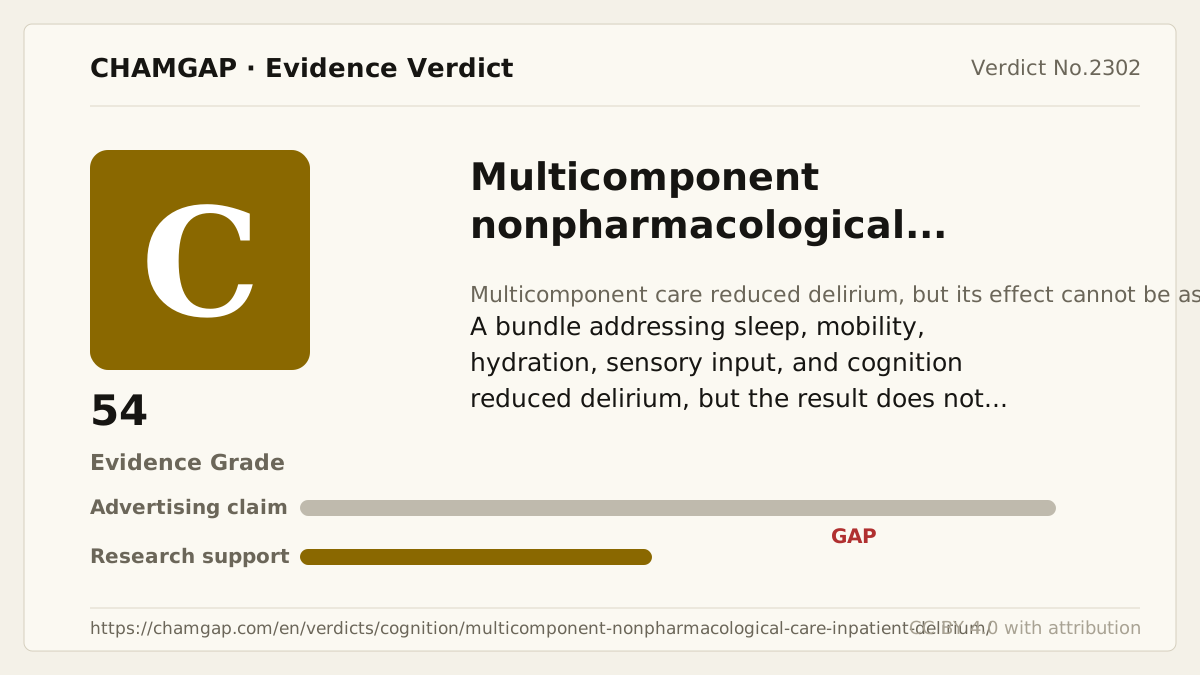
research showsThe grade is C. A 2021 Cochrane review pooled 14 multicomponent randomized trials with 3,693 participants and found RR 0.57 (95% CI 0.46 to 0.71; I-squared 39%). The 10.5% versus 18.4% figures are calculated absolute risks from the summary-of-findings baseline risk and relative effect, not simple totals of raw events. Outcome-assessor risk was high in six trials, unclear in one, and low in seven; the unadjusted cluster design in Hosie added a separate flaw, giving C with 56 points.
ads claimThis was a comparison of a structured bundle with usual care. The 43% relative reduction cannot be attributed separately to sleep, drinking, walking, glasses, or cognitive activity.
Useful facts when choosing a product
- Bundles varied but commonly addressed orientation, cognition, sleep, mobility, sensory support, nutrition, and hydration.
- Controls received usual hospital care rather than no care.
- Validated delirium methods included CAM, DRS-R-98, and DSM criteria.
Chamgap Semantic Classification Code
Candidate index · review held
UNK.multicomponent-nonpharmacological-delirium-prevention-care-bundle.UNK.incident-delirium-hospitalized-outside-intensive-care.reduce.UNKUnknown > Multicomponent nonpharmacological delirium-prevention care bundle > Unknown > incident delirium hospitalized outside intensive care > Reduction claim > Unknown
An automated migration candidate, not an issued permanent code; exact claim scope remains under review. This machine-generated migration candidate helps retrieval but is not a permanent assignment. The original verdict ID and URL remain authoritative.
What the research actually shows
The Cochrane review included 22 non-ICU randomized trials with 5,718 participants; 14 trials with 3,693 participants contributed to the multicomponent-versus-usual-care delirium analysis. Across trials, bundles combined reorientation and familiar objects, cognitive stimulation, sleep hygiene, early mobility, glasses or hearing aids, nutrition and hydration, oxygenation, infection identification, pain control, medication review, bowel and bladder care, and mood assessment. Controls received usual hospital care. Delirium was repeatedly assessed during admission with validated methods including CAM, DRS-R-98, DSM-IV, or DSM-5. Marcantonio used daily blinded interviews and CAM and found 20/62 (32%) versus 32/64 (50%). Among the 14 multicomponent trials, outcome-assessor risk was high in six, unclear in one, and low in seven. The Cochrane assessment identified no cluster adjustment in Hosie 2020; its original methods section was not directly checked here. Excluding cluster trials gave RR 0.65 (95% CI 0.55 to 0.77).
Why this is classified as C (56)
Delirium reduction was present, but only one individual trial was cited and two distinct avoidable flaws were identified, giving C with 56 points.
Counterpoint. Verdict 1148 is F with 18 points for melatonin alone. Verdict 2302 asks a different question about a multicomponent care bundle versus usual care.
Rejudgment record. Cross-check applied — Delirium reduction with limited individual-trial citation, avoidable unblinded assessment, and unadjusted clustering in Hosie
| Endpoint | H | Hard endpoint - actual events such as death |
| Replication | R1 | Single confirmatory trial |
| Independence | I2 | Decisive evidence is publicly or non-profit funded |
| Effect size | E+ | Meets the clinically important threshold |
Stored derived and displayed grades match; this is not a current recalculation or validity check (C).
Sub-claim grades by effect
This ingredient is marketed for several effects. A single overall grade blends strong and weak claims together, so each effect is graded separately here. The overall grade reflects the strongest disconfirming or core claim.
| Effect (sub-claim) | Grade | Basis |
|---|---|---|
| Reduction of incident delirium by the multicomponent bundle | C | Summary-of-findings calculated risks were 10.5% versus 18.4%. |
| Isolated effect of sleep or mobility alone | ? | Bundle comparisons cannot establish the isolated effect of each component. |
Cross-check — AI research and Codex final gate
Evidence Table
| Study | Design | Sample | Funding | Endpoint | Result | Weight |
|---|---|---|---|---|---|---|
| Burton et al. 2021 Cochrane review | Systematic review of randomized non-ICU trials | 14 multicomponent-versus-usual-care trials with 3,693 participants | Review supported by NIHR and Medical Research Scotland; multiple included trials had public or nonprofit funding | Incident delirium during admission using validated instruments | Summary-of-findings calculated risks 10.5% versus 18.4%; RR 0.57 (95% CI 0.46 to 0.71), I-squared 39% | Pivotal pooled evidence |
| Marcantonio et al. 2001 | Individually randomized hip-fracture trial with blinded outcome assessment | 126 participants, 62 versus 64 | Public funding from the US National Institute on Aging | Incident delirium by daily interviews and CAM | 20/62 (32%) versus 32/64 (50%); RR 0.64 (95% CI 0.37 to 0.98) | Only individually cited primary trial |
Receipt — 2 References
All 2 cited sources were verified for existence at the original page (as of 2026-08-05).
Final verification and publication gate: Codex · Evidence date: 2026-08-05 · Corrections: none
Cite this verdict
[Chamgap] Multicomponent nonpharmacological care x incident delirium — Evidence Grade C·56. 2 cited sources checked. Source: https://chamgap.com/en/verdicts/cognition/multicomponent-nonpharmacological-care-inpatient-delirium/ · CC BY 4.0CC BY 4.0 — free to use with attribution; do not distort grades, numbers, or verdict meaning.
What this document does and does not do
Chamgap is an information source. It reports what research has and has not confirmed; it does not tell readers what to take or buy. That decision belongs to readers and, when needed, medical or legal professionals. This verdict reflects literature available up to the search date and may change as new research appears. Nothing here is medical advice.