
Mechanical thrombectomy,
does it really help with Reduced 90-day disability and increased good functional status after acute basilar-artery occlusion stroke?
research showsThe grade is B. ATTENTION and BAOCHE found large absolute gains of about 23 and 22 percentage points in 90-day mRS 0-3. Four authors overlapped, however, and the independent BASICS team did not confirm improved functional independence, so the exceptional A requirement for independent replication is not met; the score is B with 72 points.
ads claimMarketing should report 90-day disability and procedural harms, not recanalization success alone.
Useful facts when choosing a product
- Mechanical thrombectomy uses an endovascular catheter to retrieve or aspirate an occluding clot.
- Anterior-circulation verdict 1152 is A with 97 points and pools individual data from five randomized trials, a broader evidence base than this posterior-circulation record.
- Eligibility depends on imaging, clinical severity, timing, and emergency stroke-team assessment.
Chamgap Semantic Classification Code
Candidate index · review held
P.mechanical-thrombectomy.procedural.disability-and-increased-good-functional-status-after-acute-basilar-artery-occlusion-stroke.reduce.UNKProcedures, devices and tests > Mechanical thrombectomy > Procedural > disability and increased good functional status after acute basilar-artery occlusion stroke > Reduction claim > Unknown
An automated migration candidate, not an issued permanent code; exact claim scope remains under review. This machine-generated migration candidate helps retrieval but is not a permanent assignment. The original verdict ID and URL remain authoritative.
What the research actually shows
ATTENTION randomized and analyzed 340 participants, 226 versus 114. BAOCHE randomized and analyzed 217, 110 versus 107. ATTENTION used university-hospital and nonprofit funding and BAOCHE used Chinese science-ministry funding, but overlapping investigators fail the rule requiring independence of both investigators and funding.
Why this is classified as B (72)
Large patient-centered functional benefits were consistent, but independent-investigator confirmation is absent, giving B with 72 points.
Counterpoint. The grade applies to imaging-confirmed acute basilar occlusion in patients resembling trial eligibility, not every posterior-circulation stroke.
Rejudgment record. Cross-check applied — Large 90-day functional benefits were consistent, but shared authors in the pivotal trials and nonconfirmation in independent BASICS prevent independent replication
| Endpoint | P | Symptom or function itself is the target - including patient reports and performance tests |
| Replication | R1 | Single confirmatory trial |
| Independence | I2 | Decisive evidence is publicly or non-profit funded |
| Effect size | E+ | Meets the clinically important threshold |
Stored derived and displayed grades match; this is not a current recalculation or validity check (B).
Sub-claim grades by effect
This ingredient is marketed for several effects. A single overall grade blends strong and weak claims together, so each effect is graded separately here. The overall grade reflects the strongest disconfirming or core claim.
| Effect (sub-claim) | Grade | Basis |
|---|---|---|
| Increased 90-day modified Rankin score 0-3 | B | Two trials showed consistent absolute increases of about 22-23 points, but the investigators were not independent. |
| Increased functional independence at 90 days | B | Stricter outcomes favored treatment in the two pivotal trials, but independent BASICS did not confirm functional independence. |
Cross-check — AI research and Codex final gate
Evidence Table
| Study | Design | Sample | Funding | Endpoint | Result | Weight |
|---|---|---|---|---|---|---|
| Tao C et al. 2022 ATTENTION | Multicenter randomized open-label superiority trial with blinded endpoint assessment | 340 randomized and all 340 in the primary intention-to-treat analysis, 226 versus 114 | Chinese university-hospital innovation program and nonprofit stroke and cardiovascular foundations | Primary endpoint: modified Rankin score 0-3 at 90 days | 104/226 (46%) versus 26/114 (23%), adjusted risk ratio 2.06 (95% CI 1.46 to 2.91), P<0.001. | Pivotal randomized functional-outcome evidence |
| Jovin TG et al. 2022 BAOCHE | Multicenter randomized open-label superiority trial with blinded endpoint assessment | 217 randomized and analyzed, 110 versus 107; stopped at a planned interim analysis | Public grant from the Chinese National Ministry of Science and Technology | Primary endpoint: modified Rankin score 0-3 at 90 days | 51/110 (46%) versus 26/107 (24%), adjusted risk ratio 1.81 (95% CI 1.26 to 2.60), P<0.001. | Consistent randomized trial with overlapping authors |
Receipt — 2 References
All 2 cited sources were verified for existence at the original page (as of 2026-08-01).
Final verification and publication gate: Codex · Evidence date: 2026-08-01 · Corrections: none
Cite this verdict
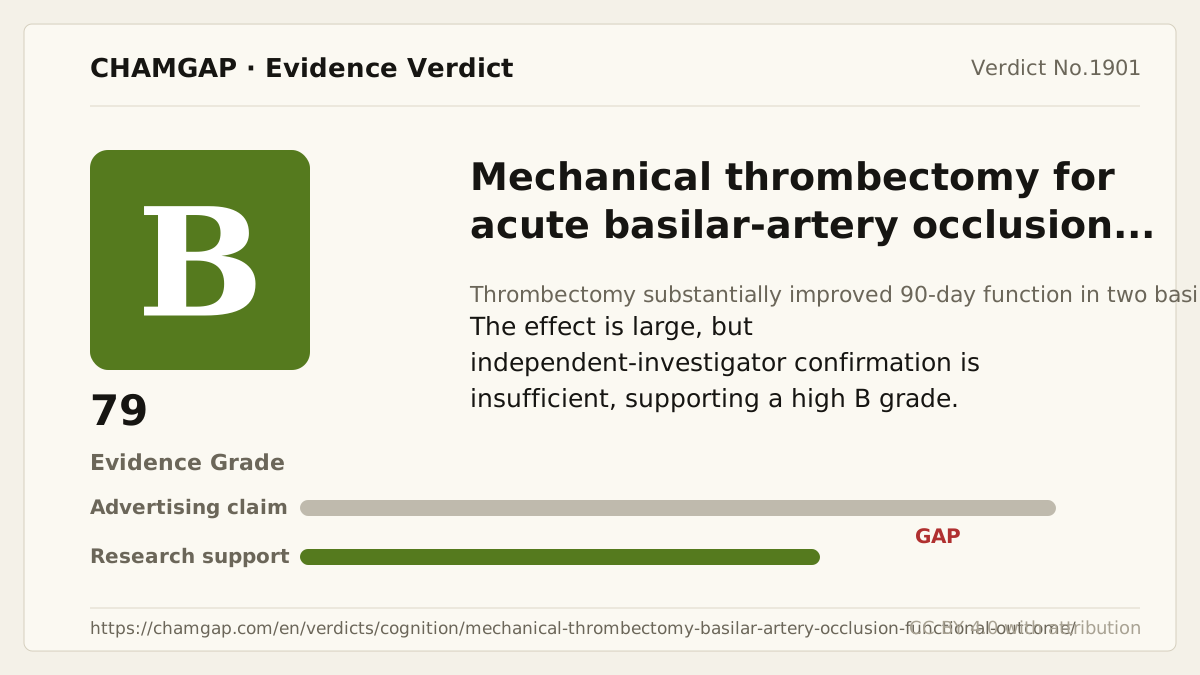
[Chamgap] Mechanical thrombectomy x 90-day functional recovery after basilar-artery occlusion — Evidence Grade B·72. 2 cited sources checked. Source: https://chamgap.com/en/verdicts/cognition/mechanical-thrombectomy-basilar-artery-occlusion-functional-outcome/ · CC BY 4.0CC BY 4.0 — free to use with attribution; do not distort grades, numbers, or verdict meaning.
What this document does and does not do
Chamgap is an information source. It reports what research has and has not confirmed; it does not tell readers what to take or buy. That decision belongs to readers and, when needed, medical or legal professionals. This verdict reflects literature available up to the search date and may change as new research appears. Nothing here is medical advice.