
Lacosamide,
does it really help with Maintenance of six-month seizure freedom as monotherapy for newly diagnosed focal or primary generalized tonic-clonic epilepsy?
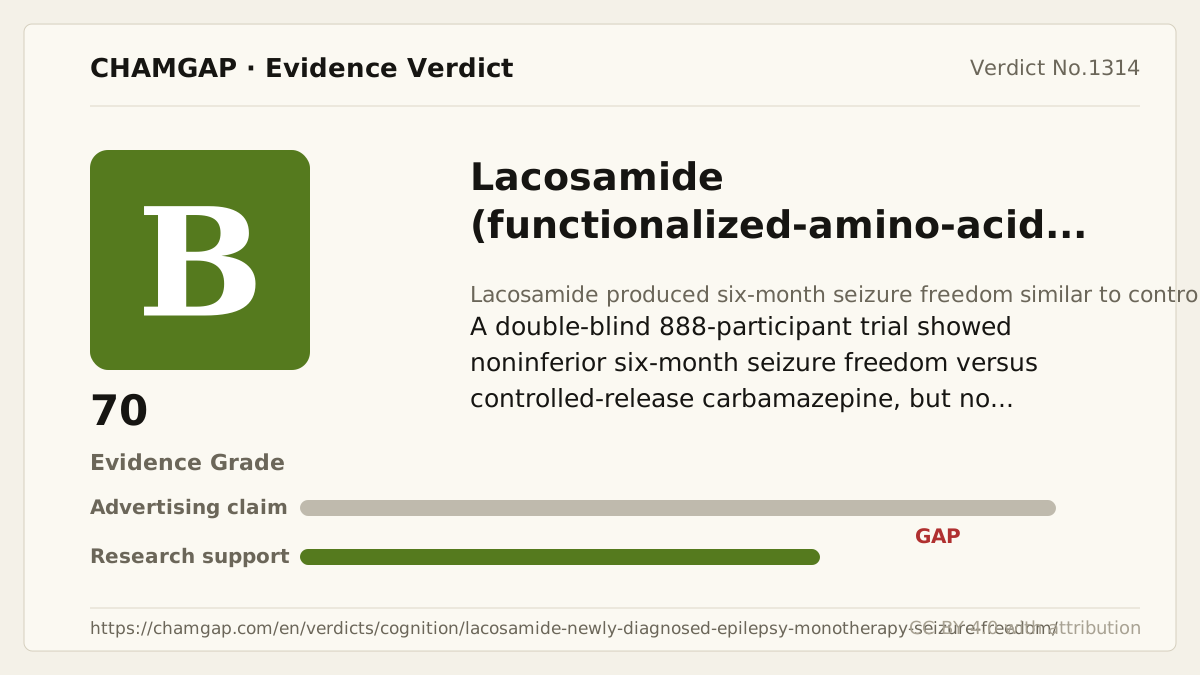
research showsLacosamide is rated B because monotherapy was noninferior to controlled-release carbamazepine for six-month seizure freedom in newly diagnosed focal or primary generalized tonic-clonic epilepsy. In a double-blind randomized trial of 888 patients, Kaplan-Meier estimates were 90% with lacosamide and 91% with controlled-release carbamazepine, with an absolute difference of -1.3% that met the prespecified noninferiority criteria. It was not a placebo-controlled estimate of absolute efficacy, so the active-comparator noninferiority evidence supports B rather than A.
ads claimMarketing can simplify the 90% estimate into an observed six-month seizure-free rate for every newly treated patient. It was a model-based estimate after dose adjustment and reassessment, not placebo superiority or proof that lacosamide is better than every alternative antiseizure medicine.
Useful facts when choosing a product
- Lacosamide is a prescription antiseizure medicine whose monotherapy dose is titrated according to seizure type, age, kidney and liver function, and concomitant medicines. Abrupt discontinuation can worsen seizures.
- Dizziness, diplopia, headache, nausea, and gait instability can occur, so driving and fall risk deserve attention during initiation and dose increases.
- PR-interval prolongation and arrhythmias are possible. Electrocardiographic assessment may be appropriate with conduction disease, structural heart disease, or other PR-prolonging medicines; suicidal thoughts or severe hypersensitivity also require prompt assessment.
Chamgap Semantic Classification Code
Candidate index · review held
UNK.lacosamide.UNK.seizure-freedom-as-monotherapy-for-newly-diagnosed-focal-or-primary-generalized-tonic-clonic-epilepsy.maintain.activeUnknown > Lacosamide > Unknown > seizure freedom as monotherapy for newly diagnosed focal or primary generalized tonic-clonic epilepsy > Maintenance claim > Active comparator
An automated migration candidate, not an issued permanent code; exact claim scope remains under review. This machine-generated migration candidate helps retrieval but is not a permanent assignment. The original verdict ID and URL remain authoritative.
What the research actually shows
Baulac and colleagues randomized 888 patients aged 16 years or older with newly diagnosed epilepsy to double-blind lacosamide or controlled-release carbamazepine. Eligible patients had focal seizures or primary generalized tonic-clonic seizures, and a seizure triggered titration to the next prespecified dose level and restart of the six-month assessment. In the full analysis set, Kaplan-Meier estimates of six-month seizure freedom after stabilization at the last assessed dose were 90% and 91%, with an absolute difference of -1.3% (95% confidence interval -5.5 to 2.8), meeting noninferiority criteria. In the long-term extension and pooled analysis, seizure freedom from first dose at 12 months was 50.8% versus 54.9%, and at 24 months 47.0% versus 50.9%. This verdict is distinct from existing entries for lamotrigine 1204, carbamazepine 1225, and ethosuximide 1224: it concerns lacosamide monotherapy and noninferiority to controlled-release carbamazepine.
Why this is classified as B (70)
In an 888-participant phase 3 double-blind randomized trial, six-month seizure freedom after stabilization at the last assessed dose met prespecified noninferiority criteria versus controlled-release carbamazepine. The endpoint was direct, but the design was active-comparator noninferiority without placebo-based absolute efficacy, supporting B with 70 points. Long-term pooled analyses showed similar sustained seizure freedom but were post hoc.
Counterpoint. Drug selection also considers seizure type, pregnancy potential, cardiac conduction, mood symptoms, concomitant medicines, cost, and individual tolerability; the verdict does not make lacosamide the preferred first medicine for every newly diagnosed patient.
Rejudgment record. New verdict — Applied B because an 888-participant phase 3 double-blind randomized trial showed prespecified noninferiority of lacosamide monotherapy to controlled-release carbamazepine for six-month seizure freedom, but the active-comparator noninferiority design provided no placebo-based absolute effect
Sub-claim grades by effect
This ingredient is marketed for several effects. A single overall grade blends strong and weak claims together, so each effect is graded separately here. The overall grade reflects the strongest disconfirming or core claim.
| Effect (sub-claim) | Grade | Basis |
|---|---|---|
| Maintenance of six-month seizure freedom as monotherapy for newly diagnosed focal or generalized tonic-clonic epilepsy | B | Directly assessed after stabilization at the last evaluated dose, with a Kaplan-Meier estimate of 90%. |
| Noninferior six-month seizure freedom versus controlled-release carbamazepine | B | The absolute difference was -1.3% (95% CI -5.5 to 2.8), satisfying the prespecified -12% noninferiority margin. |
| Maintenance of seizure freedom at 12 and 24 months | B | Extension and pooled analyses were similar to controlled-release carbamazepine but were limited by their post hoc nature. |
Cross-check — AI research and Codex final gate
Evidence Table
| Study | Design | Sample | Funding | Endpoint | Result | Weight |
|---|---|---|---|---|---|---|
| Baulac M et al. 2017 | Phase 3 multicenter randomized double-blind active-controlled noninferiority trial | 888 patients with newly diagnosed epilepsy | UCB Pharma | Six consecutive months of seizure freedom after stabilization at the last assessed dose | Kaplan-Meier estimates were 90% versus 91%; the absolute difference was -1.3% (95% CI -5.5 to 2.8), meeting noninferiority criteria. | Pivotal direct noninferiority randomized trial |
| Ben-Menachem E et al. 2019 | Double-blind extension and post hoc pooled analysis of initial and extension trials | 886 treated in the initial trial; 548 in the extension | UCB Pharma | Twelve- and twenty-four-month seizure freedom from first dose and long-term safety | Seizure freedom was 50.8% versus 54.9% at 12 months and 47.0% versus 50.9% at 24 months. | Supportive long-term durability evidence |
Receipt — 2 References
All 2 cited sources were verified for existence at the original page (as of 2026-07-23).
Final verification and publication gate: Codex · Evidence date: 2026-07-23 · Corrections: none
Cite this verdict
[Chamgap] Lacosamide x six-month seizure freedom as monotherapy for newly diagnosed epilepsy — Evidence Grade B·70. 2 cited sources checked. Source: https://chamgap.com/en/verdicts/cognition/lacosamide-newly-diagnosed-epilepsy-monotherapy-seizure-freedom/ · CC BY 4.0CC BY 4.0 — free to use with attribution; do not distort grades, numbers, or verdict meaning.
What this document does and does not do
Chamgap is an information source. It reports what research has and has not confirmed; it does not tell readers what to take or buy. That decision belongs to readers and, when needed, medical or legal professionals. This verdict reflects literature available up to the search date and may change as new research appears. Nothing here is medical advice.