
L-theanine,
does it really help with Improved attention and choice reaction time after a single dose in healthy adults?
research showsL-theanine is rated C because healthy adults show an acute signal of faster choice reaction time after a single 200-mg dose. A 2026 meta-analysis of 31 randomized trials and 1,168 participants reported improved choice reaction time when 200 mg was taken 30 to 60 minutes before testing, but this was a short computerized surrogate rather than improved real-world functioning. A 2025 monotherapy meta-analysis likewise found a benefit on selected visual-attention reaction times but no effect on simple reaction time or the Stroop test. This verdict is therefore distinct from verdict 036 on sleep and tension relief: it accepts only the acute attention signal and does not infer sustained cognitive enhancement or long-term clinical benefit.
ads claimMarketing expands a short-term reaction-time change into stronger focus, enhanced brain performance, and prolonged immersion. The key 2026 meta-analysis also disclosed that one author had founded a dietary-supplement sales company. The evidence best fits a single 200-mg dose and selected acute tasks in healthy adults, not persistent cognitive enhancement with daily use or prevention of cognitive disease.
Useful facts when choosing a product
- L-theanine is a non-protein amino acid present in tea leaves, and supplements may use material extracted from green tea or produced by fermentation or synthesis.
- The common acute research dose was 200 mg given once 30 to 60 minutes before testing, which is not equivalent to drinking one cup of tea or taking a supplement every day for months.
- Many studies tested L-theanine together with caffeine, but this verdict prioritizes L-theanine monotherapy and does not attribute caffeine's stimulant effect to L-theanine.
- Short trials generally found acceptable tolerability, while evidence remains limited for pregnancy, breastfeeding, children, prolonged high-dose use, and product-specific purity.
Chamgap Semantic Classification Code
Candidate index · review held
S.l-theanine.oral.attention-and-choice-reaction-time-after-a-single-dose.improve.placeboSupplements and nutraceuticals > L-theanine > Oral > attention and choice reaction time after a single dose > Improvement claim > Placebo
An automated migration candidate, not an issued permanent code; exact claim scope remains under review. This machine-generated migration candidate helps retrieval but is not a permanent assignment. The original verdict ID and URL remain authoritative.
What the research actually shows
Gerolymos and colleagues synthesized 31 placebo-controlled randomized trials in healthy and clinical populations and reported improved choice reaction time after a single 200-mg dose. One author disclosed having founded a company that sells dietary supplements, a competing interest that should be considered in interpretation. Mátyus and colleagues restricted their review to placebo-controlled L-theanine monotherapy trials in healthy adults and quantitatively synthesized five trials with 148 participants. Rapid visual-information-processing and recognition visual reaction time improved by about 15 milliseconds, while simple reaction time and Stroop outcomes were null; the number and size of trials were small and preparations and cognitive tests were heterogeneous. A separate dose-response crossover study similarly found placebo-adjusted improvement in simple visuomotor reaction time but not complex sustained attention or inhibitory control.
Why this is classified as C (51)
The 31-trial meta-analysis found a positive SMD of 0.51 for choice reaction time after a single 200-mg dose, but the outcome was an acute computerized surrogate with uncertain clinical meaning and no established long-term effect. The monotherapy meta-analysis was positive for selected tasks but null for simple reaction time and Stroop performance, so it does not show consistent global cognitive enhancement. The surrogate-endpoint ceiling yields C with 51 points; safety is separate from efficacy.
Counterpoint. A single dose before a demanding task may provide a small benefit on selected reaction-speed tasks. Sleep, caffeine intake, anxiety, medicines, and the work environment may matter more for actual attention, and a supplement does not replace evaluation of causes or sustained cognitive practice.
Rejudgment record. New verdict — Accepted the positive choice-reaction-time signal after a single 200-mg dose in the 31-trial meta-analysis, but applied the rule ① ceiling of C because outcomes were acute test surrogates, long-term clinical meaning is unknown, and the monotherapy meta-analysis showed inconsistent results across cognitive tasks
Sub-claim grades by effect
This ingredient is marketed for several effects. A single overall grade blends strong and weak claims together, so each effect is graded separately here. The overall grade reflects the strongest disconfirming or core claim.
| Effect (sub-claim) | Grade | Basis |
|---|---|---|
| Improved choice reaction time after a single 200-mg dose | C | A 31-trial meta-analysis was positive, but the outcome was an acute surrogate measured 30 to 60 minutes after dosing. |
| Improved overall attention after a single dose | C | Selected visual-attention tasks were positive, but simple reaction time, Stroop, and complex sustained-attention results were inconsistent. |
| Sustained cognitive enhancement with repeated use | D | No direct clinical outcome links the acute test signal to long-term everyday function or cognitive health. |
Cross-check — AI research and Codex final gate
Evidence Table
| Study | Design | Sample | Funding | Endpoint | Result | Weight |
|---|---|---|---|---|---|---|
| Gerolymos C et al. 2026 | Systematic review and meta-analysis of randomized placebo-controlled trials | 31 randomized trials and 1,168 participants | Academic research; no industry funding reported, but one author disclosed founding a dietary-supplement sales company | Stress, affective outcomes, reaction time, and attention tasks after single or repeated dosing | A single 200-mg dose 30 to 60 minutes before testing improved choice reaction time (SMD 0.51, 95% CI 0.25 to 0.77). | Key acute synthesis based on a surrogate endpoint |
| Mátyus RO et al. 2025 | Systematic review and meta-analysis of monotherapy randomized trials in healthy adults | Five randomized trials and 148 participants in quantitative synthesis | Hungarian academic research support; authors reported no conflicts of interest | Rapid visual information processing, recognition visual reaction time, simple reaction time, and Stroop performance | Selected visual reaction times improved by about 15 milliseconds, while simple reaction time and Stroop outcomes were not significant. | Confirms endpoint inconsistency and small samples |
| Dassanayake TL et al. 2023 | Randomized double-blind placebo-controlled dose-response crossover trial | 32 healthy adults | Funding details were not stated in the accessible abstract | Visuomotor speed, sustained attention, and inhibitory control | After placebo adjustment, only simple visuomotor reaction time improved at 100 and 200 mg, with no improvement in complex sustained attention or inhibitory control. | Defines the limited scope of the acute monotherapy effect |
Receipt — 3 References
All 3 cited sources were verified for existence at the original page (as of 2026-07-20).
Final verification and publication gate: Codex · Evidence date: 2026-07-20 · Corrections: none
Cite this verdict
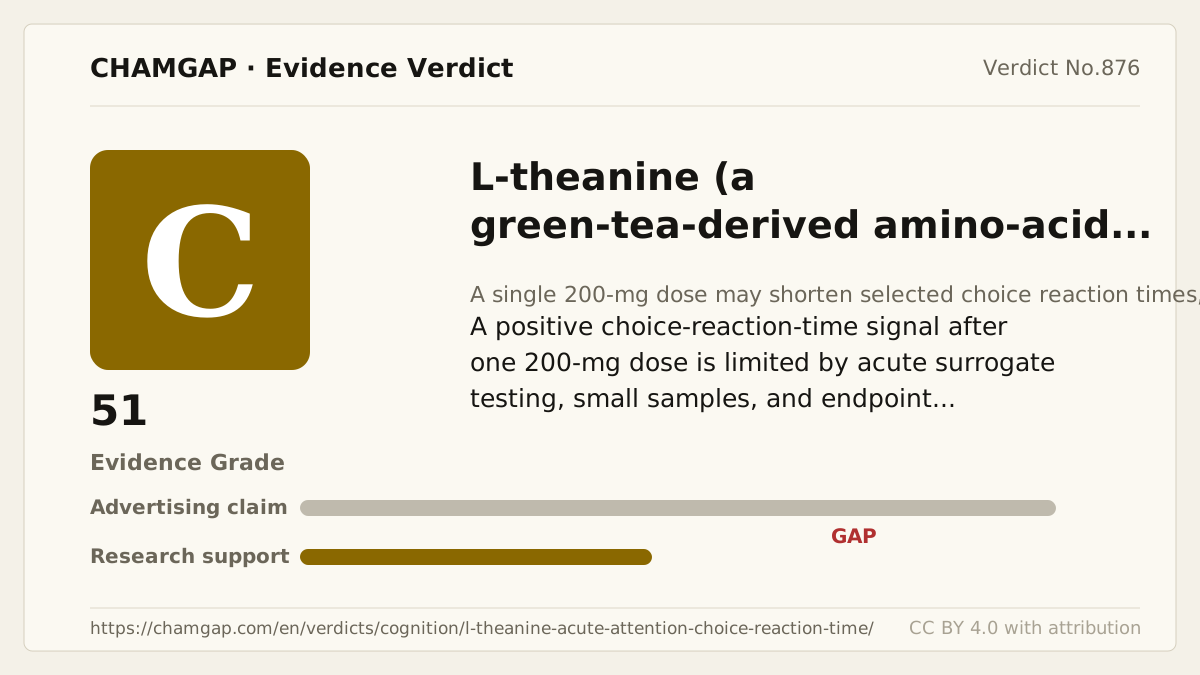
[Chamgap] L-theanine x improved attention and choice reaction time after a single dose — Evidence Grade C·51. 3 cited sources checked. Source: https://chamgap.com/en/verdicts/cognition/l-theanine-acute-attention-choice-reaction-time/ · CC BY 4.0CC BY 4.0 — free to use with attribution; do not distort grades, numbers, or verdict meaning.
What this document does and does not do
Chamgap is an information source. It reports what research has and has not confirmed; it does not tell readers what to take or buy. That decision belongs to readers and, when needed, medical or legal professionals. This verdict reflects literature available up to the search date and may change as new research appears. Nothing here is medical advice.