
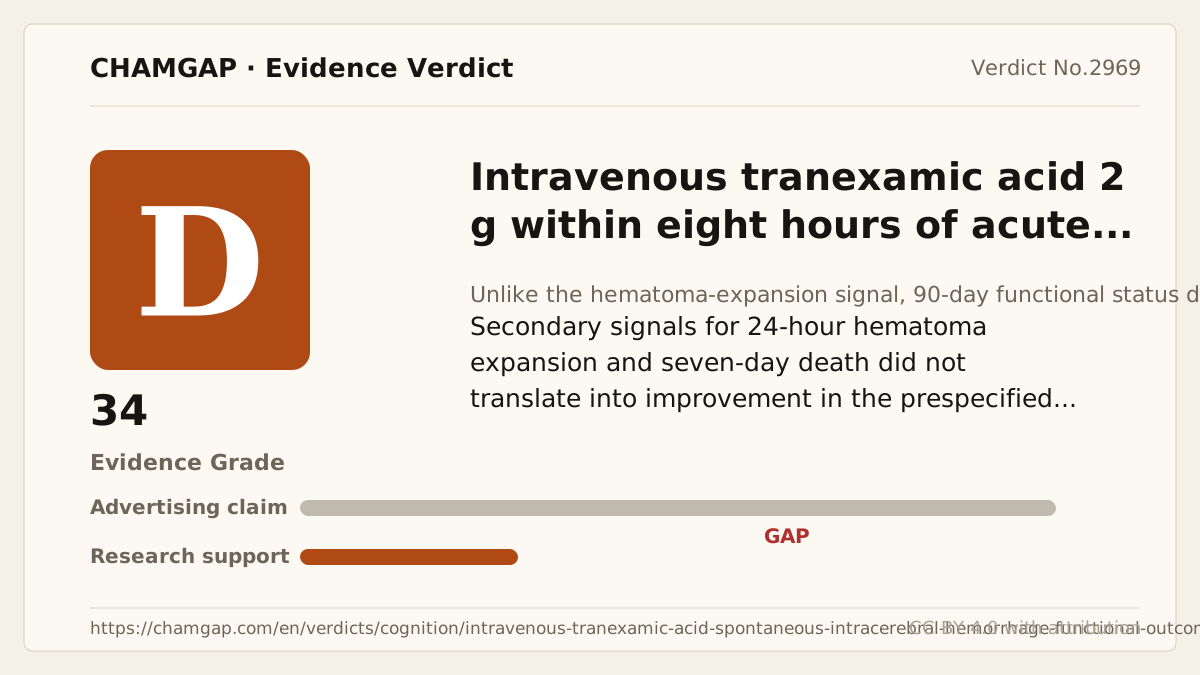
Intravenous tranexamic acid 2 g within eight hours of acute spontaneous intracerebral hemorrhage,
does it really help with Improved 90-day functional status on the modified Rankin Scale?
research showsGrade D. In 2,325 TICH-2 participants, the adjusted common OR for the 90-day mRS shift was 0.88 (95% CI 0.76 to 1.03), P=.11. In the latest individual-patient-data meta-analysis, poor functional outcome at 90 days was also null: 53.2% versus 53.6%, adjusted common OR 0.93 (95% CI 0.81 to 1.07). The full randomized evidence to date, not only TICH-2, reaches the same conclusion.
ads claimImprovement in the secondary imaging endpoint of hematoma expansion cannot be rewritten as successful 90-day functional recovery.
Useful facts when choosing a product
- The mRS ranges from 0, no symptoms, to 6, death; lower is better.
- Seven-day death and 24-hour hematoma expansion were secondary outcomes.
- The death-or-dependency sensitivity analysis was also statistically null.
Chamgap Semantic Classification Code
Candidate index · review held
M.tranexamic-acid-within-of-acute-spontaneous-intracerebral-hemorrhage.intravenous.functional-status-on-the-modified-rankin-scale.improve.placeboMedicinal interventions > tranexamic acid within of acute spontaneous intracerebral hemorrhage > Intravenous > functional status on the modified Rankin Scale > Improvement claim > Placebo
An automated migration candidate, not an issued permanent code; exact claim scope remains under review. This machine-generated migration candidate helps retrieval but is not a permanent assignment. The original verdict ID and URL remain authoritative.
What the research actually shows
TICH-2 randomized 2,325 patients at 124 hospitals in 12 countries: 1,161 to tranexamic acid and 1,164 to placebo. Ninety-day mRS was obtained in 2,307 (99.2%). The UK NIHR HTA Programme and Swiss Heart Foundation funded the trial; the University of Nottingham sponsored it. Sharp Clinical Services prepared active drug and saline placebo in identical packs at trial expense. No pharmaceutical donation, analysis, medical writing, or publication funding was reported, and registration preceded recruitment.
Axis 6 B0 evidence ① Allocation concealment: "Randomisation was done centrally in real time via a secure website, with stratification by country and minimisation on key prognostic factors." ② Masking: "Treatment allocation was concealed from patients, outcome assessors, and all other health-care workers involved in the trial." The 90-day mRS was collected masked to allocation. ③ Analysis population and missing data: "Analyses were done in accordance with the intention-to-treat principle, with participants kept in the groups to which they were allocated by the minimisation algorithm." Ninety-day mRS was available for 2,307/2,325. ④ Prespecified primary endpoint: "The primary outcome was functional status at day 90, as assessed with the modified Rankin Scale." — matches ISRCTN93732214 · EudraCT 2012-004108-37
Why this is classified as D (34)
The large publicly funded patient-centered trial had a null prespecified primary functional outcome, and the meta-analysis of all randomized evidence reached the same null conclusion for 90-day function, giving D with 34 points. Early death and hematoma-expansion signals were present, but author overlap and endpoint hierarchy mean this is not independent replication, so R1 remains.
Counterpoint. Safety and secondary hematoma findings do not rescue the null primary efficacy outcome.
Rejudgment record. Cross-check applied — Null prespecified 90-day mRS in TICH-2, alongside its large publicly funded double-blind intention-to-treat design
| Endpoint | P | Symptom or function itself is the target - including patient reports and performance tests |
| Replication | R1 | Single confirmatory trial |
| Independence | I2 | Decisive evidence is publicly or non-profit funded |
| Effect size | E0 | Null |
| Precision | C0 | The confidence interval leaves room for benefit |
Stored derived and displayed grades match; this is not a current recalculation or validity check (D).
Sub-claim grades by effect
This ingredient is marketed for several effects. A single overall grade blends strong and weak claims together, so each effect is graded separately here. The overall grade reflects the strongest disconfirming or core claim.
| Effect (sub-claim) | Grade | Basis |
|---|---|---|
| Improved 90-day functional status | D | The prespecified primary endpoint was null at P=.11. |
Cross-check — AI research and Codex final gate
Evidence Table
| Study | Design | Sample | Funding | Endpoint | Result | Weight |
|---|---|---|---|---|---|---|
| Sprigg N et al. 2018 TICH-2 | International multicenter double-blind randomized placebo-controlled phase 3 trial | 2,325 randomized, 1,161/1,164; 90-day mRS in 2,307 | NIHR HTA Programme and Swiss Heart Foundation | Shift in modified Rankin Scale at day 90 | Adjusted common OR 0.88 (95% CI 0.76-1.03), P=.11 | Large publicly funded primary functional outcome |
| 2026 individual-patient-data meta-analysis of tranexamic acid | Systematic review and individual-patient-data meta-analysis of randomized trials in acute spontaneous intracerebral hemorrhage | Nine trials, 3,194 participants; individual data from five trials and 2,860 participants (90%) | All included trials were at low risk of bias | Poor functional outcome at 90 days; seven-day death and hematoma expansion | At 90 days, 53.2% vs 53.6%, adjusted common OR 0.93 (95% CI 0.81-1.07); significant reductions in seven-day death and hematoma expansion (adjusted OR 0.70 for seven-day death) | Null 90-day functional result and early secondary signals across the randomized evidence |
Receipt — 2 References
All 2 cited sources were verified for existence at the original page (as of 2026-08-26).
Final verification and publication gate: Codex · Evidence date: 2026-08-26 · Corrections: none
Cite this verdict
[Chamgap] No Benefit of Intravenous Tranexamic Acid for 90-Day Function After Spontaneous Intracerebral Hemorrhage — Evidence Grade D·34. 2 cited sources checked. Source: https://chamgap.com/en/verdicts/cognition/intravenous-tranexamic-acid-spontaneous-intracerebral-hemorrhage-functional-outcome/ · CC BY 4.0CC BY 4.0 — free to use with attribution; do not distort grades, numbers, or verdict meaning.
What this document does and does not do
Chamgap is an information source. It reports what research has and has not confirmed; it does not tell readers what to take or buy. That decision belongs to readers and, when needed, medical or legal professionals. This verdict reflects literature available up to the search date and may change as new research appears. Nothing here is medical advice.