
Intranasal regular insulin, 40 IU per day,
does it really help with Delay cognitive and daily-function decline in mild cognitive impairment or mild Alzheimer disease.?
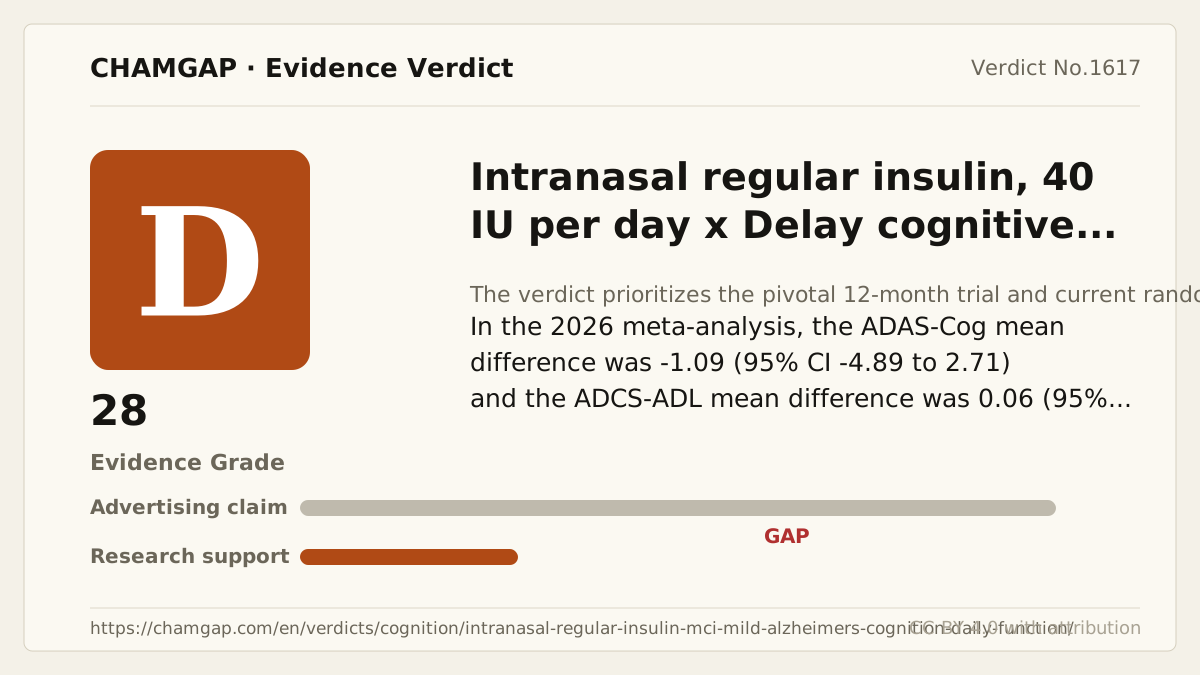
research showsCurrent evidence says no. A meta-analysis of five randomized trials and 540 participants was null for ADAS-Cog, activities of daily living, CDR-SB, and delayed recall, and the pivotal 12-month trial missed its primary cognitive endpoint. The verdict is D with 28 points.
ads claimThe claim that nasal delivery bypasses the blood-brain barrier and restores brain insulin signaling is a biological hypothesis. Human trials have not established that daily 40-IU dosing delays cognitive or daily-function decline.
Useful facts when choosing a product
- Trials administered 40 IU of regular insulin each day through a specialized nasal delivery device; this is not an established dementia regimen.
- Intranasal use differs from inhaled or subcutaneous diabetes insulin and is not interchangeable with either.
- Device performance can alter drug delivery and trial results, limiting generalization across devices.
- Systemic hypoglycemia was uncommon, but rhinitis or nasal irritation can occur and long-term safety and optimal formulation remain unsettled.
Chamgap Semantic Classification Code
Candidate index · review held
M.intranasal-regular-insulin.intranasal.delay-cognitive-and-daily-function-decline-in-mild-cognitive-impairment-or-mild-alzheimer-disease.reduce.placeboMedicinal interventions > Intranasal regular insulin > Intranasal > Delay cognitive and daily-function decline in mild cognitive impairment or mild Alzheimer disease. > Reduction claim > Placebo
An automated migration candidate, not an issued permanent code; exact claim scope remains under review. This machine-generated migration candidate helps retrieval but is not a permanent assignment. The original verdict ID and URL remain authoritative.
What the research actually shows
The 2026 meta-analysis of five randomized trials and 540 participants found an ADAS-Cog mean difference of -1.09 (95% CI -4.89 to 2.71) and an ADCS-ADL mean difference of 0.06 (95% CI -0.33 to 0.45); CDR-SB, DSRS, and delayed recall were also null. In the reliable-device cohort of the 2020 12-month trial, the ADAS-cog12 difference was 0.0258 (P=.98), with no significant benefit in CDR-SB, ADL-MCI, or memory. The 2012 study of 104 participants over four months was an exploratory pilot, and favorable device- or APOE-genotype signals remain note-level, hypothesis-generating findings that do not override the null pooled estimates.
Why this is classified as D (28)
The primary cognitive endpoint in the key 12-month trial and pooled cognitive and daily-function outcomes in the 2026 meta-analysis were null, supporting grade D.
Counterpoint. Effects could conceivably differ by APOE genotype, device, or formulation, but no prespecified and replicated subgroup evidence changes the current verdict.
Rejudgment record. Cross-check applied — The primary endpoint of the key human trial and pooled randomized estimates were null; favorable subgroup findings do not upgrade a null overall result.
Sub-claim grades by effect
This ingredient is marketed for several effects. A single overall grade blends strong and weak claims together, so each effect is graded separately here. The overall grade reflects the strongest disconfirming or core claim.
| Effect (sub-claim) | Grade | Basis |
|---|---|---|
| Delay of cognitive decline in mild cognitive impairment or mild Alzheimer disease | D | The pooled ADAS-Cog estimate and the primary cognitive endpoint of the key 12-month trial were null. |
| Preservation of daily function in mild cognitive impairment or mild Alzheimer disease | D | The pooled ADCS-ADL estimate and ADL-MCI in the long-term trial were nonsignificant. |
| Delay of overall clinical progression measured by CDR-SB | D | The pooled CDR-SB result was null. Favorable device- and APOE-genotype findings remain exploratory signals and are not promoted to independent efficacy subclaims. |
Cross-check — AI research and Codex final gate
Evidence Table
| Study | Design | Sample | Funding | Endpoint | Result | Weight |
|---|---|---|---|---|---|---|
| Silva AMP et al. 2026 | Systematic review and meta-analysis of randomized controlled trials | Five randomized trials and 540 participants | Funding information was not stated in the public abstract | ADAS-Cog, ADCS-ADL, CDR-SB, DSRS, delayed recall, and biomarkers | The ADAS-Cog mean difference was -1.09 (95% CI -4.89 to 2.71) and ADCS-ADL was 0.06 (95% CI -0.33 to 0.45); other major cognitive and functional outcomes were also nonsignificant. | Current pooled randomized efficacy evidence |
| Craft S et al. 2020 | Multicenter randomized double-blind placebo-controlled phase 2/3 trial | 289 participants overall; 240 in the reliable-device primary cohort | Supported by the U.S. National Institute on Aging | Twelve-month primary ADAS-cog12 endpoint, CDR-SB, ADL-MCI, and memory | The primary-cohort ADAS-cog12 difference was 0.0258 (95% CI -1.771 to 1.822; P=.98), and major secondary cognitive and functional endpoints were null. | Key 12-month direct null trial |
| Craft S et al. 2012 | Exploratory randomized double-blind placebo-controlled pilot trial | 104 participants over four months | Public support including the U.S. NIH and Department of Veterans Affairs | Delayed recall, ADAS-cog, ADCS-ADL, and cerebrospinal-fluid biomarkers | Selected memory and functional measures showed positive signals, but this 104-person, four-month exploratory pilot was not replicated by the pivotal trial or pooled analysis. | Context for the early positive but unreplicated signal |
Receipt — 3 References
All 3 cited sources were verified for existence at the original page (as of 2026-07-24).
Final verification and publication gate: Codex · Evidence date: 2026-07-24 · Corrections: none
Cite this verdict
[Chamgap] Does intranasal insulin slow decline in mild cognitive impairment or mild Alzheimer disease? — Evidence Grade D·28. 3 cited sources checked. Source: https://chamgap.com/en/verdicts/cognition/intranasal-regular-insulin-mci-mild-alzheimers-cognition-daily-function/ · CC BY 4.0CC BY 4.0 — free to use with attribution; do not distort grades, numbers, or verdict meaning.
What this document does and does not do
Chamgap is an information source. It reports what research has and has not confirmed; it does not tell readers what to take or buy. That decision belongs to readers and, when needed, medical or legal professionals. This verdict reflects literature available up to the search date and may change as new research appears. Nothing here is medical advice.